harlequinadeTerence Rattigan’s Harlequinade is an awkward play to stage – too short to represent value for money in a large theatre, too big a cast to be viable on the fringe. A few years ago, the National solved the problem by doubling it up with The Browning Version, a play with a central role that could have suited Kenneth Branagh. Here Branagh spurns that opportunity and tags on Rattigan’s 20-minute monologue All On Her Own as the evening’s opener for the first production in his season at the Garrick. Together, the plays run for 100 minutes without an interval, hardly the best value at West End Prices. Delivering the monologue, Zoë Wanamaker is, predictably, magnificent, dressed in a cocktail dress and clutching a full wine glass, she laments the passing of the husband that she never valued properly during his lifetime. Wanamaker re-appears for the main course as Dame Maud, most senior member of a theatre company run by old style actor/manager Arthur Gosport (Branagh), the type who would play Romeo one night and Lear the next. In modern theatre, the only actor remotely resembling Gosport could be Branagh himself, which is, presumably, the big joke. Rattigan’s humorous observations of the theatre he knew, 70 years or so ago, are often delightful and always amusing. Gosport and his leading lady and wife (or maybe not) Edna Selby (Miranda Raison) live for the theatre and are either oblivious to or disdainful of the inconveniences of normal life. Many of the company also appear in The Winter’s Tale, running in repertory, meaning that there is an impressive array of talent on display, with Branagh and Rob Ashford directing the two productions. Bubbling along nicely, this is not a production to set the world on fire, but it is good lightweight fun.

Performance date: 11 November 2015

Husbands-And-Sons-posterThree households lying side-by-side in a Nottinghamshire mining village in 1911 form the setting for this inspired adaptation of three DH Lawrence plays – The Daughter-in-LawThe Widowing of Mrs Holroyd and A Collier’s Friday Night. The walls of the houses are invisible and the plays run together, scenes alternating, with characters from each meeting in the street. The performance is in the round (well oblong), with the audience changing ends at the interval so as to become more closely involved in different dramas. Ben Power is the adaptor and, unsurprisingly when something as imaginative as this appears at the National, the director is Marianne Elliot. The plays work together brilliantly, painting a unique picture of a struggling community, bound by codes of loyalty and morality that, in many ways, seem strange in the modern world. The title is misleading; “Wives and Mothers” would have been more apt, as this is a matriarchal society held together by the fortitude of its women, the men being workhorses who are weak-willed and often drunk. In a company of over 20, Anne-Marie Duff is the star name, giving a wonderful performance as Lizzie Holroyd, protecting her young son from her husband (Martin Marquez), a violent drunkard, and being drawn by the attentions of a younger electrician (Philip McGinley). Louise Brearley is a revelation as Minnie, daughter-in-law in the Gascoigne home, determined to make her marriage to the errant Luther (Joe Armstrong) work in spite of opposition from his domineering mother (Susan Brown). In A Collier’s… another mother (Julia Ford) relegates her husband to insignificance and smothers her student son (Johnny Gibbon). The production runs for three hours, but we want it to be six. Unquestionably one of the year’s best.

Performance date: 9 November 2015

sister george

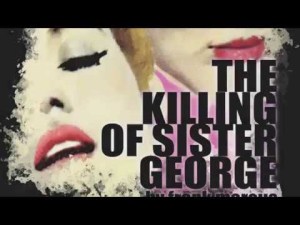
In 2015, soap characters are killed off at a rate of about one a week and same sex relationships are depicted in dramas almost as regularly. It is difficult to believe that, when The Killing of Sister George first appeared 50 years ago, it was regarded as mildly shocking. June Buckridge, played here with macho swagger by Sioned Jones, has been playing George in a radio soap much like The Archers for six years when the axe falls and her relationship with her partner Childie (Briony Rawle) is also on the rocks. The axe is wielded by a BBC exec, Mrs Mercy (Sarah Shelton giving a near-impeccable Margaret Thatcher impersonation) who also moves in on Childie. A clairvoyant in the Madam Arcati mould (Janet Amsden) is on hand to stir things up. We assume that June (always referred to as “George”) and Childie are a lesbian couple, but the writer Frank Marcus is coy about it and never spells it out (maybe the watchful eye of the Lord Chamberlain constrained him back in 1965) and there are hardly any displays of affection between the two in Scott le Cross’s production. George comes across as a sadistic, gin-swilling bully, Childie as a simpering parasite and it is very difficult to feel much sympathy for either as their shared world begins to unravel. Justin Savage’s one-room set is suitably shabby, giving a good period feel to the production. Jones’ performance builds as the play progresses, showing George’s torment upon realising that nothing in life can be taken for granted, nothing is forever. Projecting that message, the play still has some relevance, but it takes far too long to get to the point and, although the acting is decent throughout, it still comes across as something of a museum piece.

Performance date: 5 November 2015

Teddy Ferrara*** (Donmar Warehouse)

Posted: November 8, 2015 in Theatre

teddy feraraFull review will appear here shortly

Performance date: 5 November 2015

Xanadu**** (Southwark Playhouse)

Posted: November 8, 2015 in Theatre

XANADUFull review will appear here shortly

Performance date: 4 November 2015

the moderate sopranoFull review will appear here shortly

Performance date: 3 November 2015

american in parisFull review will appear here shortly

Performance date: 1 November 2015

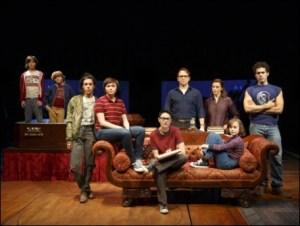
Fun_Home_0085_-_Cast_Portrait_Photo_Credit_Joan_Marcus_444_335Full review will appear here shortly

Performance date: 31 October 2015

al_pacino-570x427Full review will appear here shortly.


Performance date: 29 October 2015

smallest showSometimes things can be all about timing. In this case, it is bad timing on my part to catch a touring production on the dreaded Monday night with a half full house. And for a show about reviving a failing cinema, it is unlucky timing to hit the stage so soon after a show about reviving a failing theatre (Mrs Henderson Presents) has been greeted with rapturous praise and a West End transfer. Comparisons between the two are inevitable, but let’s just say that Mrs H has original songs and this show, sadly, hasn’t. The book by Thom Southerland and Paul Alexander is an adaptation of the 1957 British film, famously featuring Margaret Rutherford and Peter Sellers in supporting roles. Southerland has gained a big reputation on the London fringe for breathing fresh life into half forgotten American musicals (Titanic, The Grand Tour and the forthcoming Grey Garden are examples) so this is a departure for him, embarking on a musical that is original, British and staged for large, traditional theatres. His directorial flair and imagination, developed from working on shows with scant resources, are here in abundance and the big numbers, choreographed by his regular collaborator Lee Proud, are all excellent. Most of us will have seen the film at some time, screened on tv on some rainy afternoon and remember the plot. It is a sort of “Fleapit Paradiso” about a couple, played here by Laura Pitt-Pulford and Haydn Oakley, who inherit the Bijou cinema in Sloughborough (somewhere where they speak with Lancashire accents), together with its batty pianist (Liza Goddard) and its drunken projectionist (Brian Capron). It is warm, affectionate and nostalgic and here it is spruced up with songs (Simple Melody, Always, It’s a Lovely Day Today, Steppin’ Out…etc, etc) by Irving Berlin, whose catalogue is so huge that finding a song to fit comfortably into every situation in a show like this should not have presented many difficulties. However, there is a very big difference between songs that fit in and ones that arise naturally from a story and its characters and that difference represents the show’s main weakness. It is not just the lyrics that feel not quite right, but the melodies that sound like American show tunes of the pre-War era, rather than the music that characterised Britain when the show is set in the late 50s, the time that rock ‘n’ roll was making its breakthrough. The compensations for this disappointment are substantial – terrific performances all round, splendid staging and the illusion that it all ends with “blue skies from now on”. In reality, we all know that the best efforts of the characters here were only postponing the inevitable and that competition from television and the rise of multiplexes would quickly see off the Bijou and its like. Nonetheless, this mixed bag still contains lots of goodies to enjoy.

Performance date: 19 October 2015