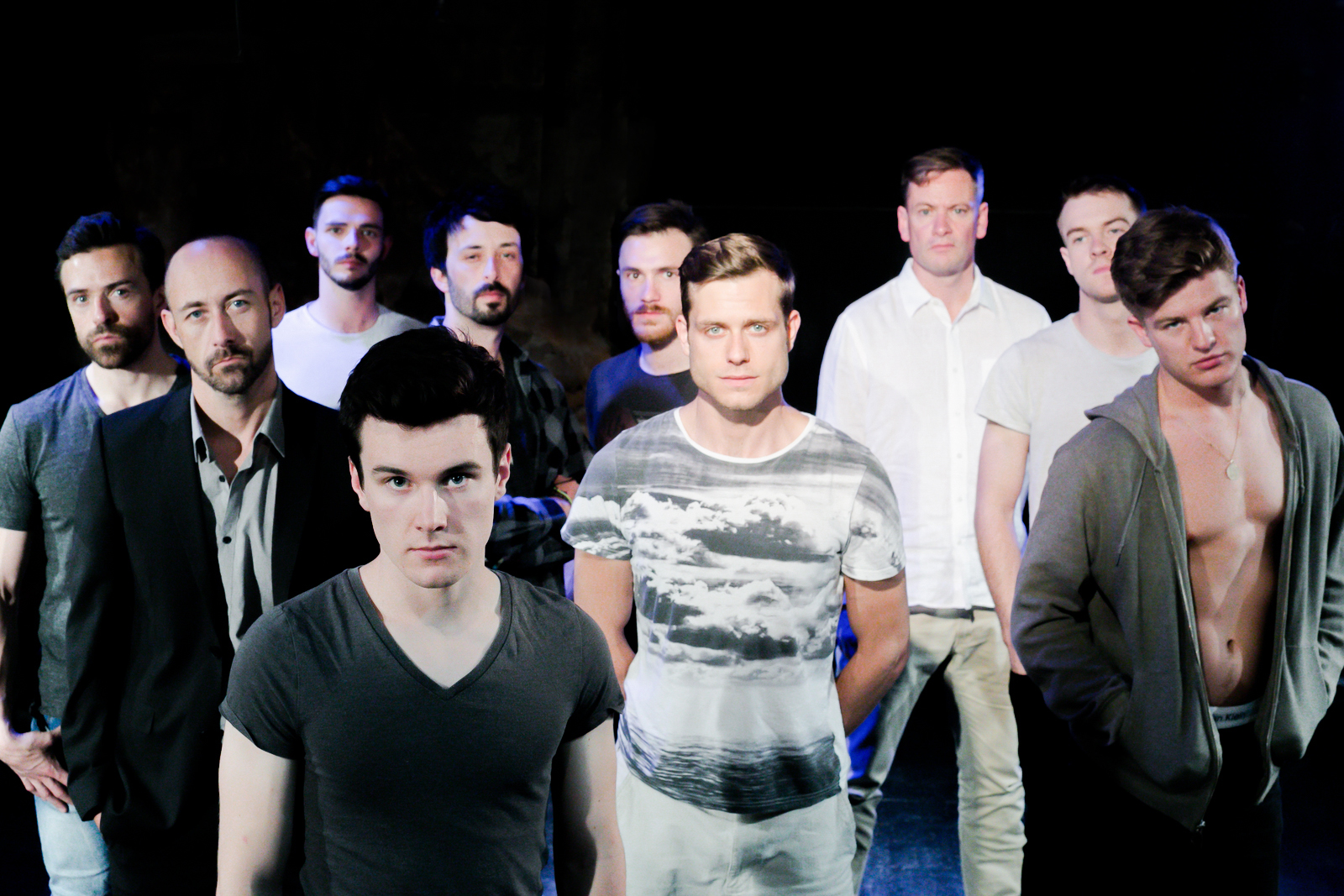
F-cking MenThis review was originally written for The Public Reviews: http://www.thepublicreviews.com

The general concept of Arthur Schnitzler’s play La Ronde, written in 1897, has come around in many guises over the years – the musical Hello Again and David Hare’s The Blue Room are examples – and here Joe DiPietro gives a distinctly modern twist to the old story. This production is a revival of the play that already holds the record (nine months) for a run at the King’s Head. It tells of a chain of lovers linked together by carnal desires, but torn between sexual freedom and commitment. Repeated references to the “only connect” passage in EM Forster’s Howard’s End underline that the play’s central purpose is to examine the nature of connections that people make with each other.. Oh, and in case the title had not given it away, all the characters are gay males, although, in the equal society of 2015, sexual orientation may be regarded as incidental. DiPietro is writing about the wider human condition, but the assertion by one character that the advantage of being gay is not being trapped by monogamy now seems rather ironic. This 90-minute merry-go-round ride begins in a park at night with John (Chris Wills), a rent boy, picking up a soldier (Harper James), who justifies the encounter to himself, unconvincingly, with “you take girls to dinner first, with guys you just have to look”. The soldier develops a taste for the thrill and the danger of casual liaisons and goes to a sauna, where he meets a tutor (Ruben Jones), who then finds it impossible to resist the teasing of a 21-year-old student (Euan Brokie). When the student sets up an internet hook-up with an older man (Jonathan McGarrity), DiPietro begins to explore the fragility of marital fidelity. The man is having this casual dalliance for no better reason than that his spouse (Richard De Lisle) does the same regularly, observing agreed rules (or so he believes). But these scenes ask whether monogamy and promiscuity can ever co-exist without deceit. A porn actor (Haydn Whiteside) who yearns to be valued for more than just his physical attributes, a fringe playwright (Darren Bransford), a closeted Hollywood movie star (Johnathon Neal) and a television chat show host (Richard Stemp) all follow in the chain until, finally, the latter hires the services of John. By its nature, the play is episodic, but Geoffrey Highland’s simply-staged production flows smoothly from scene to scene. It is edgy, acted with conviction and, with soft music such as Ravel’s Bolero heard in the background, tinged with pathos. The play offers a witty and entertaining reflection on the fundamental human dilemma – to commit to someone or to roam free or both? In the final segment, a hint of sentimentality creeps in and DiPietro seems to come down on the side of commitment, but, otherwise, he presents all the cases objectively and leaves us to decide for ourselves.

Performance date: 8 August 2015

thepublicreview_hor_web copy

FullSizeRender-81

At its best, Jerry Herman’s score for Mack and Mabel must rank alongside the greatest ever written for a Broadway musical and Jonathan Church’s revival reminds us that it never strays far from that best. The overtures to both acts, played here superbly by Robert Scott’s orchestra, send shivers down the spine, before Herman’s exquisite lyrics are heard or the sparkling dance routines are seen. So, the enigma of M & M is why it has never received all the fine things that it deserves either on Broadway or in the West End, where it may never have been seen at all were it not for Torvill & Dean’s unforgettable routine to its music. The theory that musical theatre audiences demand happy endings is not borne out by the success of many other shows and Michael Stewart’s book is certainly not sub-standard, or at least not in this version, revised by Francine Pascal. Maybe the story, a love affair based on real-life characters and set against the backdrop of the birth of Hollywood in the 1920s silent movie era, is trying to pack in too much. Maybe the relationship between the central characters is just too complex to convey successfully. For me, having now seen four different productions, a clue comes from the fact that my favourite remains the miniature version directed by Thom Southerland at the old Southwark Playhouse in 2012. The intimacy of the small venue may have diminished the spectacle of the big routines, but it brought the human story to the fore. Here, Chichester’s large thrust stage is perfect for the big song and dance numbers, but, when one or two characters are alone on it, they seem lost. In the end, it probably comes down to striking the right balance between the intimate and the spectacular and, maybe, no production, including this one, has yet quite managed to achieve that. Michael Ball, quite a bit older than Mack Sennett was in the 1920s captures the essence of the hard-nosed film director who is obsessed with making people laugh and is totally inept when it comes to wooing his leading lady, Mabel Normand; but then Herman makes it easy for him by summing up the character in a single song: “my pace is frantic my temper’s cross, with words romantic I’m at a loss…”. Ball may well have sung I Won’t Send Roses a thousand times over the years, but here he acts it and means it. Rebecca LaChance is beguiling as the naive small town waitress Mabel, but she is less assured when her character develops into the self-important, damaged movie star. It is somewhat disappointing, given the stage space available, that Church does not make more of the slapstick, particularly the Keystone Cops, and some of Stephen Mear’s choreography in the first half is just ordinary. However, Hundreds of Girls is buoyant and When Mabel Comes in the Room is staged with real panache. Near the end, in the middle of the show’s unfolding tragedy, comes Tap Your Troubles Away to do exactly what Hollywood movies have always done – cheer us up. This is the third time that I have seen Anna-Jane Casey take the lead on this glorious dance routine and, if she chooses to shape her career around it, is anyone going to complain? One serious gripe (and a surprise bearing in mind the number of years in which Church has worked at Chichester) is that almost all of the production is played directly to the front, apparently ignoring the fact that the audience here is seated in a crescent-shaped auditorium. Yes, the production will be going on tour to proscenium arch theatres, but, if that is the excuse, it is a pretty weak one. Otherwise, this is a polished and highly entertaining show that will do nothing to damage Chichester’s growing reputation for generating world-class productions of musicals. One day, someone will come up with the perfect Mack and Mabel, but, while we wait for it, at least we can wallow again in all those magnificent songs.

Performance date: 5 August 2015

GrandHotelThis review was originally written for The Public Reviews: http://www.thepublicreviews.com

Wonderful as the place is, it takes some doing to make Southwark Playhouse appear opulent. Yet, with just one glittering chandelier, a host of glorious performances and a ravishing musical score, it now looks and feels like a million dollars (or maybe Deutschmarks). The setting is the Grand Hotel, Berlin in 1928, a building hosting fabulous wealth and creeping decadence in equal measures. Based on Vicki Baum’s 1929 novel, this is a Tony Award winning musical that is hardly a stranger to these shores, having had two major London productions previously, the most recent of which was at the Donmar Warehouse in 2004. Producer Danielle Tarento and director Thom Southerland have specialised in rescuing American musicals threatened with obscurity and bringing them to London fringe venues. One of their greatest successes, Titanic, was seen here exactly two years ago. The involvement of Maury Yeston gives a clear link between this show and Titanic, while the musical style and the subject matter of the two also bear strong resemblances. Here we have characters in transit all facing their nemeses – failing health, failing finances, failing careers – and in the distance is the metaphorical iceberg of the Third Reich. Southerland makes this point to chilling effect in a finale that sees all the finery stripped away and discarded ruthlessly. A traverse performance area gives the impression of the show taking place in a long hotel corridor. This occasionally results in awkward staging and some craning of necks is required from most seating positions. However, Southerland makes imaginative use of the set-up at the very start, with hotel staff and guests entering at opposite ends and facing up to each other as if going into battle. Then follows a 20-minute opening musical sequence in which the characters are introduced to us, one by one. A sinister, war-wounded German army doctor (David Delve) roams the hotel like a harbinger of doom, witnessing a period of change in which American financiers are mingling with fading European aristocrats. The old order is represented by the young, penurious Baron von Geigern (Scott Garnham with debonair looks and a soaring tenor voice); living off his title and dodging his creditors, he proves incapable of succeeding as either a thief or a gigolo, because, at the crunch, he is just too decent. Christine Grimaldi brings grace and elegance to the role of a 50-something ballerina, guarded by her loyal aide (Valerie Cutko); she convinces us that she is too old to dance and then she falls hopelessly in love like a teenage girl and dances. Victoria Serra is charming as a timid secretary, dreaming of a career in Hollywood, but hampered by being pregnant. Perhaps the most moving character is Otto Kringelein (George Rae giving a glowing performance), a terminally ill Jew who is determined to blow all he has on living, albeit briefly, the high life. The hotel manager at first refuses him entry, giving a bitter reminder that Hitler did not invent anti-Semitism, but, after the Baron has intervened, Otto revels in the luxury and gaiety. He performs the show’s best number, Who Couldn’t Dance With You?, and, casting aside his frailty, turns cartwheels across the stage. Such moments of magic linger in the memory for quite a while. Time allows only for the characters to be drawn as small cameos, but they are drawn vividly in the songs of George Forest, Robert Wright and Yeston and brought to life by an outstanding company of 17. The show is close to being sung-through, but Luther Davis’ book gives it shape and substance. Lee Proud’s choreography, incorporating Waltzes, Foxtrots and Charlestons, is spot-on, as are Lee Newby’s period costumes, and an eight-piece band, under the direction of Michael Bradley fills the space with a rich sound. The most striking features of Southerland’s production are its effortless flow and its unfaltering momentum. No scenery means no scene changes, multiple entrance and exit points mean that action at one end of the stage has begun almost before action at the other end is over. Everything combines to produce a whirlwind 110 minutes (no interval) and the only regret is having to check out so soon.

Performance date: 4 August 2015

thepublicreview_hor_web copy

we-know-where-you-live-mainThis review was originally written for The Public Reviews: http://www.thepublicreviews.com

London is a city that began selling its soul many generations ago and continues doing the same right up to the present day. This is the verdict given by Steven Hevey in his 100- minute one-act play, examining the rights and wrongs of inner city development, which is getting its World Premiere here. “A vibrant hybrid environment” and “beyond urban” are descriptions offered by a glib estate agent (Ross Hatt), who is showing clients around a tiny, dingy flat in the East End. In more common terms, it is an area about to become gentrified and Ben (Matt Whitchurch), an architect, and his girlfriend Asma (Ritu Arya), an interior designer, see the flat as an affordable place to begin their life together. Hevey paints a bleak picture of a community lacking in real warmth, unable to free itself from the shackles of the past or to accept the changes that will bring the future. This is an urban area in which indigenous badgers, foxes and human beings are being overrun by city professionals, where cocktail lounges are replacing pubs and where sushi bars are taking over from jellied eel stalls. Links to the past are personified by the three members of the local Community Association. The feisty and stubborn Mary (Paddy Navin), born in the flat now rented by Ben and Asma, has known plentiful hardship and tragedy; she is battling for a row of Victorian villas to be turned into a shopping and leisure complex, because she believes that her area “deserves nice things”. Ben is scornful of such plans and favours preserving the villas for their aesthetic and historical value. Also on the Committee are Roy (Gary Beadle), a park keeper who has left-wing revolutionary views and Keith (Daniel York) who gives us a reminder of ugly undercurrents of racism, homophobia and violence still persisting in this part of London. The ingredients are in place for a meaty drama, but the writing meanders and John Young’s direction provides too little momentum and tension. As a result of this, when Hevey sharpens his focus and raises the stakes in later scenes, the conflicts feel forced and unnatural. Libby Todd’s set design is littered with cardboard boxes, but, too often, it feels as if they are sharing the stage with cardboard characters. Hevey’s play is driven by issues and the protagonists in it appear to have been created primarily to give voices to the various conflicting arguments. Despite highly capable performances, the characters are not sufficiently well rounded for us to become involved in their lives. Overall, this is a timely and thought-provoking piece that can stimulate healthy debate, but it is one that rarely ignites as an absorbing human drama.

Performance date: 3 August 2015

thepublicreview_hor_web copy

Bakkhai**** (Almeida Theatre)

Posted: July 30, 2015 in Theatre

FullSizeRender-80

The Almeida Greeks Season could hardly have had a more impressive start than the visceral and starkly modern interpretation of the Oresteia trilogy, soon to get a richly-deserved transfer to the West End. And now for something completely different. Anne Carson’s new version of Euripides’ Bakkhai (or Bacchae) opens with a monologue by Dionysus, son of Zeus, newly arrived on Earth having taken on human form, the form of Ben Wishaw to be precise. Wearing a long dark wig, Wishaw delivers his monologue, breaking intermittently to giggle, in a manner that is mocking, capricious and camp. This is an asexual god, intent on mischief, establishing at the outset that what follows is to be a production awash with unorthodoxy and irreverence. Dionysus inspires the women of Thebes to congregate for the world’s first bacchanalian orgy, fuelled by wine and sex, leaving it to the King, Pentheus, to restore order. The women, ten of them seen on stage, double as Chorus, mostly singing their lines a cappella in perfect unison, alternating between sweet harmonies and strident wailing. The effect is very strange, but stranger is still to come. Dionysus persuades Pentheus that the only way to infiltrate the orgy is to abandon his neatly-pressed modern business suit and dress in women’s clothing. As Bertie Carvell plays Pentheus, what ensues has a feeling of déjà vu, but Greek tragedy performed in the style of Some Like it Hot has to be a first. Later, Carvell reappears in even more hideous drag, playing Pentheus’ mother, perpetrator of the play’s inevitable bloody deed, and, at this point, the balance of James MacDonald’s production between tragedy and comedy is precarious, yet fascinating for being so. On a bare stage, superbly lit, all the solo roles are played with vigour by Wishaw, Carvell and the sturdy Kevin Harvey. Euripides explored the relationships between gods and mortals, rule of law and anarchy, good and evil, but Carson and MacDonald move his play one stage further by challenging us to take in all the forms and illusions of theatre itself, compressed into a 110 minute time frame. The result is a head-dizzying theatrical cocktail that, love it or loathe it, will not be easy to forget.

Performance date: 29 July 2015

3 days

After supposedly suffering from a long spell of writers’ block, Patrick Marber has reappeared in true London bus style with three productions in quick succession. First came the Donmar’s revival of Closer, followed by The Red Lion in the Dorfman and now here is his new version of Ivan Turgenev’s comedy of unrequited love, A Month in the Country. With the rural sojourn cut by around four weeks, perhaps we should feel cheated, but Marber is in top form, delivering a script that is concise, witty and modern. And, with a production that is cast to the hilt, surely nothing could go wrong. Unfortunately it could and Marber the director makes a very good attempt at sabotaging the work of Marber the writer. To start with, Mark Thompson’s set – an array of perspex panels in front of a backdrop of a clouded sky and a square, descending red sun that later becomes a door – is truly dreadful and does nothing to complement the play. And then, Marber seats actors not involved in scenes, in varying numbers, on green chairs around the perimeter of the stage; towards the end, all the actors are so seated, standing in turns to deliver their lines. What Marber is aiming to achieve by making a polished production in one of our premier theatres appear like a first read-through in a rehearsal room is one of the evening’s great mysteries. In earlier stages, at least the actors’ movement around the large, empty stage is uninhibited, even if they have to speak to each other from some considerable distance apart and, in one case, make a references to an absent character being “in the billiard room” when, in fact he is sitting in clear view. Amanda Drew is a majestic Natalya, bored with her neglectful husband (John Light), toying with her long-time suitor (John Simm) and competing with her ward (Lily Sacofsky) for the attentions of her son’s new tutor (Royce Pierreson). It is all delightfully played, never more so than in the second act opener in which the family doctor (Mark Gattis – developing into our finest character actor?) makes a hilarious proposal of marriage to an old lady’s snuff-taking companion (Debra Gillett). It says a great deal for the writing and the acting that, ultimately, they are able to triumph over the peculiarities of a very quirky production.

Performance date: 27 July 2015

Temple**** (Donmar Warehouse)

Posted: July 27, 2015 in Theatre

FullSizeRender-78

The encampment of anti-Capitalist demonstrators on the steps of St Paul’s Cathedral in 2011 presented the Church of England with a fundamental dilemma – should it support a movement that was, prima facie, advocating the values of Christianity or should it act to protect its own property? Steve Waters’ new play gives a fictional account of events at that time, centring on the Cathedral’s Dean, who, having made the decision to close the building to the public, is now planning to re-open it. Tim Hatley’s magnificent set of an ancient office with large windows overlooking a close-up monochrome image of St Paul’s establishes immediately that this will be an impressive production. And then the Dean, in the form of Simon Russell Beale, appears to elevate it to an even higher level. Suppressing all the flamboyance often associated with him, he gives a superb, quietly powerful performance as a man whose duties are divided, part humble administrator, part Man of God. He is surrounded by dissenters; the hot-headed Canon Chancellor (Paul Higgins) has resigned on Twitter and the traditionalist Virger (Anna Calder-Marshall) follows suit on paper. The Bishop of London (Malcolm Sinclair) is an adept politician, equally skilled at both sitting on the fence and passing the buck.  The Dean’s new temporary PA (a beautifully judged comedy performance by Rebecca Humphries) tries to provide support, emphasising her qualifications as the daughter of a rural vicar and an almost graduate in History. Shereen Martin  gives an excellent cameo as an icy lawyer representing the City of London, urging the Dean to put his name to action seeking a Court injunction to remove the protesters. Waters tends to play too long on the singles joke of the fusty Clergy tackling the world of texts, Twitter and the like, but, otherwise he and a fine company under the direction of Howard Davies give us an utterly compelling 90 minutes.

Performance date: 23rd July 2015

American Idiot**** (Arts Theatre)

Posted: July 23, 2015 in Theatre

american-idiot-broadway

“You’ll hate it!” is all I heard from anyone who discovered that I planned to see this stage adaptation of a 2004 album by the American rock band Green Day. Do they think I’m too old for it? Well, having now got my belated introduction to Green Day, I feel obliged to point out that the band merely picked up a baton previously held by Led Zeppelin, Queen, Bon Jovi, etc, etc and ran with it. This sort of stuff was invented by my generation – oh yes, don’t forget The Who too. The music has edge, it has bite and, given a choice between this and the bland pop of Bend it Like Beckham, I’ll go for this any day of the week, green or otherwise. Bringing it to the stage is all about finding a concept that fits the music and the show is given a dystopian feel by Sara Perks’ two-levelled, cave-like set and indeed by the distinctly non-glam Arts Theatre itself. The time is 2001/02 in the immediate aftermath of 9/11 and television clips suggest that the 43rd POTUS could, very aptly some would say, be the title character; in fact this turns out to be Johnny, a young, rebellious New Yorker who, like his city and his country at that time, is disorientated and struggling to gain a toe hold in a new reality. The story takes the form of a post-apocalyptic odyssey, giving glimpses of war in Asia and drug-induced nightmares. Aaron Sidwell as Johnny, on stage almost throughout, dominates the show with an electrifying performance; Amelia Lily, first seen as if a princess locked in a tower also does well as the girl Johnny wins and then, like an idiot, loses. Lyricist Billie Joe Armstrong is co-writer (with Michael Meyer) of a book that is sketchy and does little more than link the rock anthems together; in a show that runs for only 105 minutes (without interval), perhaps there could have been room for more character and story development to make it all more memorable. As it is director/choreographer Racky Plews’ production has vitality and imagination in abundance, matching the throbbing intensity of the music. The show is a refreshing change from standard West End fare and, with top-priced tickets costing less than half what theatres just around the corner are charging, it’s a real bargain too.

Performance date: 21 July 2015

sincerely yoursThis review was originally written for The Public Reviews: http://www.thepublicreviews.com

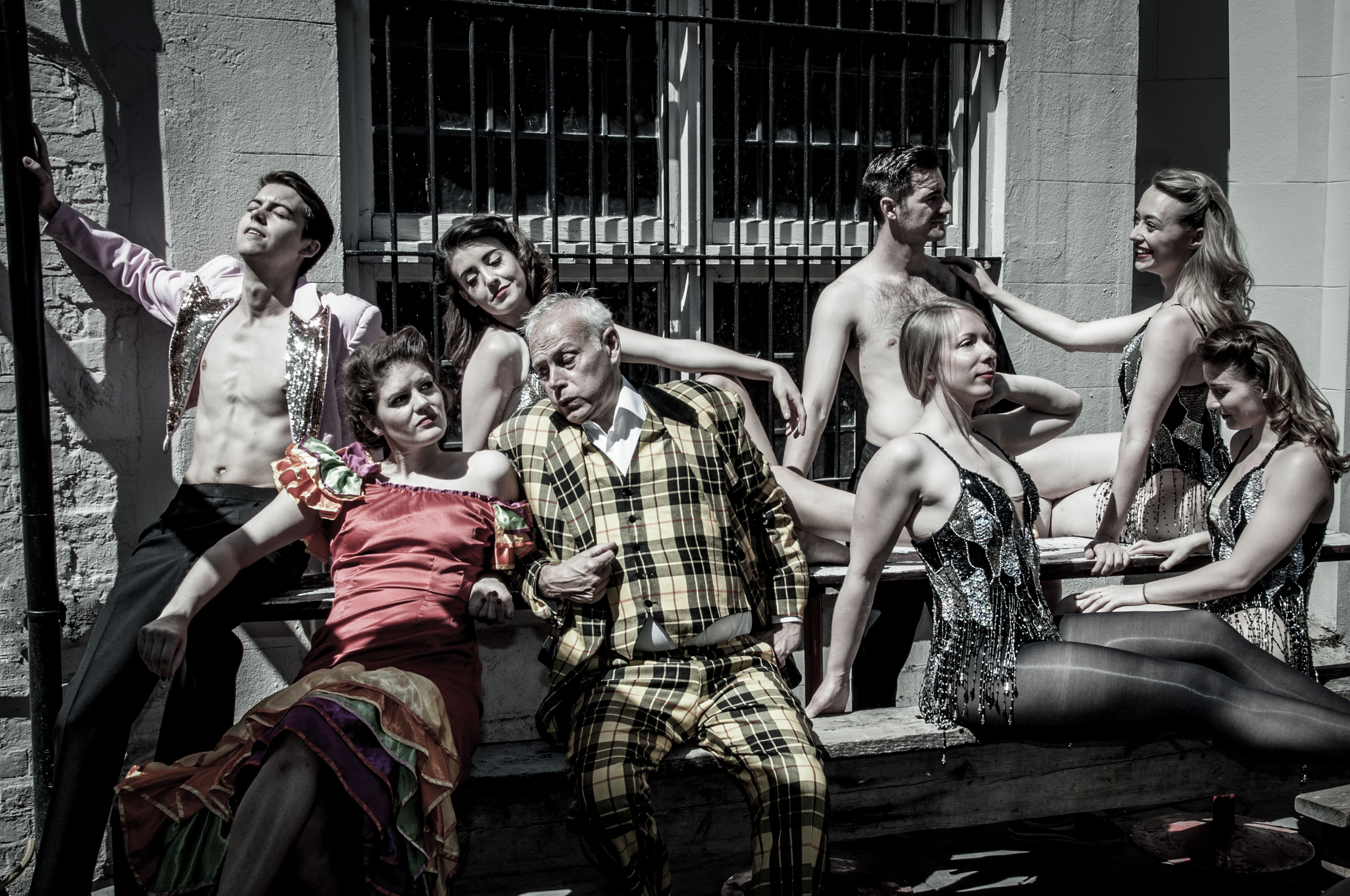
The sea of poppies surrounding the Tower of London last Autumn gave a poignant reminder as to how the nation’s wartime efforts still touch our hearts and images of those poppies are the starting point for this show. Sadly, few of those who lived through World War II as adults are still amongst us, but stories and music from that era form part of all of our lives and, here, we are invited to pack up our troubles in an old kit bag for a couple of hours of wallowing in nostalgia. The show raids the songbooks of the Andrews Sisters, Glenn Miller, Vera Lynn, Gracie Fields and more. Somewhat carelessly, Edith Piaf’s If You Love Me (written in 1954) is slipped in, but it is such a lovely song that we can let that pass. The focus is on an ENSA (Entertainment National Service Association) troupe, putting on shows to entertain service men and women, firstly at home and then in a combat zone in Italy. Jeffrey Raggett’s cheery, cheeky MC holds everything together; dressed in a loud checked suit, he is a comic in the Max Miller mould who fires wisecracks (refreshingly non-pc by modern standards) both on and off stage. Packing around 20 songs into two hours, the show has room only for snapshots of the lives of the performers. Peter Nichols’ Privates on Parade gives a more detailed account of entertainers during the War, but this show is mainly about the songs. Sarah O’Connor’s book picks out two stories – a love triangle and a gay romance – and looks at them through specs tinted by 21st Century values. Single motherhood may not have been greeted by quite so much enthusiasm in the 1940s and gay men proclaiming the intention to “be themselves” whilst serving on the front line seems a little unlikely. Nonetheless, she leaves us wanting to know more about how these stories pan out, which cannot be a bad thing. The Landor is decked out in Union Jacks to look like any British Legion hall up and down the country – good venues for this show to move on to perhaps. Director Robert McWhir, choreographer Robbie O’Reilly and musical director Michael Webborn are expert at staging musicals in this small space and they give us a song and dance display that is well up to usual standards. Sometimes it benefits a production to look a bit rough around the edges, perhaps put together hastily and with limited resources. If that is sometimes the case here, the show reflects its subject matter well, but top-class singing and dancing from a 15-strong company and touching featured performances give it plenty of sparkle. It all adds up to a thoroughly entertaining evening.

Performance date: 17 July 2015

thepublicreview_hor_web copy

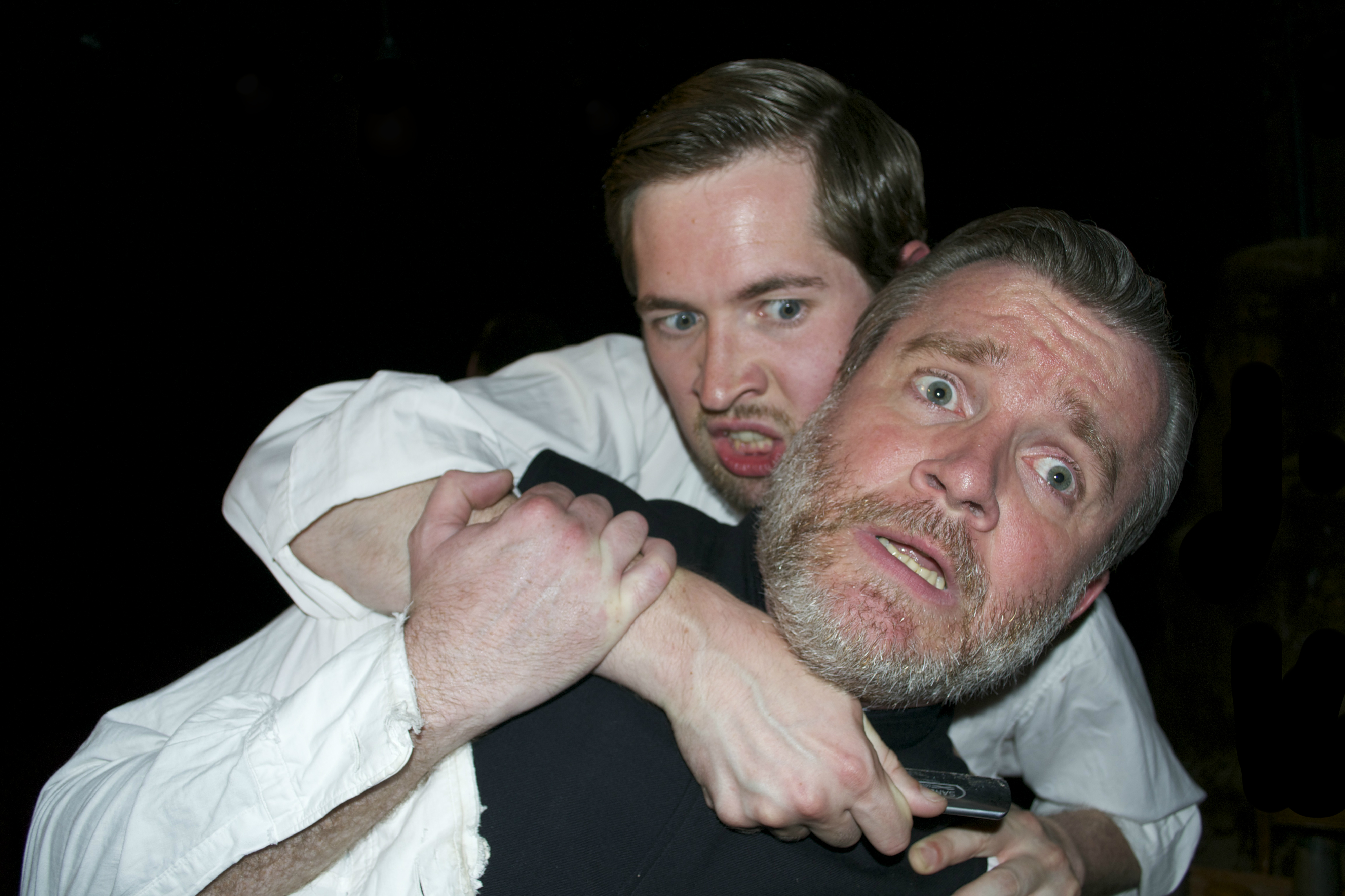
Daniel Collard as Sweeney Todd and Andy Watkins as Constable DrummleThis review was originally written for The Public Reviews: www.thepublicreviews.com

Now here’s a good idea – a new musical take on the legend of Sweeney Todd. Good except that the great Stephen Sondheim got there first and his 1979 version has had three different productions in London in the last year alone. First thoughts are that the creators of this alternative must be supremely confident or perhaps slightly insane. Sondheim based his account of depravity and cannibalism in Victorian London on a play by Christopher Bond in which Sweeney was a vengeful convict returning home after escaping from Australia and Mrs Lovett was an opportunistic pie maker, seeking to profit from his killing spree. Here a much younger Sweeney has no back story and he meets the widowed Mrs Lovett long after she has begun baking her dodgy pies, plucking plump babies from her sister’s orphanage before moving on to bigger things. The strong theme of this show is that the female of the species is much deadlier than the male. Louise Torres-Ryan makes Lovett a formidable lady, ruthlessly exploiting Daniel Collard’s shy barber, Sweeney. She uses all her guile and feminine allure to seduce her man into wielding his sharp razor in exchange for his nightly nooky. Rachael Barnett, Eddie Mann, Sarah Shelton and Andy Watkins provide strong support. This 80 minute show grabs every opportunity for audience participation, creating a celebratory mood, although the grizzly plot offers little cause for celebration. Discarding comparisons with the other version, Jo Turner’s music is actually rather pleasing and well sung, although the songs are spaced out too irregularly through the show. A barbers’ shop quartet routine is inspired and very apt; Russian dance music and an Argentine Tango fit in less comfortably. Another song has no stronger pretext then “let’s all ‘ave a sing-song”, but we have to accept that most of the good lyrics about pie fillings have already been used up. For a long stretch in the middle of the show, Dave Spencer’s dialogue is of the “so bad it’s good” variety, but deadpan delivery often makes it very funny and, as the laughs are plentiful, we ought to assume that they are intentionally so. Lovett and Todd is never going to hit the heights of Sondheim’s masterpiece, but, as a small fringe show, it is cleverly done and jolly, if gruesome, good fun.

Performance date: 16 July 2015

thepublicreview_hor_web copy