Oresteia***** (Almeida Theatre)

Posted: June 5, 2015 in Theatre

IMG_0228

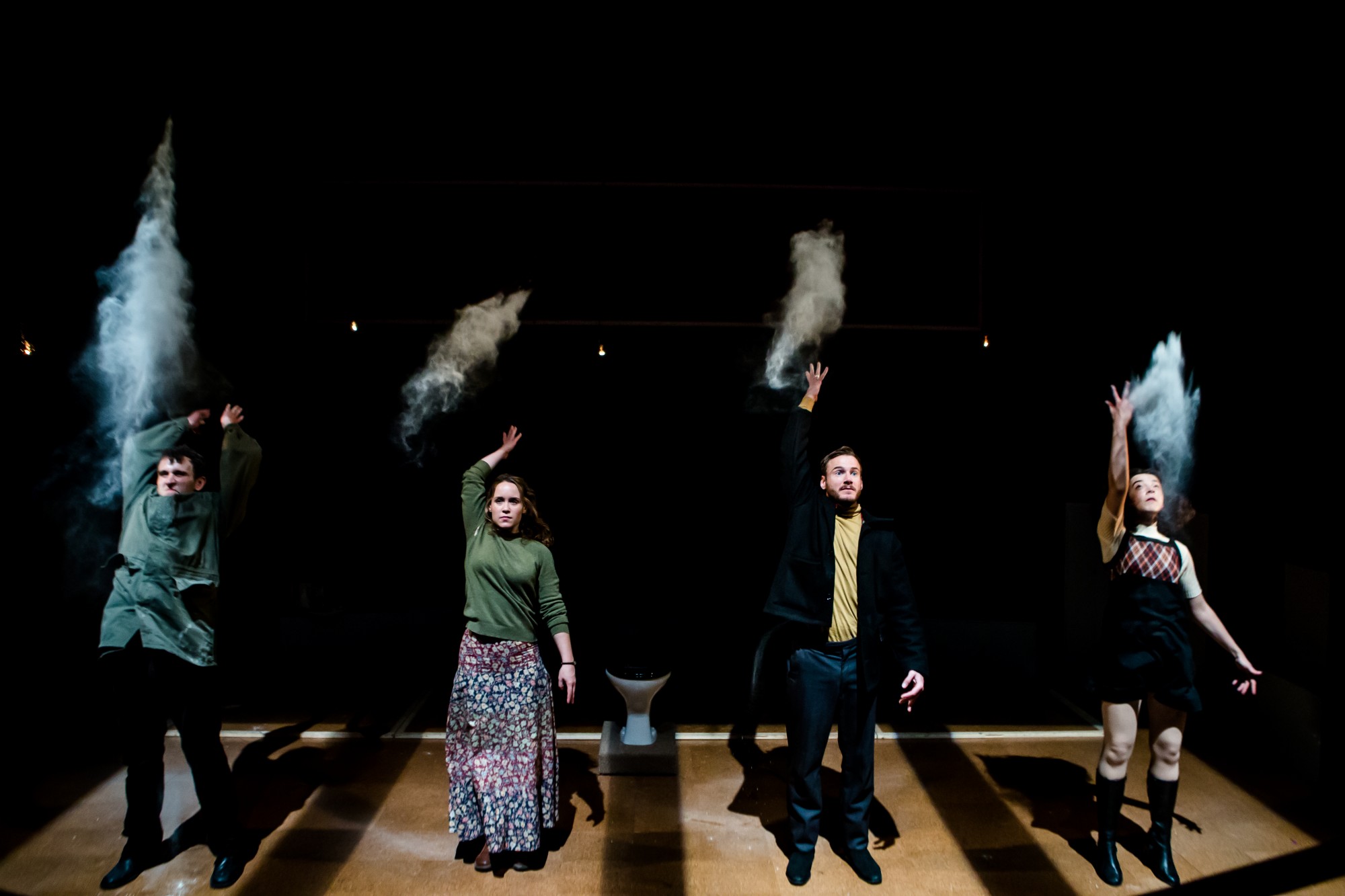
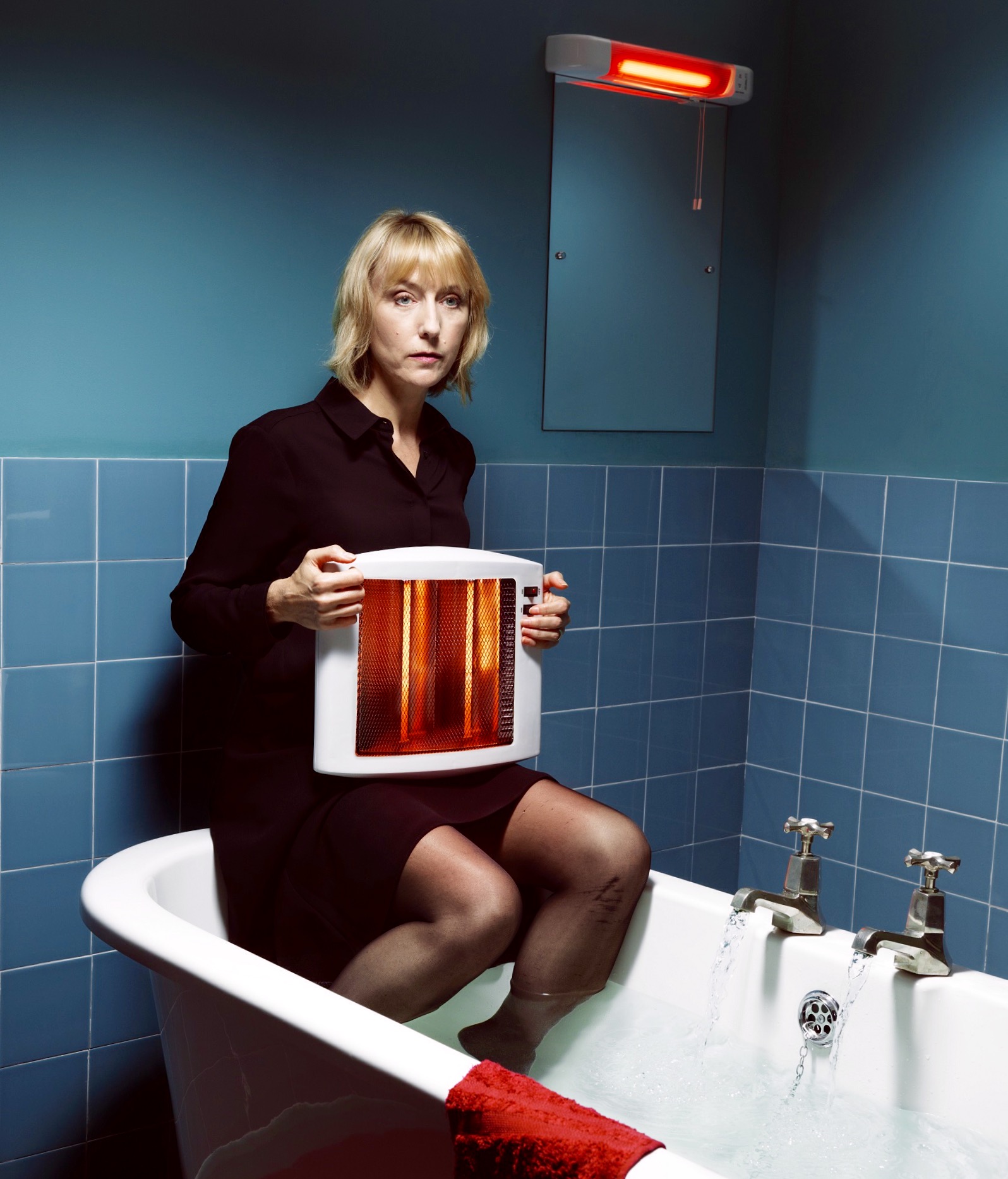
Beginning the Almeida’s Greek Season in just about as ambitious a way as possible, Robert Icke has created a new version, directed by himself, of Aeschylus’ trilogy from c.458BC. Many Greek tragedies are notable for their brevity and intensity. This runs for a bum-numbing 3 hours 40 minutes, but the intensity is there in spades and “new version” means much more than just a new translation – it is modern in language, characters and relevance. Time is one of the most significant themes and digital clocks can be seen on stage, in the auditorium and even the foyer; they stop to highlight the precise time during the performance when each key incident occurs and they even count down the two interval breaks to get us back to our seats promptly for the resumption. We are reminded repeatedly that the time which each of us spends in the universe over the  entire course of its existence is miniscule. At the beginning and the end, the Chorus reads out a roll call of Gods of all main religions from ancient Greece to the present, as if pointing a finger of guilt at them for all the carnage brought about in the name of religion throughout the ages, up to and including the year 2015. The overriding theme is the link from the Gods to family, going through the military. Agamemnon (Angus Wright) receives a sign from the Gods to commit an act which will lead to victory in a war, but will have devastating consequences for his wife Klytemnestra (Lia Williams) and their family. The trilogy follows their son Orestes (Luke Thompson) through from a happy family childhood to the realisation of his own fate. The Almeida stage is widened to its full expanse and left bare, save for a few furnishings, and clouded screens at the back conceal a bathroom in which key events take place as if in distant nightmares. Such is the power of the raw drama in the first three hours that they feel like one, scenes gripping with the ferocity of the eagle’s talons, referred to in a repeated metaphor. Williams is magnificent, reacting like a wounded tigress to her husband’s foul deeds. Wright and Thompson are also superb, as is Jessica Brown Findlay (an impressive stage debut for the former Downton star), making a relatively brief appearance as Elektra. It is only in the final section that the production loosens its grip as it centres on an overlong trial sequence and its key themes become lost. Now the play questions how it can ever be possible to discern between truth and fantasy when the perceptions of two or more people can be so contradictory; unintentionally, the play actually demonstrates its own point by relating the same events as Sophocles’ play Elektra, but with major differences. When the question of gender inequalities is thrown in late on, the point being made is an important one, but it feels like too much of a diversion from the main track. Nonetheless, this brave production is a substantial achievement and it augurs well for what is to come in the Almeida’s Season.

Performance date: 4 June 2015

Bradley-Cooper-John-Merrick-Alessandro-Nivola-Frederick-Treves-Patricia-Clarkson-Mrs-Kendal.-Photo-credit-Joan-Marcus-1024x683

Obvious comparisons can be drawn between the fascination which Victorians had for freak shows and the modern day obsession with Hollywood movie stars. In the 1880s, John Merrick, the title character of Bernard Pomerance’s play, drew the masses to grubby funfair tents to stare disbelievingly at his grotesque deformities and then he moved upwards to become the darling of high society, whose members were equally intrigued, but in a slightly more refined way. Hollywood has turned out few bigger names in the last decade than Bradley Cooper, star of many critically acclaimed and commercially successful films. Huge crowds might gather in Leicester Square to gawp at his appearance for a premiere, but now he can be seen in a more civilised (and probably drier) setting just around the corner by anyone prepared to cough up for a ticket at West End prices and pay £10 for a programme (justify that please!). Defying the suggestion that movie stars are superhuman, Mr Cooper shows that he is in fact made of just flesh, blood and bone and he is actually not at all bad, or rather he is as good as Pomerance’s somewhat creaky play allows him to be. In David Lynch’s 1980 film of this story, John Hurt had to give his performance whilst buried in tons of prosthetics, but, in Pomerance’s stage version, we see Merrick as the human being behind the disfiguration, Cooper distorting his face and body and straining to speak in an affected English upper class accent. He gives Merrick dignity, but Pomerance does not overcome the character’s problem with articulation, not finding a way to express his inner thoughts to the audience. As a result, the surgeon, Frederick Treves becomes the play’s more interesting character, a scientist in the post-Darwin era, struggling to find a moral code to equate with his beliefs. Alessandro Nivola gives a compelling performance as Treves, but this production’s star turn comes from the wonderful Patricia Clarkson as the actress Mrs Kendall who befriends Merrick. This character is the polar opposite of Treves in her certainty that moral conventions are there to be defied and Clarkson, giving her both the classiness of a society lady and the sauciness of a mischievous tart, lights up the stage with her every appearance. London theatre needs to see her again, often. Director Scott Ellis’s production, transferred more or less intact from its Broadway run, is conventional and efficient, the simple set designs by Timothy R Mackabee ensuring that the focus stays where it needs to be – on the actors. However, the play itself still falls well short of classic status.

Performance date: 4 June 2015

The Clockmaker's DaughterThis review was originally written for The Public Reviews: http://www.thepublicreviews.com

It’s time to pop Champagne corks. Here we have a brand new British musical that does not simply recycle old hits and is not adapted from a film, a play or a novel. Michael Webborn and Daniel Finn conceived and developed this show as a totally original piece of musical theatre, the story, words and music being woven together from the very start in a process which now looks set to pay them handsome dividends. The show is a fairy story with hints of Pinocchio (maybe even Frankenstein in its darker moments). Abraham (Lawrence Carmichael), the clockmaker in the small Irish town of Spindlewood, grief-stricken at the loss of his only daughter, makes a clockwork replacement for her, Constance, who takes human form but needs to be wound up to become active. Abraham holds her key. Of course, this all requires considerable suspension of disbelief, but didn’t Wicked? The songs work perfectly in harmony with the book to propel the story. Webborn and Finn’s lush, melodic music has touches of Irish folk and, if influences of previous shows can sometimes be detected, they are only the best shows. Constance is a massive starring role and it gets a massive starring performance from Canadian actor/singer Jennifer Harding. Her quizzical eyes and beaming smile convey astonishment and joy at the world outside her maker’s home, her mechanical movements becoming progressively more human as she grows in confidence. The town’s dressmaker (Jo Wickham) turns into Constance’s adversary and the story’s villain, but her son, Will (an endearing performance by Alan McHale) befriends the girl, leading to a tentative romance. Robert McWhir’s production, choreographed by Robbie O’Reilly, is mysterious, enchanting and, at times, dazzling. A company of 20 fills this small stage as the townsfolk of Spindlewood celebrate New Year, Market Day, a wedding, etc. The chorus singing and dancing is marvellous to hear and behold. David Shields’ set designs of gold-painted pillars and clocks enhance the timeless, magical feel, with moveable blocks quickly adapting from, say, a library to the town’s bridge. As with all good fairy tales, this is also a morality tale and the show has darker themes which come to the fore in Act II, changes in tone always being driven by the music. Abraham can now be seen as a possessive and manipulative father, Constance becomes a social outcast and the people of Spindlewood, earlier a joyful throng, turn into an unruly mob in a powerful transformation scene. Drawing parallels with racism, the story asks what is the difference between clockwork and bones, or between oil and blood. The serious undercurrents give the show depth and texture. British musicals have had a rough time in the last couple of years. Producers who have dropped new works straight onto West End stages, expecting them to make a running start, may want to ponder the advantages of opening in a small venue such as the Landor, thereby giving a show time to settle, breathe and find its audience. The Clockmaker’s Daughter could be adapted easily for a bigger stage, but it is here for just five weeks, an opportunity to get in on the birth of something very special.

Performance date: 1 June 2015

Photo: Poppy Carter

thepublicreview_hor_web copy

fc75cf_2b21c5d3dcfb4967adc6e34475240440.jpg_256This review was originally written for The Public Reviews: http://www.thepublicreviews.com

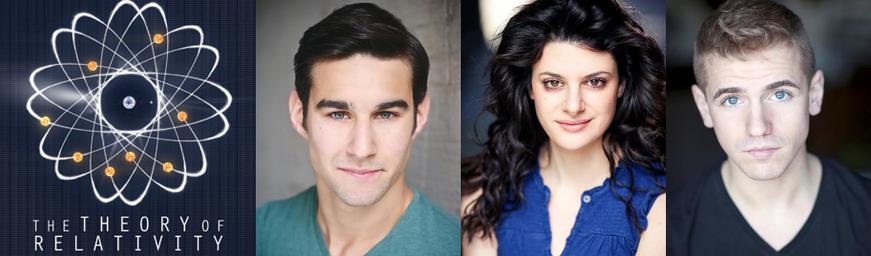
For those of us who had E=MC squared instilled in us at school, but still have no idea what E, M or C stand for nor care, this is the perfect show. Mr Einstein does not feature in the character list and serious science is mentioned only very whimsically. Instead we have a show more about connectivity than relativity, developed from the loose idea that we are all comets travelling in our own orbits, crossing paths, maybe meeting, maybe colliding. This 80-minute musical entertainment which originated in Canada, is not quite a fully- fledged musical, although perhaps it will eventually become one. Brian Hill’s book links the songs and gives us amusing short sketches, but it does not provide a narrative running through. The general theme is young people making discoveries and feeling their way around life’s common obstacles. A Maths geek (Simon Bailey), obsessed with the perfection of Pi, randomly dates an Art historian (Jodie Steel) with a disastrous relationship history. A young man with an allergy to cats (Curtis Brown) becomes besotted with a girl who is inseparable from her feline friends. An OCD sufferer (Natasha Karp) dreads the prospect of eating a cake made especially for her by her boyfriend, who has touched all the ingredients with his hands. A lifelong hater of apples (Joshua LeClair) finds himself an unlikely soulmate A young woman (Rebekah Lowings) announces her engagement to her girlfriends, trying to pretend that nothing will change. And so on. In more wistful moments, an only child (Ina Marie Smith) pays tribute to her mother, a student (LeClair again) reflects on the footprints that he has left in the shifting sands of his past and another young man (Andrew Gallo) sings of the weight of family expectations. The songs – solos, duets and chorus numbers – are performed in Christopher Lane’s very simple production with keyboard accompaniment on a stage adorned only by a high stool for each of the eight performers. Neil Bartram’s varied middle-of-the-road music is always easy on the ear and climaxes with Nothing Without You, a rousing anthem for the entire company which would not have been out of place in a Broadway or West End hit. However, it is Bartram’s witty and thoughtful lyrics which really stand out and beautifully clear singing showcases them perfectly. Relaxing and uplifting, this show offers an ideal way to spend an early Summer evening and, for those of us who are always on the lookout for the next Sondheim, well who knows?

Performance date: 29 May 2015

thepublicreview_hor_web copy

Pamela Raith Photography_The Dogs of War_005This review was originally written for The Public Reviews: http://www.thepublicreviews.com

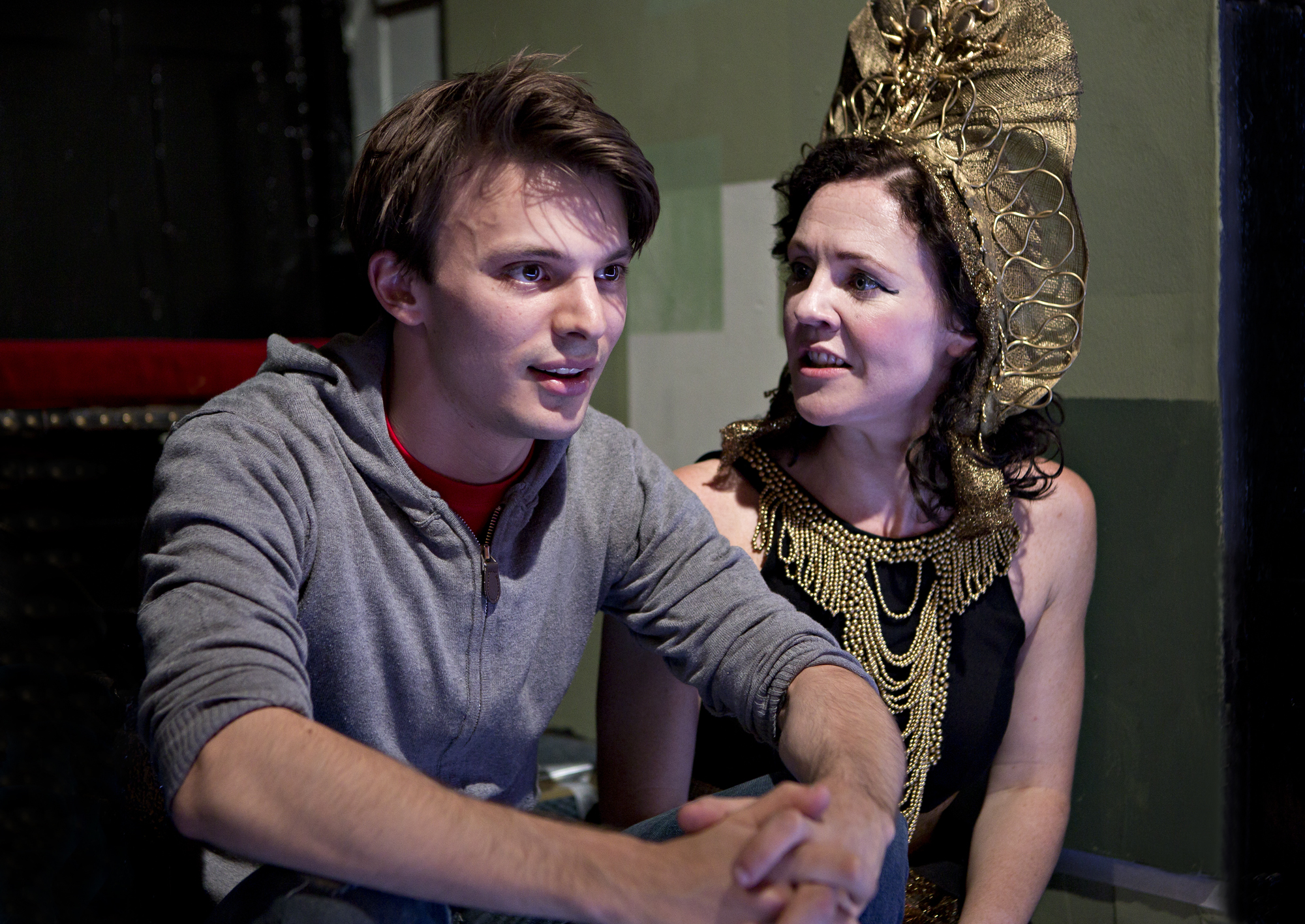
Taking a train, a ferry and two buses to arrive at his parents’ remote home in Northern Ireland, Johnny is greeted by three invisible dogs and a mother who barks at him louder than any of them. So begins Tim Foley’s debut full-length play, which becomes a harsh and bruising study of a family living with schizophrenia and of the cross-generational effects of that condition. The play is described as a “dark comedy”, but, although there are humorous touches, it has an overriding bleakness which often belies the comedy tag. The Old Red Lion seems to have become a magnet for interesting new writing and its compact configuration is perfect for a claustrophobic domestic drama such as this. Libby Todd’s set is an austere kitchen, the centrepiece of the home of a family reduced to frugal living as a consequence of illness. “Mam” has become reclusive, selfish, dependant on medication and she does little more than brood or sleep in her armchair, pampering her beloved dogs. Maggie O’Brien plays her as tormented and resentful, her pent-up anger being released in tirades of vicious and irrational abuse towards her husband and son. Her long-suffering husband (Paul Stonehouse) is her carer, his motivation being duty born out of staunch Catholicism more than real affection. He claims to see the dogs which are invisible to Johnny, but maybe he does so just to pander to his wife. A neighbour (Melanie McHugh) also sees the dogs, but could she be imaginary? Certainly imagined is Cleopatra (McHugh again), who toys flirtatiously with Johnny when he slips into his alter ego of the mighty Caesar. Richard Southgate’s Johnny is uncertain and afraid. He debates with himself whether what he sees as the onset of mental illness comes from nature or nurture. Trying desperately to deny a genetic link, he goes back to childhood incidents, memories of which his mother uses to torment him cruelly, and thinks of words heard and misinterpreted in order to explain his delusions. Most obviously, he connects them to a computer game with which he has become obsessed and the play asks us to consider the links between virtual reality and insanity. Foley’s play meanders at times before finding its purpose and some early scenes could benefit from trimming, but Tom O’Brien’s tight production comes strongly to the boil in two explosive second act scenes. The drama draws heavily from the symbolism of the dogs, teasing us with what is real and what is imagined, what is normal and what is madness. Johnny doubts his sanity when he cannot see the dogs, but then neither can we, the audience.

Performance date: 28 May 2015

Photo: Pamela Raith

thepublicreview_hor_web copy


Beautiful_Thing2_main_1

Having met the cast and director Nikolai Foster, at the press launch of this touring production – http://www.thepublicreviews.com/preview-beautiful-thing-back-on-tour/ – I was intrigued to see it on stage and what better place to catch it than at the splendid Curve, where Mr Foster is Artistic Director? Sadly the tour will be going no further than here, but congratulations are due to the entire team for reinvigorating Jonathan Harvey’s groundbreaking work of theatre and giving it a modern feel, whilst staying true to its original period and setting – the 1990s in a South London social housing block, represented in Colin Richmond’s set by three adjacent blue doors. 20 years ago, it drew the tag “gay play”, but now, with it’s surprise value diminished, it can be seen more clearly as what Harvey may have always intended, a simple demonstration of the basic human needs of caring and being cared for. Take, for example, Leah, delightfully played by Vanessa Babirye, who is excluded from school and just about everything else in life; she lacks a caring parent, but finds consolation in the music of Mamma Cass, whose warm, melodic voice provides the show’s backing track. Sandra (Charlie Brooks at her feistiest) is a single mother, struggling to make ends meet working in a bar and she attaches herself to a succession of unsuitable boyfriends, the latest of which is Tony (Gerard McCarthy). Her sensitive 15-year-old son Jamie (Sam Jackson) plays truant on days when Games is on the school timetable; he has become used to standing up to her and the pair bicker constantly, but, thanks to fine performances from Brooks and Jackson, the strength of the bond between mother and son is never in question. Neighbour Ste (Thomas Law) lacks such a stabilising influence, his drunken father brutally abusing him and it is when he takes refuge in Sandra’s flat that his relationship with Jamie starts to develop. The great beauty of Foster’s production is how it picks out small and humorous gestures of warmth in Harvey’s script and magnifies them – Jamie rubbing foot cream (the only thing he could find) into Ste’s bruises, Jamie accepting a gift of a woolly hat from Ste and snapping “I’m having it”, instantly realising that the significance of the gift is far more important than a detail such as whether or not it fits. Again Jackson and Law have great on-stage chemistry, getting us rooting for them as they set out tentatively into a world which they realise may be hostile towards them. In less confident hands, a lot of this could make up too sugary a pill for many to swallow, but here it has a savoury coating extracted from real life and it becomes irresistible.

Performance date: 28 May 2015

FullSizeRender-70

Who ever knew that Lichfield could be so much fun? George Farquhar’s joyful romp from 1707 begins with two penurious London gentlemen (Samuel Barnett and Geoffrey Streatfeild) arriving disguised in our smallest cathedral city with a stratagem to hook a pair of rich ladies. Once there, they encounter, amongst many others, a drunken husband with a lusting wife, French officers taken prisoner, an Irish-Belgian priest, several buxom wenches with drooling pursuers, a gang of highwaymen and so on. Director Simon Godwin gives a lavish and richly comic production to a play that is ridiculously over-plotted and totally nonsensical from start to finish. Lizzie Clachan’s towering set of multiple staircases is breathtaking and Michael Bruce’s music fits in perfectly with the text, always pleasing to the ear. Barnett and Streatfeild shine, Susannah Fielding’s maltreated wife sounds feminist battle cries 200 years ahead of her time, Pearce Quigley achieves the production’s best laughs-per-line ratio as the droll servant Scrub, but the cast of over 20 all give excellent performances. This is the sort of thing that the National ought to do better than anyone else and, happily, it lives up to such expectations.

Performance date: 27 May 2015

The-Angry-Brigade_172-2000x1333

Having established himself as a chronicler of modern British political history, James Graham now turns to anti-politics with this fact-based look at the early 1970s anarchist movement of the play’s title. This is actually two plays – one concerning the police investigation and the other set amongst the anarchists – which Graham instructs can be performed in either order with the same actors, or with different ones. James Grieve’s production gives us the police play first and uses the same four actors – Mark Arends, Pearl Chanda, Harry Melling and Lizzy Watts – in both. The order is the correct one, leaving the best until last. The police play shows us four young officers brought together by Scotland Yard to introduce some joined-up thinking to the hunt for terrorists who are modelling themselves on European equivalents and placing home made bombs at key locations in London. The point that the person sitting next to you on the tube could be one of the anarchists is well made and, ironically, the hunt itself becomes anarchic, with the officers beginning to long for release from the shackles of their everyday lives. The problem is that the play rambles aimlessly for too long at the beginning and its comedic tone does not sit well with the material; dealing with a bumbling police unit, there are times when an appearance by Rowan Atkinson would not seem out of place, except that the play is never really very funny. All attempts at comedy are abandoned after the interval when we join the Brigade in its quest to undermine the British social structure. And a very angry brigade it is, tearing down walls and hurling filing cabinets across the stage. The key protagonists are Jim (Melling). venting rage and frustration born out of the constrictions of growing up in Northern England during post-War austerity, and Anna (Chanda), a nascent feminist who is the first in the group to realise the value of what she in intent on destroying and thereby becomes the Achilles’ heel which the police can target. Graham gives the play’s most eloquent speeches to Jim and Anna, providing fascinating argument and counter-argument, but the most telling moment comes when she sets a dinner table awaiting Jim’s return to their squat, instinctively using that symbol of middle class convention – napkins. Much of what Graham writes can be related to modern day extremism and the assertion “the Tories always win” is as true as ever in 2015. Flawed and uneven as it is, this production is full of interesting insights.

Performance date: 26 May 2015

crouch, touch, pause, engage

The Welsh town Bridgend has gained an unenviable reputation for being the UK’s capital of suicide, reporting extraordinarily high figures which have led to suspicions of a cult, particularly amongst teenagers. Robin Soans’ new play, examines that fractured former mining community by looking at three of the town’s inhabitants: two schoolgirls – the self-harming Darcy (Lauren Roberts) and Meryl (Katie Elin-Salt), a budding writer whose abusive father commits suicide – and the local celebrity, Welsh International Rugby player Gareth “Alfie” Thomas, tortured and near suicidal through the process of admitting his homosexuality to the World. Soans politicises his play with an appearance by Neil Kinnock (Patrick Brennan) who says: “Scargill and Thatcher between them killed the mining industry…what was particularly sickening was the way Thatcher claimed ownership of a change that was inevitable while at the same time blaming the mining communities, but what it meant was that no social cushioning had been put in place nor was it going to be.” It is not clear whether Kinnock has himself articulated such views, but perhaps, if he and other figures on the left of politics had possessed the courage to acknowledge these obvious truths at the time, the healing process for Bridgend and similar communities could have been speedier. Soans seems to be telling us that his three central characters and Bridgend as a whole now have to face up to reality, re-group and move on. The boldest feature in Max Stafford-Clark’s production is having Thomas played, more or less equally, by all six members of the cast (the others are Rhys ap William, Daniel Hawksford and Bethan Whitcomb), only one of which is both male and in the correct age group. The actor who is to be Thomas dons a red Rugby shirt and receives a ball passed by his/her predecessor. This device has the remarkable effect of showing Thomas as belonging to the community, the well publicised trials and torments of a celebrity being of no greater or lesser significance than those of others, his denial of the truth reflecting the plight of his town. However, the effect comes at a cost, as scenes dramatising Thomas’s personal crisis are robbed of authenticity and power. Soans touches on the dilemmas facing gay sports personalities and on intrusions of prurient media into private lives, but such concerns are made to seem secondary. Hearteningly, Soans sees a bright future for all of his three central characters. He tells us that Bridgend embraces its gay son once he has come out – we have seen in Ireland this very weekend how ordinary people can prove to be much wiser than moral guardians such as media hypocrites or religious leaders – and, as in a Rugby scrum (the metaphor in the play’s title) they huddle together and prepare to advance. Beautifully acted and gripping throughout, this is, notwithstanding its flaws, a brave and imaginative piece of theatre.

Performance date: 23 May 2015

FullSizeRender-69

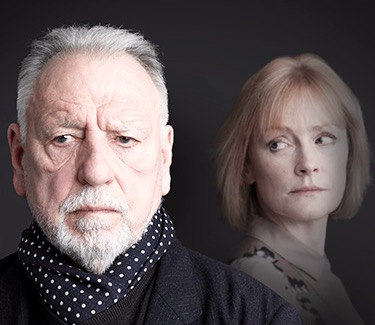
Shakespeare described life’s last scene of all as being “second childishness and mere oblivion….sans everything”. French writer Florian Zeller now expands that scene into this 90 minute play, translated by Christopher Hampton. “The Father” is Andre, played with intense feeling by Kenneth Cranham, a retired engineer, once a man of intellect and dignity, now afflicted by the onset of dementia and clinging desperately to the wreckage of his life. His only surviving daughter, Anne, is torn between duty towards her father and living her own life. The set-up seems to suggest that we are in for a worthy if rather routine drama about caring for the elderly, but Zeller’s novel twist is to tell the story from the perspective of Andre, rather than from that of Anne, thereby giving the audience an insight into Andre’s nightmare. Each short scene ends with the stage blackening and then, after a brief spell of grating music, the lights return for us to see possibly the same room, but with some slight difference – perhaps an unfamiliar character appears or a piece of furniture disappears – and what is said may contradict what we have been told previously. As Andre becomes confused and disorientated, we share in his experience, unable to distinguish between truth and make-believe, not knowing exactly where we are. The device is executed brilliantly and it also opens the door for some delightful comedy to relieve the gloom of a tragic situation. Andre’s regression from proud senior citizen back to childhood and eventually infancy is played out as something like a harrowing comedy. The great strength of Cranham’s performance is his ability to show us the man that Andre once was as well as the pale shadow of him that he has become. Claire Skinner matches him by bringing out the suffering of Anne as she tries to care for her father, only to be faced with wounding insults from him and little support from her partner. James Macdonald’s sensitive production is seldom sombre in tone as it charts a tragic and unstoppable decline and it becomes deeply moving when the play reaches its own last scene.

Performance date: 20 May 2015