communicating doors

Alan Ayckbourn and I have drifted apart in recent times, amidst a growing feeling that his comedies of middle class social manners now feel very dated. After his big successes of the 1970s and 80s, many of Ayckbourn’s plays delved into darker areas of the human condition and others have tackled science fiction and the supernatural, but I still did not find those that I saw (by no means all of them), fully satisfying. This one, dating from 1995, is a comedy-thriller on the theme of time travel; it had previously escaped me, but the fact that Lindsay Posner is directing and it is being staged at the wonderful Menier made it worth a look and I am happy to say that this is the first production of an Ayckbourn play that I have truly enjoyed for more than 30 years. The play is set in 1980, 2000 and 2020 in a luxury hotel suite (splendidly designed by Richard Kent), which has a closet enabling those entering to travel backwards and forwards in time. It begins in 2020 with a dying man meeting a prostitute in the suite, whilst civil disorder is rife in the street below. Rachel Tucker’s Poopay, the bewildered whore, aided by a document that had been stuffed down a bidet, colludes with her client’s feisty wives, Ruella (Imogen Stubbs) in 2000 and Jessica (Lucy Briggs-Owen) in 1980 to bring to a halt the murderous spree of Julian (David Bamber), the sort who would kill his own mother and, in fact, did exactly that. A hapless hotel detective (Matthew Cottle) gets dragged into the ensuing mayhem. Obviously, suspension of disbelief is essential and very little stands up to scrutiny after the curtain call, but the beauty of the writing and direction is that they carry us with the play whilst it is all going on. Aided by a top class cast, Ayckbourn and Posner ensure that this production pulls off the notable double of being both hilarious and suspenseful; they throw in a couple of shocks to jolt us and the big highlight is what must surely be the best balcony scene since Romeo and Juliet, although it is far, far funnier. Not everything is wonderful; corrupt businessmen and ill-used housewives are familiar stereotypes in Ayckbourn and the conservative (small “c”) values that they represent sometimes cause irritation, particularly when they embrace sneering attitudes to minority groups, as again here. Also, the final scene is possibly the most stilted in all Ayckbourn’s 79 plays, with two characters revealing to each other what both already know just for the benefit of the audience. However, it contains a surprise that is such a peach and rounds of the play so perfectly that it almost makes the appalling writing of the scene forgivable. Taken overall, this production is terrific entertainment.

Performance date: 19 May 2015

High Society***** (Old Vic)

Posted: May 17, 2015 in Theatre

high society

Well, did you evah?! I really wasn’t expecting very much at all of this. The 1940 Hollywood film The Philadelphia Story is, of course, pure bliss, but Philip Barry’s stage play which preceded it disappointed when it was performed at this same theatre in 2005 and the 1956 film musical adaptation, High Society, has never felt quite as good as it should have been. Furthermore, this stage version of the film musical has not been a big hit anywhere before and it is brought here without the benefit of big star names on the posters. However that last point works very much in this production’s favour, because, given a choice between mis-cast big stars and lesser knowns who fill their roles perfectly, the second option always wins hands down and superb casting is one of two main reasons why the show now hits the heights. The other is the work of director Maria Friedman, who, along with her choreographer Nathan M Wright, turns the show into one long party, fizzing as much as the Champagne that is on constant flow. It helps that the Old Vic is still in the round, thereby making the audience part of the festivities, although it is a shame that we are not offered a small glass of bubbly, maybe just Prosecco, to get us in the mood; with ticket prices as they are here, this is not such an unreasonable request. The theatre ushers are dressed as party waiters and the hired entertainer, Joey Powell (Joe Stilgoe) takes to the grand piano to amuse us with a brilliant 10 minute improvised routine – can this be the first show in history to get a rapturous ovation before it has even begun? The party at the Long Island estate of the very rich Lord family, is to celebrate the second wedding of daughter Tracy Samantha to a very dull social inferior. It is gatecrashed by Tracy’s ex, Dexter (still a “one gal guy”) and two paparazzi, Mike and Liz. The appearance of classical actor Kate Fleetwood (she is off to play the murderous Medea after this) as Tracy comes as a surprise, but, pitching her performance much closer to Katherine Hepburn than to Grace Kelly, she sets the tone of the show and is a true delight. Rupert Young is not quite Cary Grant, but he is a lot more comfortable in the role of Dexter than was Bing Crosby, whilst Annabel Scholey also scores as the lovestruck (for Mike), but constantly overlooked Liz. The plum role in most versions of this story is that of Mike, the cynical hack who sneers at the lifestyle of the snobbish filthy rich whilst himself grasping at the opportunity to revel in it. Frank Sinatra put an indelible stamp on the role and James Stewart won an Oscar for it, but now think only Jamie Parker, who makes it completely his own. Barbara Flynn, Ellie Bamber, Jeff Rawle, Richard Grieve and Christopher Ravenscroft all feature strongly in support, even though Arthur Kopit’s book is forced to condense sub-plots in the original play in order to make room for the musical numbers. Almost all of Cole Porter’s songs are now standards, so much so that over-familiarity could have made them boring, but it is here that Friedman and Wright really triumph, reinventing and reinvigorating each of them with imagination and zest so as to make them seem fresh and new; As performed by Parker and Scholey, Who Wants to Be a Millionaire is simply dazzling and, when Young, perched on a balcony duets True Love with Fleetwood, who is standing beside a pool of blue light on which a miniature yacht is circling, the whole theatre is reduced to tearful silence. The party gets into full swing in an intoxicating second act, the highlight of which is the full company displaying shameless decadence for a lengthy and dizzying Well Did You Evah/Let’s Misbehave sequence. Designer Tom Pye, unable to use backdrops, manages to evoke an air of opulence, with floral displays, gleaming furnishings and pianos popping up from beneath and ornate balconies on opposite sides of the stage, which provide a home for the orchestra. What a swell party this is!

Performance date: 16 May 2015

SOAE DressThis review was originally written for The Public Reviews: http://www.thepublicreviews.com

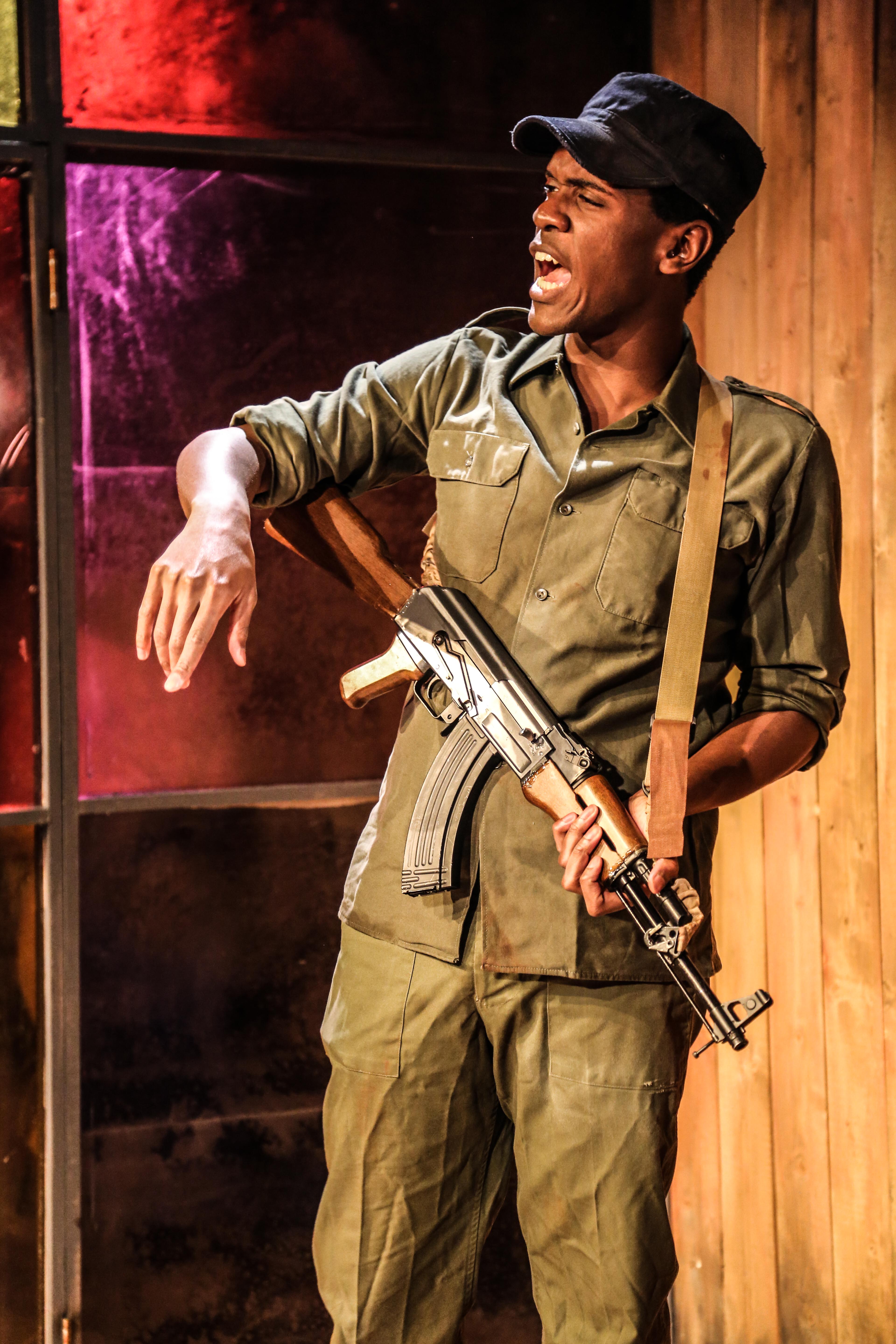
In the catalogue of unspeakable atrocities which plagued the 20th Century, the Rwandan genocide of 1994 holds a prominent position. Ken Urban’s taut and riveting new thriller is set in the aftermath of the war in that country, using a fictional incident to explore how blame can be attributed and to ask whether it can ever be possible for survivors to find closure. The structure of Urban’s play is reminiscent of Lucy Kirkwood’s Chimerica in that it centres on an American journalist setting out to uncover the truth lying behind a tragic event in recent history. The Rwandan conflict was rooted in tribal warfare between Hutus who ruled the country and Tutsis who became the victims of the genocide. The journalist, needing to revive his career, is Charles (Ben Onwukwe), who asserts proudly that he is an African American, only to be rebutted with: “American, yes. African, no!” by Paul (Abubakar Salim), a Rwandan army corporal. Thus Charles is shown that he brings with him prejudices and preconceptions from a different culture, likely to colour his view of the events that he is investigating. Two nuns (Lynette Clarke and Akiya Henry), both Hutus, face trial in Belgium accused of being complicit in a massacre of Tutsis which took place in their church. Charles’ mission is to prove their innocence to the World before the trial begins, being driven by the assumption that the teachings of the Roman Catholic Church would have overridden tribal loyalties. As the truth begins to unfold, Charles meets Dusabi (Kevin Golding), a survivor of the massacre who describes the events in horrific detail and sows seeds of doubt in his mind over the involvement of the nuns. Cecilia Carey’s multi-functional set of wood and tinted glass panels encloses the intense drama, which is brought to life by five passionate and authentic performances. Urban is posing profound questions about what defines complicity, how blame can ever be fairly attributed to individuals in wartime situations and whether there is any point in doing so anyway. Jonathan O’Boyle’s direction is crisp and focussed, maintaining the tension throughout. The scenes are short and actors arrive on set in darkness so as to begin a scene instantly once the preceding one ends. O’Boyle seems to realise that any break would loosen the play’s grip and, wisely, he runs it straight through its 90 minutes without an interval. There is sour irony in the fact that Urban’s play gets its World Premier in the same week that a new Hutu-Tutsi conflict has broken out in Burundi, neighbouring Rwanda. Sadly, it may be premature for the play’s title to refer to any sort of “ending” when, in this and other parts of the World, senseless violence goes on.

Performance date: 15 May 2015

Photo: Jack Sain

thepublicreview_hor_web copy


constellations

Nick Payne’s quirky, romantic not-quite-a-comedy was a big success at the Royal Court and in the West End in 2012 and more recently, on Broadway. It now looks very much like a modern classic and, in sending this re-cast production out on tour, perhaps the Royal Court is hoping to remind us that it was once capable of producing hits on its own, without collaborating with Headlong. In a nutshell, it is Groundhog Day meets Love Story, borrowing more than a little from Sliding Doors. If that sounds confusing, it is nothing compared to the notion of quantum cosmology, the science with which Payne tries to blind us and which is best left unexplained. Suffice to say that Marianne (Louise Brealey) works inputting data related to that science and the play charts her on/off relationship with a beekeeper, Roland (Joe Armstrong). Here, on/off means both on and off, as the couple play out several alternative versions of every situation which arises, answering the question “what would have happened if….?” at each junction in their lives, until they reach a barrier of fate which leaves few options open. The play begins with a naff chat up line and proceeds in similar vein, with seemingly inconsequential conversations gaining a ring of truth and substance as the story moves on, not always in a linear progression, taking two steps forwards and one step back. The play works so well because of its dizzying effect, rather than despite it, creating an outer-worldly feel which becomes captivating and very touching. Much credit for this goes to director Michael Longhurst’s light touch, Tom Scutt’s set consisting of helium-filled balloons and Lee Curran’s warm and glowing lighting. Another big plus is that, at 70 minutes, the play does not hang around long enough for it to become irritating. Big name stars have played the two roles previously, bringing the stamp of personality that comes from instant recognition. However, if this puts Brealey and Armstrong at a disadvantage, they do well in overcoming it, making a genuinely engaging couple and handling the regular changes in tone with great confidence. Quantum cosmology remains unfathomable, but this play speaks to the heart rather than the brain and, as such, it is a delight.

Performance Date: 14 May 2015

Gypsy***** (Savoy Theatre)

Posted: May 15, 2015 in Theatre

FullSizeRender-68

Okay, I know it’s criminal to go and see something for a second time when there are so many good shows around with too little time to see them all. I plead Guilty! I am not going to repeat everything that I wrote after seeing Jonathan Kent’s faultless production in Chichester (see review posted on this site on 22 October 2014) but, reading that review again now and comparing it with what critics in the national press have written, I feel the need to apologise for having underrated it. It is a tribute to the good taste of London theatregoers that box office records at the Savoy have already been broken; perhaps they fear that the leading performance is so phenomenal that its like will never be seen in this city again. Perhaps they are right. The Savoy is much more compact than the Festival Theatre in Chichester and, with its proscenium arch and art deco fitments, it suits the show’s story perfectly. The choreography loses something on the smaller stage, particularly when Tulsa (Dan Burton) performs All I Need is the Girl, serenading Louise in Gene Kelly style just before eloping with her sister. However, for those small drawbacks, there come massive compensations when the theatre’s intimacy magnifies the intensity of the emotional outpourings towards the end. I continue to rave about Lara Pulver’s performance, her transformation from Louise to Gypsy being pure magic. Peter Davison has now taken over from Kevin Whateley as Herbie, but he brings exactly the same qualities to the role. Nicholas Skilbeck’s orchestra sounds just as good, particularly its wonderful brass section and the standing ovations come in exactly the same places. Yet, for all those wonders, the question most people ask at the end is something like “how on Earth does that lady do that for eight shows a week?” The lady is Imelda Staunton, still playing the lead role of Rose.

Performance date: 13 May 

wilderness_web_imageLeft wing politics are under the microscope again right now, perhaps in different ways from what might have been envisaged when this production started to take shape. The play, the first of only two written by Doris Lessing, explores the shallow roots of British radicalism more than half a century ago and effectively sounds a death knell. In 1958, Myra (Clare Holman) is still repeating the Socialist battle cries of the 1930s, but is short of causes to attach them to, CND taking up most of her time. Her 22-year-old son Tony (Joel MacCormack) returns home from two years of National Service to find Myra and the house a complete mess and yearns for order, stability and sanity. Lessing asks us to view events through Tony’s eyes and she paints a picture of well-meaning, chattering middle class lefties championing political causes which relate to worlds outside their own experiences. Myra’s latest lover Sandy (Josh Taylor) is Tony’s age and, when it is suggested that he should take up a career in politics, he is told to join the Labour Party, not because of any conviction but because he does not have the connections to make it to the top as a Tory. Some of this may resonate in the light of history made in May 2015, but there are very few respects in which Lessing’s writing is prescient; this is a drama belonging to the late 50s, a history lesson which throws light on the present day. The play is sometimes stilted and uneven in tone and there are patches when Paul Miller’s in-the-round production struggles to overcome these problems. John Lightbody, as one of Myra’s many ex-lover’s and Rosie Holden as his feeble, whining new girlfriend seem to play for comedy, going very much against the grain of the play. Susannah Harker redresses the balance with a strong display of dignified vulnerability as Sandy’s mother, also Myra’s best friend. However, the two leading performances are what hold this production together – Holman is a brittle rebel with very little cause, still pressing the case for the left wing, yet wondering what her life has been for if her beliefs come to nothing. Still more outstanding is the mature and sincere performance of MacCormack, commenting sardonically on the lifestyle of the mother to whom he is devoted, whilst seeking nothing more than the security of his family home. Tony represents the contentment and complacency which, by 1958, had already begun to undermine Myra’s style of radicalism. He wants to be left alone, free of political bullying, a sentiment which may be echoed by many at the end of the long 2015 Election campaign.

Performance date: 12 May 2015

everymanIt was a bad mistake see a play that I was always going to find difficult to engage with on the evening after the long night of the General Election. Performed on a blackened Olivier stage, Everyman is a version of a medieval morality tale updated to the modern day by Poet Laureate Carol Ann Duffy. The central character, played by Chiwetel Ejiofor, is called by the Grim Reaper and sent on a journey to account for his selfish and debauched lifestyle before meeting his maker and seeking to pass through the Pearly Gates. Written in rhyming verse, Duffy’s language is modern, stark and often coarse. Looked at as a whole, it become difficult to see the play as anything other than a very long Sunday sermon. The stage presence of the charismatic Ejiofor is, inevitably, the biggest saving grace, but many imaginative visual touches in Rufus Norris’s production – ranging from a Bacchanalian orgy to a tsunami – also keep the interest alive. So, quite a lot to admire here, but, personally, I found little to like.

Performance date: 8 May 2015

OLYMPUS DIGITAL CAMERAThis review was originally written for The Public Reviews: http://www.thepublicreviews.com 

They used to say that those who can do do and those who can’t do teach. Nowadays it seems more a case of anyone unfit for a worthy profession going into politics, with the proviso that such a person must be capable of being moulded to fit the required image. The Lab Collective’s 50-minute piece of interactive theatre does a hatchet job on modern politicians and the fact that it is scheduled to run after the General Election suggests that is intended less to influence how we vote than to make us reflect on what on Earth we have done (yet again). We are asked to use our smart phones to send texts (free) voting on choices that are put before us. Firstly, we must choose one from five candidates (all played by Omar Ibrahim), based solely on first impressions of superficial qualities. At this performance, unsurprisingly, the chosen candidate was bland and shallow, revealing no political leaning, except that a pro-European Union speech gave a faint hint that he did not belong to UKIP. The candidate having been chosen, an image consultant (Matthew Flacks) moves in to knock him into shape and we are offered more choices to decide how we want him to be. Lively exchanges between Ibrahim and Flacks and natural interplay with the audience make the process highly entertaining. The key point, that our own complacency towards politics gives us the politicians we deserve, is well made. When this candidate is asked to outline policy, he does what all politicians do and tub thumps about the National Health Service, coming up with just one constructive idea, which is “to make it better”. He has no firm ideology, spouts meaningless platitudes to tell us what he thinks we want to hear and he conforms to a squeaky clean image, with any indiscretions in his private life being air-brushed away quickly by the PR people. The choices offered in this show and the outcomes of the audience votes demonstrate how we are complicit in creating a circus of spin and delusion which reaches its nadir when Prime Minister’s Question Time resembles more a custard pie fight than a serious debate. Food for thought indeed, but, unfortunately, the chance to rectify things may not now come round for another four years and 51 weeks.

Performance date: 6 May 2015

thepublicreview_hor_web copy


SweeneyTodd_01

Soggy, bland, with a side of lumpy mash and all swimming in tasteless green slime; the worst pie in London? Very possibly. So, that’s the review of the food, what about the show that follows it? This tiny production, devised by Tooting Arts Club caused a minor sensation when performed in the real Harrington’s towards the end of last year and, like many others, I found it impossible to get tickets. Yet somehow, on the very last afternoon of its limited run, a certain Mr S Sondheim managed to overcome that problem and was so smitten with what he saw that, reportedly, he used his influence to secure this transfer to a pop-up replica of the shop in Shaftesbury Avenue, the scene, very aptly, of a gangland murder in 2013.sondheim It is exactly five weeks since I saw this same show performed as a semi-staged opera in the huge Coliseum with a full orchestra and international stars. There were more people on stage that night than there are here seated on wooden benches around oblong tables to see a cast of just eight performing to the backing of a three-piece band. The contrast is stark, but the show is the same and my long-held affection for it is an open secret; so let’s not go there again and concentrate only on this unique production. The advance expectation might have been for a novelty site-specific production of average quality, but what director Bill Buckhurst actually delivers is a show that it rich with imaginative insights and brings out many details that I have never appreciated before in the countless times that I have seen it since it first opened on Broadway in 1979. I can add that the performances here are as good as and, in some cases better than, any I have ever seen in these roles. Jeremy Secomb’s Sweeney is brooding and menacing, Siobhan McCarthy’s Mrs Lovett is conniving and resourceful and Nadim Naaman’s Anthony is hopelessly lovestruck as he stands on a table in one corner of the room to serenade the lovely Johanna (Zoe Doano) on a stairway in the opposite corner. Getting up close and personal with the performers is an added bonus, whether it be chatting with Johanna at the table before the show, having Toby (Joseph Taylor) rub hair restorer into my scalp (it’s too late Toby!) or congratulating Judge Turpin (Duncan Smith) in the bar at the interval on the wonderful  Pretty Women that he had just duetted with Sweeney. I avoided the particularly smarmy Beadle Bamford (Ian Mowat) and I was not conned into giving cash to the Beggar Woman, played by Kiara Jay, who doubles as Signor Pirelli and gives him a soprano voice which seems very fitting. Benjamin Cox makes Stephen Sondheim’s music sound just as good as in the opera house. What a shame that this production cannot run forever, maybe transferred again to somewhere in Fleet Street. I know I should be docking a star for the awful pie, but it’s a 6-star show anyway, so we can call it quits.FullSizeRender-67


Performance date: 5 May 2015

CarrieThe shows that we remember best are the very good ones and the very bad ones; the mediocre ones slip from the memory. I saw Carrie before it took its place in the graveyard of Broadway flops, during its short run in Stratford in 1988 and I cannot recall a thing about it. On the other hand, I am still reeling from the shock of Brian dePalma’s film version, seen several years before that. Maybe this highlights the difficulties involved in making a musical out of something fantastical that can only work if it is taken completely seriously. Unlike the many tongue-in-cheek horror musicals, Stephen King’s parable on the theme of bullying is rooted in the reality of the modern world and demands to be treated in deadly earnest. Gary Lloyd’s new production does not completely sweep away the suspicion that the show’s concept was flawed from the outset, but the gusto shown by the company and the technical skill of the production team diminish it very considerably. Evelyn Hoskins is wonderful in the title role, the 17-year-old girl with telekinetic powers who is bullied viciously at school and smothered by her mother’s religious zealotry at home; slight of frame and stooping, with her face peeping out shyly through her long red hair, she is pitiable, then hopeful and ultimately vengeful. Her unruly classmates (a little over-age as played here, but we can let that pass) pile on the cruelty, except for Sue (Sarah McNicholas) and her boyfriend Tommy (Greg Miller-Burns) who devise a misguided scheme to help her. Leggy blonde Chris (Gabriella Williams) is the would-be Prom Queen who diverts to become Queen of Mean, Carrie’s chief tormentor. Back in the 80s, some elements here could have been likened to Grease, but the brand of American High School musicals is now even more familiar and Michael Gore’s rock-inspired score often struggles in the early stages to raise the show above the ordinary. Furthermore, Lloyd’s choreography has little that is distinctive about it and it begins to look as if we are in for Glee without any glee, until the appearance of Kim Criswell, playing Carrie’s mother Margaret, brings about an extraordinary transformation. She gives her scenes the feel of grand opera, attacking the role with the ferocity that she might have applied to singing Wagner. This is a terrifying portrayal of a crazed woman who is no longer capable of distinguishing right from wrong and it alters the tone of the entire show. The second act is much more consistent and assured, with Gore’s score improving too, played superbly by Mark Crossland’s seven-piece band. The recurring A Night We’ll Never Forget ratchets up the tension leading to the fateful Prom and Criswell’s rendition of the gorgeous “aria” When There’s No-one puts the cherry on top of the cake. Dean Pritchard’s lyrics and Laurence D Cohen’s book work well together throughout in compressing King’s story into key scenes and telling it with clarity. The Large at Southwark Playhouse, back to the three-sided configuration that has been so effective for musicals before, adds to the production’s intensity, which is enhanced further by Tim Oliver’s excellent lighting designs. The mayhem created when Carrie’s powers are unleashed is suggested well, within obvious limitations, but it is slightly disappointing that the same effect is used to climax both acts. Southwark Playhouse may well have a big hit on its hands here, but whether the show could retain its impact if transferred to a conventional theatre in the West End must be questionable. One thing for sure is that, thanks largely to two stupendous leading performances, this is not a production to be forgotten in a hurry.

Performance date: 4 May 2015