Photo: Emilio Madrid

Writer and performer: Mike Birbiglia

Director: Seth Barrish

⭐️⭐️⭐️⭐️⭐️

Occupying a fertile territory that lies somewhere between a play in monologue form and a stand-up routine, the theatre of comic storytelling opens up endless possibilities. Perhaps Daniel Kitson is the United Kingdom’s best known current practitioner of the art, but now we get a rare chance to enjoy the work of Broadway’s near-equivalent, Mike Birbiglia, for a short run in the heart of London’s West End. “Here for a good time, not a long time” the publicity tells us.

Birbiglia’s show is not, as the title suggests, a downsized version of an Ernest Hemingway novel, rather it is a heartfelt and hilarious account of crossing the threshold into middle age. in 2017, the storyteller, an angst-ridden New Yorker,  recalls reaching the age of 40, going for a routine medical check-up and being diagnosed as in very, very bad shape. His grandfather and father had both suffered heart attacks when 56 and he had already made plans to take a year out when reaching that age.

Averse to any form of physical exercise and dietary restraint, our hero rejects suggestions of daily press-ups and joining a wrestling club, so the doctor urges him to learn to swim. However, he is haunted by a childhood experience and the vision of a wrinkly old man at the pool. Despite this, he heads for the nearest YMCA, slips into his “speedless” and takes the plunge.

The main narrative gives structure to the show, but it is often less important than the digressions, of which there are many. Almost certainly, everything is scripted rigidly, but Birbiglia is supremely gifted at making it look improvised as he develops a rapport with the audience and chastens a latecomer (a plant perhaps?) cruelly. He is also adept at mixing in brief moments of pathos and then springing back to comedy in a flash. Standing alone or sitting on a high stool, the actor/comedian needs no props or sets to tell his story. This is theatre at its purest and arguably its most effective.

Birbiglia smashes to pieces the theory that neither humour nor humor can survive Transatlantic crossings. In a blissful 80 minutes, he delves into his character’s deepest anxieties, thereby making us contemplate our own mortality and then laugh out loud at it. He delivers a good time for sure and, hopefully, he will stay for longer next time.

Performance date: 15 September 2023

Infamous (Jermyn Street Theatre)

Posted: September 13, 2023 in Theatre

Photo: Steve Gregson

Writer: April De Angelis

Director: Michael Oakley

⭐️⭐️⭐️

“infamy, infamy, they’ve all got it in for me” yelled Kenneth Williams in the film Carry on Cleo and, sure enough, throughout history, figures branded as infamous have always drawn widespread fascination. in Georgian England, few could have been more worthy of the label than Lord Nelson’s mistress Emma Hamilton, the subject of April De Angelis’ new play, receiving its World Premiere here.

The play opens in 1798. Napoleon’s fleet has just been defeated by the British at the Battle of the Nile and the victorious Admiral Nelson is about to break his journey home with a stopover in Naples. Waiting there is Emma, wife of the British Ambassador, determined to make herself known to the new national hero. Rose Quentin is a vivacious Emma who begins by writing a fan letter and then continues her pursuit  with a vigour and determination which could be seen to make her the 18th Century equivalent of a modern day WAG.

A cautionary note is sounded by Emma’s mother (a rather glum Caro;ine Quentin), who is herself not of unblemished character. With key characters, most notably Nelson, absent from the stage, the play presents a blinkered view of history and factual details are compressed very awkwardly into a few lines just to provide context. Hovering uncertainly between melodrama and comedy, the play is mostly about mother/daughter relationships, played quite touchingly by a real-life mother and daughter team. Riad Richie adds amusement, skipping in and out as Emma’s Italian servant.

The second part of the play sees an ageing Emma in 1815, penniless and exiled to a barn near Calais a decade after Nelson’s death. She is overweight, swigging wine from the bottle and re-living the perceived glories of the past. As the older Emma, paying a price for her infamy, C Quentin is unleashed to do what she does best, which is to go flat out for laughs. R Quentin takes the rather thankless role of the stuffy Horatia, Nelson’s daughter who is now living in France with Emma. The mother/daughter themes are thus resumed. Richie switches  accents to become the local mayor’s son, destined to be Horatia’s suitor. 

Designer Fotini Demou’s elaborate costunes bring a period flavour to this basement theatre not too far from Trafalgar Square. The play was always likely to look faintly ridiculous and director Michael Oakley is absolutely right to seek out comedy wherever he can find it. Some of De Angelis’ coarser humour would not feel out of place in a Carry on… film, but, as a straightforward historical drama, this play could have been unbearable and it is the humour that saves it.

Performance date: 12 September 2013

Photo: Konrad Bartelski

Music and lyrics: Stephen Sondheim

Book: George Furth

Director: Kathrine Hare

⭐️⭐️⭐️⭐️

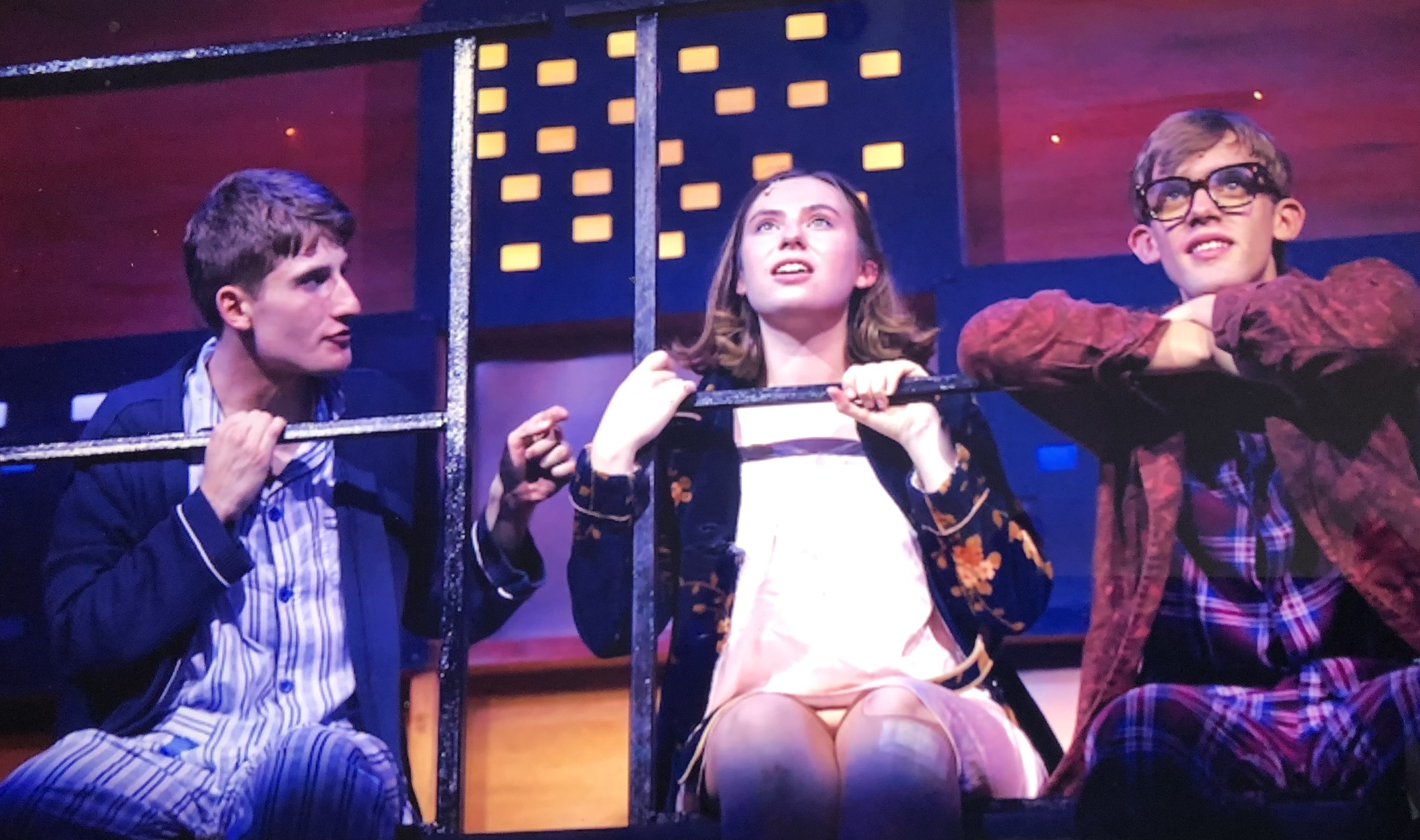
Chronologically, Merrily We Roll Along falls between two masterpieces in the canon of Stephen Sondheim. It emerged at a time when the legendary composer/lyricist had reached his absolute peak, yet the 1981 musical achieved none of the initial Broadway success of Sweeney Todd…, which preceded it and Sunday in the Park With George, which followed it. Acclaimed London productions at the Donmar Warehouse in 2000 and the Menier Chocolate Factory (later West End) in 2012 helped to restore the show’s reputation and get it back to be re-evaluated in New York.

Chronologically, the narrative of Merrily… rolls along in reverse gear, possibly a reason why some audiences have struggled to grapple with it, and it presents many challenges to a company reviving it, not least to an amateur one, as is the National Youth Music Theatre (NYMT), performing here. Poignantly, friendships are fragmented and then formed, the disappointments and disillusion of middle age melt into the joyful optimism of youth.

George Furth’s book is adapted from a 1934 play of the same name by George S Kaufman and Moss Hart, but it is believed that Sondheim saw the show as partly autobiographical. The story centres around the friendship of Franklin, Charley and Mary, formed when they are all in their early 20s. Franklin (Toby Owers) is a brilliant composer and he is a magnetic force, but he wallows in the trappings of his success and is careless with his personal relationships. Charley (Thomas Oxley), a lyricist who collaborates with Franklin to create hit musicals, is much more down-to-earth and Mary (Madeline Morgan) is a struggling writer.

Beginning in 1976, when success has brought its rewards and taken its tolls, the show traces the friendship back to 1960, when the Kennedys are newly elected to the White House and, in a similar fashion, the trio see themselves as “the movers…the shapers…the names in tomorrow’s papers”. Foreknowledge of outcomes drapes scene after scene with ironies which Sondheim exploits masterfully.

In the early stages, this production tends to become sluggish between songs and director Katherine Hare does not find the big performances needed to lift it; however, quite naturally, these young actor/singers grow in confidence as the show progresses. With a company of 27 accompanied by a superb orchestra of 11 players, Hare’s revival would be judged lavish by modern West End standards.

Numbers such as Old Friends and Our Time hare become standards in the Sondheim songbook and the former will lend its title to a tribute show in honour of the great man, coming to the West End in Autumn 2023. Most importantly, the singing here is flawless, showing full appreciation of the exquisite lyrics. In addition to the three leads, Matilda Shapland and Sophie Lagden have particularly striking solos.

One big regret is that NYMT’s production is here for five shows only. The consolation is that most of these rising stars should be around to entertain us for many years to come.

Performance date: 24 August 2023

Photo: Geraint Lewis

Writer: Ian Hallard

Director: Mark Gatiss

⭐️⭐️⭐️

Almost 50 years after Abba exploded onto the stage of the Eurovision Song Contest, the popularity of the Swedish band shows no signs of diminishing. Sharing its title with that of an Abba song, the Birmingham Repertory Theatre’s production of Ian Hallard’s comedy The Way Old Friends Do arrives for a limited rub in London’s West End. Telling the story of the rise and fall of a gender reversed Abba tribute band, the play harks back to the glittering days of floral shirts, kipper ties, flared trousers and platform shoes.

In 2015, when Mamma Mia! was in only the 17th year of its West End run, up in the West Midlands Peter (Hallard) and Edward (Anton Tweedale) hook up on Grindr and then realise that they are old friends from school 20 years or so earlier. Edward was planning to be unfaithful to his husband, while Peter, an Abba fanatic, is worried about revealing his bisexuality to his Nan, whose voice, heard over the telephone, is unmistakably that of Miriam Margolyes, even with a thick Brummie accent. Equally unmistakeable is the voice of the late Paul O’Grady, heard as a radio presenter. He could have taught these aspiring dancing queens a few things about performing in drag.

Encouraged by Peter’s close friend Sally (Donna Berlin), the old friends develop the idea of forming an Abba tribute band, with Peter becoming Agnetha and Edward Anni-Frid. Delightful cameos from Rose Shalloo as Jodie/Björn and Sara Crowe as Mrs Campbell/Benny boost the laughs as quick fire gags and camp clichés are rolled out. The jokes may be predictable, but they contribute to a boisterous first act of solid warm-hearted fun.

This is a lighter form of comedy than that most commonly associated with director Mark Gatiss, but the tone and the pacing of his production are just about perfect until the play hits the buffers in the middle of the second act. Snippets from Abba tracks are heard at scene changes throughout, but we are denied the chance to see the tribute act performing until a glitzy finale and this leaves a gaping hole which is felt most acutely when the play starts to take things too seriously. 

Christian (Andrew Horton), an over-enthusiastic young fan, arrives and begins to drive a wedge between Peter and Edward. Famously, members of Abba themselves underwent difficulties in their personal lives which were reflected in the lyrics of their songs and the writer seems to enjoy the irony of a tribute band suffering a similar fate. Unfortunately, while the play dwells for too long on the band’s demise, it is neither convincing nor amusing.

Hallard manges to pull the play back near the end by reminding us of the fun of these super troupers. It is frustrating that the laughs quota is not sustained consistently throughout the evening, but, in these gloomy days, we need to be grateful for all the cheer we can get.

Performance date: 18 August 2023

The Garden of Words (Park Theatre)

Posted: August 16, 2023 in Theatre

Writer: Makoto Shinkai

Adaptors: Susan Momoko Hingley and Alexandra Rutter

Director: Alexandra Rutter

⭐️⭐️⭐️⭐️

With the hugely successful My Neighbour Totoro returning to the Barbican Theatre in November 2023 and Spirited Away due to arrive at the London Coliseum in 2024, Japanese anime is rapidly becoming all the rage in providing source material for stage productions. Following the trend, this version of Makoto Shinkai’s 2013 film The Garden of Words plants itself in North London, where it is receiving its Worth Premiere.

Defying the Disney traditions that animated films are based on fantasy and aimed primarily at children, Shinkai tells a human story with dark, adult undertones and, in its account of isolation inside a vast, densely populated city, it is more reminiscent of a live action film, Sofia Coppola’s Lost in Translation, also set in Tokyo. The first question hanging over this adaption concerns how a 46-minute film can be extended to 105 minutes on stage, even accepting that 20 minutes of the excess can be attributed to what feels like an intrusive and totally unnecessary interval. Thankfully, the increased running time does not mean that the garden grow a surfeit of words.

Director Alexandra Rutter’s production relies heavily on highlighting cultural divisions, making aspects of Japanese life seem strange, almost mystical to a United Kingdom viewer. The strangeness leads to enchantment and, when it is applied to reality rather that fantasy, even the grubbiest details of flawed human lives become more enthralling. Coordinated movement by the company of seven expresses emotions and daily activities, piano music composed by Mark Chol plays incessantly and a sinister black bird swoops and soars around the garden.

Cindy Lin’s set design is dominated by a large impressionist backdrop depicting urban greenery in front of high rise buildings. It is in this garden that Takao, a 15-year-old boy meets Yukari, a 27-year-old woman on a rainy morning rainy and, on every subsequent morning when it rains, they meet again, unarranged, exchanging food and poetry. Hiroki Berrecloth gives a remarkably assured performance as Takao, combining naiveté and maturity, while Aki Nakagawa’s Yukari has the air of a lost soul who is deeply disillusioned and is planning an escape from the city.

Takao skips school and is caught up in a dysfunctional family life. His mother (Susan Momoko Hingley) is frequently absent from the home and his older brother (James Bradwell) is planning to move in with his actress girlfriend (Iniki Maricano). Takao dreams of becoming a shoemaker. Yukari, a school teacher, is the subject of ugly rumours involving also her head teacher (Mark Takeshi Ota) and a provocative pupil (Shoko Ito).

Just as the platonic friendship between Takao and Yukari is slow to develop, so this production takes its time to flower, not coming into full bloom until the final third. When the stories and the imagery eventually coalesce, the emotional kick is powerful. It is all strangely beguiling and strangely beautiful.

Performance dare: 15 August 2023

Photo: Carla Joy Evans

Writers: Gertrude Robins and HM Harwood

Director: Melissa Dunne

Three for the price of one!  Director Melissa Dunne’s production brings together Makeshifts and Realities, two short plays by Gertrude Robins, with Honour Thy Father by HM Harwood. All three were written and are set in the early years of the 20th Century and their common theme is the struggles by women to lead independent lives.

Makeshifts sees two sisters considering their options for the future. Sharp-tongued Dolly (Poppy Allen-Quarmby) is a teaching assistant at an infants’ school and the quieter Caroline (Philippa Quinn) is a domestic servant. Two potential suitors come into their lives: Henry (Akshay Sharan) is meek and brings the sisters sweets, while Albert (Joe Eyre) is brash, boastful and seen as a much more exciting catch. However, Albert’s visit proves teasing when he eventually announces his betrothal to a better connected woman, Rose. So, should the sisters remain independent or should one of them grasp the makeshift option of marrying Henry?

Moving forwards two years, Realities begins with Caroline and Henry married and parents to a baby son. Caroline receives a visit from Rose (Beth Lilly) who turns out to be a sneering social climber, obsessed with material possessions, She gives the first hint that her marriage to Albert may not be going well and this is confirmed later when Albert himself calls on the couple, very drunk. Maybe Henry was not second best after all.

The ironically titled Honour Th Father is set in Bruges, the city in which a bankrupt upper class English family is effectively exiled. The patriarch,  Edward (Andrew Hawkins) is a pompous hypocrite who is addicted to gambling. His long suffering wife, Jane (Suzan Sylvester) struggles as best she can to manage finances, but the family depends on support from older daughter Claire (Allen-Quarmby), who had stayed behind in London to earn her own living. 

The fact that this play was banned from being performed in public for many years after it was written gives a strong clue as to the source of Claire’s earnings, a shocker indeed for post-Edwardian England. In exposing the double standards of well-to-do society, Harwood enters territory explored around a decade earlier by George Bernard Shaw in Mrs Warren’s Profession, but the play makes its own points about the sacrifices that women make in order to forge independent lives.

Dunne’s staging is carefully paced, finely detailed and beautifully acted. The production is enriched by Carla Joy Evans’ period costume designs and sets designs by Alex Marker, which make imaginative use of a space that can often be difficult. if understanding the past helps us to understand the present, these three plays, seen together, provide an absorbing and eye-opening account of our social history.

Performance date: 10 August 2023

Spiral (Jermyn Street Theatre)

Posted: August 6, 2023 in Theatre

Writer: Abigail Hood

Director: Kevin Tomlinson

⭐️⭐️⭐️

Sometimes, people can cling on to things, even though common sense dictates that they should let go. Perhaps this could include clinging to the forlorn hope that a person who has gone missing will return or to the wreckage of a relationship that is doomed. In linked storylines, Abigail Hood’s play Spiral, first performed at London’s Park Theatre in 2018, explores both these scenarios.

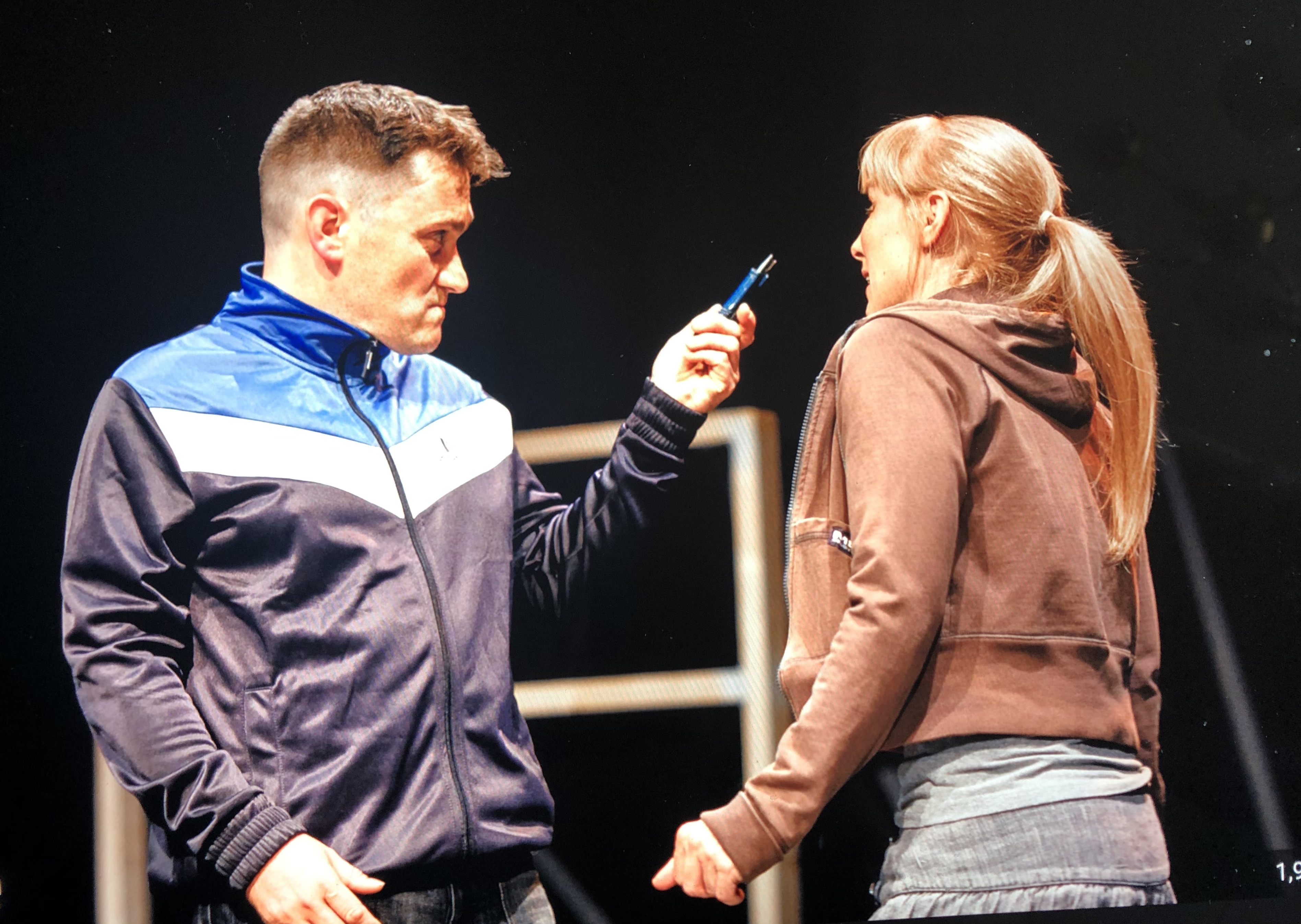
Gill (Rebecca Cranshaw) and Tom (Jasper Jacob) are a middle-aged married couple whose 15-year-old daughter had gone missing on her way to school several months earlier. The Police assume that she is either dead or has run away from home as her own choice. Gill deals with the situation by turning to religion and drink. Tom, a school teacher, is facing disciplinary proceedings for allegedly behaving inappropriately with a female student and he compensates for the absence of his daughter by hiring a young escort to wear school uniform and act out domestic scenes. Inevitably, Gill and Tom drift apart.

The writer herself plays the escort, Leah. Her boyfriend, Mark is played by Kevin Tomlinson, who also directs this production. Mark, unemployed, acts as Leah’s pimp, but is overcome by fits of extreme jealousy of the clients with whom she is spending time. His behaviour becomes controlling, aggressive and physically violent, made worse when Leah’s relationship with Tom turns into a platonic friendship in which Tom sees himself as Leah’s protector. Here, the writer tackles the burning modern issue of domestic abuse  head on, demonstrating the horror of Leah’s plight with great clarity.

Tantalisingly, Hood sets up the elements for a taut psychological thriller, but never commits fully to taking the play in that direction, opting instead for a straightforward emotional drama which succeeds only in patches. The problem is that the characters are not given sufficient depth for them and their dilemmas to become completely believable, the writer resorting too often to bland clichés when sharper insights are what is needed.

Undoubtedly, the scenes which wield the most power are those in which Tomlinson’s volatile and menacing Mark collides sickeningly with Hood’s confused and vulnerable Leah. Perhaps these characters merit their own play, but, for now, they reveal Hood to be a young writer of some potential and promise better work to come.

Performance dare: 4 August 2023

Disruption (Park Theatre)

Posted: July 14, 2023 in Theatre

Photo: Pamela Raith

Writer: Andrew Stein

Director: Hersh Ellis

⭐️⭐️

This review is written by a living, breathing human being, a point that seems worth making in view of the imminent advance of Artificial  Intelligence (AI). Hopefully the same declaration can be made by Andrew Stein with regard to his ultra-modern morality tale, unfortunately titled as the press performance coincides with widespread disruption on the London Underground.

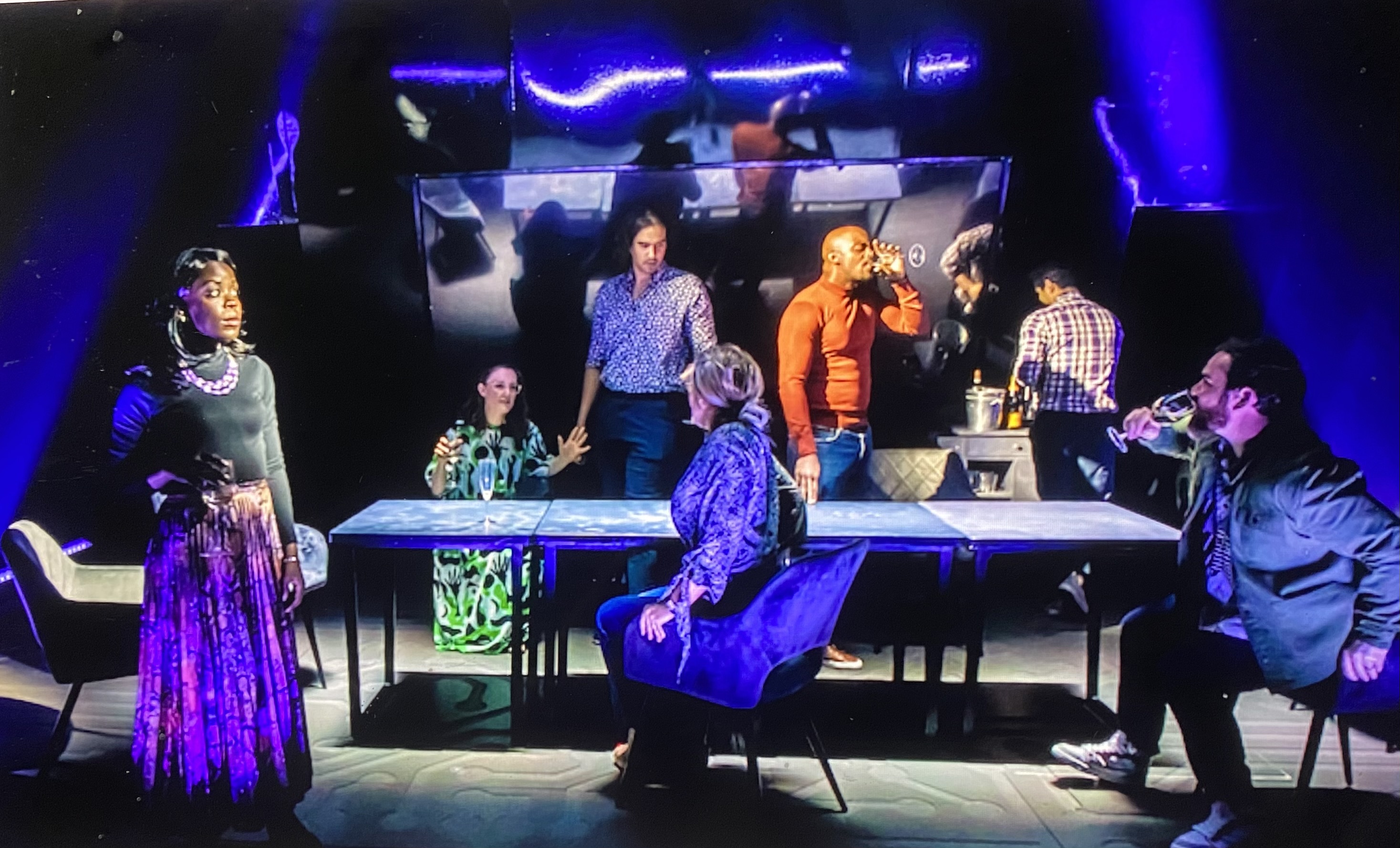
Oliver Alvin-Wilson brings a Satanic presence to the role of disruptor-in-chief whose name is Nick (obviously). His challenge is to persuade three old friends, all New Yorkers, to sell their souls to him by investing in the development of a new all-seeing, all-doing algorithm. He claims that George Clooney has already jumped on board, so it must be a safe bet. Nick’s sidekick in this venture is the alluring Raven (Sasha Desouza-Willock), the character presumably named in honour of master of the macabre Edgar Allan Poe.

The three friends – Ben (Nathaniel Curtis), Paul (Nick Read) and Barry (Kevin Shen) – are involved in tangled relationships with three women – Mia (Rosanna Hyland), Suzie (Debbie Korley) and Jill (Mika Simmons). The algorithm promises to provide the answers to all life’s key dilemmas, such as: should we buy a run-down brownstone property in Brooklyn that we can’t afford? Should we have a baby? Should we stay married?

Tracking the ups and downs of six self-obsessed, angst-ridden New York professionals, the play often resembles a triple bill of Friends episodes, strung together and modernised. There seems to be no situation that cannot be improved with a wisecrack, suiting Stein’s liking for piling on the clichés. Dire warnings of the dangers of AI, along the same lines as those issued by our politicians almost daily, are incorporated into the script, but they become secondary to the relationship stories and the devilish Nick disappears into the background in the second act.

No on-stage chair is left unmoved in director Hersh Ellis’s brash, futuristic staging, which comes with projected images and, briefly near the end, bizarre movement. A special mention also goes to lighting designer Robbie Butler for dazzling us with special effects, although some sections of the audience could appreciate more effort being put into making all the actors visible.

Jumping on the bandwagon of our newest cause for collective paranoia, Disruption is slick, smart and empty, more disappointing than disrupting. If this is a glimpse into the theatre of the future, let’s give AI a chance to do better..

Performance date: 13 July 2023

Cuckoo (Royal Court Theatre)

Posted: July 13, 2023 in Theatre

Photo: Manuel Harlan

Writer: Michael Wynne

Director: Vicky Featherstone

⭐️⭐️⭐️

The pressures of the modern, ever-changing world could become enough to drive many of us to a bout of severe agoraphobia. Michael Wynne’s amiable new family-based comedy explores this possibility through the plight of Megyn, a recent school leaver without qualifications, prospects or ambitions, who locks herself away to become a cuckoo in her grandmother’s nest.

In a town in Northwest England, four women gather for their evening meal at the home of Doreen (Sue Jenkins), who had been widowed four years earlier. Her daughter Sarah (Jodie McNee) teaches at a school in an area of social deprivation and her other daughter Carmel (Michelle Butterly) is a sales assistant at a branch of Boots in a dying High Street. 17-year-old Megyn (Emma Harrison), Carmel’s daughter, sits quietly, barely touching her food, before shooting off upstairs to Doreen’s bedroom.

The women discuss depressing news stories that flash up on their smart phones – international terrorism, climate change and so on – painting a picture of a hostile world outside their cosy family unit. Frequently, their conversations are interrupted by the sounds of ring tones as it becomes clear that their phones dominate their lives. Doreen is addicted to trading on E-Bay, Sarah scrolls down photos of someone that she does not even know, they text each other while in the same house and Megyn sleeps with her mobile phone in her hand. Perhaps, Sarah decides, the only way to make real contact is to turn off the broadband.

Peter McIntosh’s set design, a nondescript living room with a shabby red fitted carpet, provides the perfect backdrop for the family as they devour their takeaway fish and chips supper. Actually, director Vicky Featherstone’s production stops well short of patronising northerners, but Wynne’s writing is patchy in finding the level of piercing wit, drawn from everyday language, that might have flowed naturally from, say, Alan Bennett. 

The four performances are consistently engaging, fleshing out the characters as much as the script allows, but, on the few occasions when the audience is asked to invest in them emotionally, the warmth is lacking. At times, it feels as if the comedy needs the women to be played  more as outright caricatures, conflicting with the human stories which require them to be played as recognisable real people. Crucially, while concentrating on the social by-products of the internet age, the writer does not find a way to articulate adequately Megyn’s inner turmoil.

Wynne’s play takes aim at a wide range of serious and complex targets, while perhaps fewer would have given it sharper focus. This, together with the play’s comedic approach, means that it amuses but it never really takes flight.

Performance date: 12 July 2023

Photo: Craig Fuller

Writer: AJ Yi

Director: Emily Ling Williams

⭐️⭐️⭐️⭐️

When viewed from half a world away, anti-government protests look very different from what is experienced amid the turmoil. Cleverly, AJ Yi’s play A Playlist for the Revolution looks at the 2019 Hong Kong uprisings from both perspectives. Their play is receiving its world premiere at the Bush Theatre.

Yi lures the audience in with opening scenes which promise a teenage romcom, but then they take us to the heart of a modern political struggle. Jonathan is a 19-year-old Maths undergraduate at Hong Kong University; attired in a neat designer suit and tie, he is conventional and a little stuffy, but he is conflicted between the pull of his conservative roots and the pressure to react to a new reality.

Jonathan plays the piano, preferring Chopin over Beethoven, but he strives to become more Chinese. In relation to the growing protest movement, he is a “blue” (ie neutral). He meets Chloe, of similar age, who is visiting from London; she is of Hong Kong origin, but had moved overseas with her family many years earlier; she adores Beyoncé and is much more chilled out than Jonathan. Her stance on the uprisings is “yellow” (pro), even though she hates Coldplay.

Chloe returns to England after the brief encounter, but the couple remain in touch via various internet platforms and they put together joint playlists of songs with revolutionary themes. Meanwhile, Jonathan is becoming influenced by a much older college janitor, Mr Chu, who had taken part in protests over several decades. Encouraged by his new friend and by more gentle coaxing from afar by Chloe, Jonathan moves towards becoming a “yellow”.

The first act of director Emily Ling Williams’ stirring open stage production feels slightly overlong, as the play dances around its key themes rather than addressing them directly. However, Yi’s skill in blending drama with comedy is hugely impressive and this quality in their writing is strengthened by a tremendous performance from Liam Lau-Fernandez as Jonathan. He is boy and then man, passionate and then comical, utterly convincing at all times.

Mei Mei Macleod exudes youthful energy as the seemingly carefree Chloe. Her sympathies lie with the pro-democracy protesters, but she only has to watch from the sidelines, never imagining becoming directly involved. Zak Shukor is both funny and moving as the battle-hardened and lusty Mr Chu, talking of his lady friends as he assembles Molotov cocktails.

A fiery second act ends in anticlimax with an epilogue that does not really work, but Yi’s sadness at the stifling of individual expression under an increasingly authoritarian regime shines through clearly. The play’s core messages are heavy, but they are never allowed to weigh it down and moments of delicate humour spring out in the most unexpected places. The outcome is a play that is as entertaining as it is enlightening.

Performance date: 29 June 2023