jacques-brelThis review was originally written for The Public Reviews: http://www.thepublicreviews.com

To avoid confusion, Jacques Brel died in 1978 aged 49, near to Paris and no suggestion is being made of his resurrection. This show is a revue of the Belgian-born singer/ songwriter’s work which first appeared in New York in 1968 and was revived there with great success in 2006. It was last seen in London in 1997. Chris de Wilde’s set resembles a shabby Parisian night club, with a five-piece band on stage and tables at the front of the stalls. The ambience that this creates makes an instant suggestion that the show could be best enjoyed with a full glass of wine to hand, giving encouragement to wallow in the melancholic music. Using Eric Svejcar’s arrangements, Dean Austin’s band, often featuring prominent accordion, gives the evening a distinctive French flavour. Brel’s lyrics reflect lives well-lived and hard-lived, enriched by love and loss, tenderness and pain, passion and despair. In Brussels, he tells of childhood frolics and the company dances like marionettes, dressed in Chaplin outfits. But Brel’s childhood was to be interrupted by war and his music career was to develop in its aftermath. In Statue, a dead soldier comes to life to rebuke those defacing his memorial, a mother laments for her lost boys in Sons Of and, in Next, a young man rails at the indignity of conscription. The spectre of World War II hovers above many of the songs in this revue, yet Brel’s chief preoccupation seems to be with the emotions of ageing. In the bleak Old Folks, he writes of old people in the third person, but in most of his lyrics, he reminisces in a very personal way, showing a remarkable understanding of an age group that he, himself, barely reached. Fittingly, the company is made up of two performers in middle age and two younger, all have their own solo highlights and combine well with each other in duets and company routines. These are four accomplished actors who sing well, but, more importantly, they milk the songs for their dramatic effect, aided by choreography from Sam Spencer-Lane. David Burt, looking dishevelled and world weary, recollects the raucous days of his youth, when he was called Jackie; speaking some lines, finding all the gravel in his voice and varying the tempo, he gives a unique rendition of the song, as different as it could be from the famous Scott Walker version. Later, he offers comedy, rising repeatedly from his own coffin to sing Funeral Tango. Eve Polycarpou brings maternal warmth and, in all her songs, she rises to the crescendos in the style of Piaf. Particularly striking is her delivery of Brel’s best known song, If You Go Away, which she sings in French (Ne Me Quitte Pas), sitting on the edge of the stage strumming an acoustic guitar, whilst back projection shows passengers leaving Charing Cross station. Gina Beck creates an image of tarnished innocence, singing I Loved with resentment towards a man who cheated on her, but finding the resilience to end the song with “I forgot his name” and, later, with My Death, she faces up with resolution to her own mortality. After the passion shown in Statue, and the rage of Next, Daniel Boys gives a memorable, tender interpretation of the beautiful love ballad, Song for Old Lovers, showing clear joy whilst celebrating a relationship that has come through turbulence and survived. There are lighter songs, but, in general, they work less well than the poignant ones and the show ends with an anthem of hope as the company joins together for the slightly corny If We Only Have Love. Jacques Brel is rarely heard these days and Andrew Keates’ confident, well performed production gives us a welcome reminder of a great talent.

Performance date: 18 October 2014

thepublicreview_hor_web copy

TheTrialsOfOscarWilde_EuropeanArtsComapny-EvolutionsPhotoThis review was originally written for The Public Reviews: http://www.thepublicreviews.com

Showcase trials of celebrities are commonplace nowadays, but the Victorians led the way with two 1895 trials involving the writer Oscar Wilde that have continued to fascinate ever since. Writers Merlin Holland (Wilde’s grandson) and John O’Connor have based this play on the original words spoken during the trials, the first of them being the libel action brought by Wilde against the Marquis of Queensbury for accusing him of indecent acts with men and the second being the consequential criminal prosecution of Wilde for committing those acts. The script is laced with the wit of Wilde himself, but the fact-based format restricts the writers’ ability to delve into Wilde’s character in the way that, for example, David Hare did in The Judas Kiss. Therefore, he needs to rely very heavily on actor John Gorick’s excellent interpretation. Arrogant and slightly flamboyant, standing often with one hand on hip, this is a Wilde who is always putting on a performance for the court, exuding wit and intellectual authority. Yet there are moments in Gorick’s performance when the mask slips and Wilde’s underlying terror is revealed; particularly memorable is the frozen smile that appears when it suddenly dawns that the evidence that he is giving is only serving to incriminate him. Rupert Mason and William Kempsell play the opposing barristers in both trials with suitable gravitas. They also double up as all the minor characters, including a disparate string of witnesses in trial 2. Here Peter Craze’s production makes its only wrong move, because these witnesses are inevitably reduced to comic characters, thereby putting their veracity into question and upsetting the balance of the drama. Sitting in this cramped space, it often feels as if the audience is being asked to become the jury. Yet what is there to judge in these more enlightened days when Queensbury’s accusation would be deemed trivial and Wilde would have broken no law? The answer is that we are being asked to assess the motives of both Wilde before and during the trials and of the society that condemned him. Wilde dug a hole for himself in trial 1 and carried on digging in trial 2, but what fascinates is the reason why he ever picked up the spade.  The explanation offered here is that Wilde had become so absorbed in an ethereal world that he had lost touch with reality, unable to distinguish between theoretical concepts and physical acts. Sadly, he was 73 years ahead of his time and he overlooked the fact that his vision, based on the classics and writers such as Shakespeare, was out of step with the laws of the era in which he lived. As to whether or not the juries reached the correct verdicts, Holland’s play is inconclusive. However, it is made clear that Wilde’s superior manner would have alienated those in the court rooms, making it more likely that the juries would have wanted to knock him off the pedestal on which they saw him. It is for this reason that Wilde’s fall from grace reverberates so strongly today when, time after time, the media and the public collude to bring down high profile figures. Humiliated and made to serve a sentence of two years hard labour, Wilde was never to recover and he died at the age of 46 in 1900. His plays and other works live on.

photo: Evolutions Photo

Performance date: 14 October 2014

thepublicreview_hor_web copy

intothewoods29jul2014w200h200This review was originally written for The Public Reviews: http://www.thepublicreviews.com

“Be careful of what you say, children may listen” warns Stephen Sondheim in a show which delves into the grim side of fairy tales and asks us to consider what we are telling our kids and how well we are equipping them to cope with the adult world. Mixing various stories together in the first half and muddying the path to their resolutions, the show then proceeds to tell us that none of the characters live happily ever after, in an often disturbing second half, which issues stark warnings as to how harsh life (and death) can really be. Dating from 1987 when Sondheim was at his peak, Into the Woods will soon gain wider recognition with the release of the long-awaited film version. In advance of that event, this small theatre near to the edge of Waltham Forest, invites us to join an array of well-known characters – Cinderella, searching for her prince; Little Red Riding Hood, visiting her grannie; Jack, climbing his beanstalk; Rapunzel, escaping confinement; and the Baker with his wife, trying to resolve their infertility problem – and share their experiences in woody terrain. The show’s intricate lyrics carry the unmistakable mark of Sondheim and the score must rank amongst his finest, with songs that are comic, romantic, hopeful and despairing linking perfectly together. Cinderella’s Prince (Josh Pugh) and Rapunzel’s Prince (Tim Phelps) both seen here as arrogant toffs, share the wonderful Agony, venting their frustration at their failure to seek out their respective loves; and Helena Raeburn, as the Witch, pleads to her disaffected daughter with a heartfelt rendition of Stay With Me. For all its many treasures, this is not a show without problems. James Lapine’s book always risks falling between two stools, being too dark and, narratively, too complex for small children and too childish for grown-ups. It needs a constant flow of inventive comedy to carry it through the first half and sincere, convincing performance to carry it through the second. Tim McArthur’s well-judged production does well on both counts. With a few exceptions, this is a very young company and, in one instance, a son looks much older than his father. Of course, youth means energy, which is here in abundance. However, Raeburn, heavily disguised as a hunchbacked bag lady and then turning into an embittered, possessive mother upon losing her powers, does not yet have the maturity to be the perfect Witch. Amongst the more seasoned performers, Paul Hutton and Jo Wickham, as the Baker and his wife, are outstanding. Hutton makes a stirring pacifist plea to end the arboreal mayhem, singing No More, and then duets with Annie Kirkham (as Cinderella) for the lovely, soothing lullaby No One Is Alone. Wickham flirts with Cinderella’s Prince as they sing the mischievous Any Moment before dissolving two more of the first half’s happy endings. These examples typify a production which is beautifully sung throughout, accompanied by a five piece band under the direction of Aaron Clingham. Gregor Donnelly’s set, a leafy glade with a stage covered in wood shavings, provides intimacy with the audience as well as plentiful space for the large cast to move around and make their many rapid entrances and exits. Into the Woods is a far from easy show to stage well, so congratulations to all involved with this production. They have just about nailed it.

Performance date: 10 October 2014

thepublicreview_hor_web copy

Damn Yankees**** (Landor Theatre)

Posted: October 8, 2014 in Theatre

Damn Yankees (c) Roy TanThis review was originally written for The Public Reviews: http://www.thepublicreviews.com

The 1950s was a damn good decade for Broadway shows. Their energy and good humour reflect what seem like more innocent times and their enduring popularity indicates that they have become a beacon of light in a more cynical modern world. The Richard Adler and Jerry Ross musical The Pajama Game was revived to acclaim in Chichester and then London recently and now it is the turn of the same team’s Tony award winning follow-up, an unlikely marriage of Baseball and Faust, to reappear. Bringing to life every sports fan’s fantasies, the show sees Joe Boyd (Gary Bland), a Baseball-addicted, overweight couch potato, do a deal with the Devil and transform into the fresh-faced, athletic Joe Hardy (Alex Lodge), joining his beloved Washington Senators team to help depose the all-conquering Yankees. But he ought to have been more careful of what he wished for, because he soon begins to doubt whether all the fame and riches that ensue can equal the worth of plain domesticity and a loving, dutiful, stay-at-home wife. Yes, of course, after toying with immorality, the book by George Abbott and Douglass Wallopp soundly endorses all the values of the middle America of 60 years ago, giving out just the messages that Broadway audiences of that era wanted to hear. The dated nature of the book may have seemed less significant had all of the Adler/Ross songs been top class. However, only two of them, the Coach’s pep talk, (You’ve Gotta Have) Heart and the seduction song, Whatever Lola Wants, have become standards. The rest are somewhat disappointing and the singers here often struggle to give the solo numbers any life. That said, Robert McWhir’s production skips lightly over most of the cracks in the show’s foundations, the 20-strong company giving a terrific ensemble display. The exuberant chorus line sings to raise the celling and dances to rattle the glasses in the bar below. Choreographer Robbie O”Reilly works miracles in cramming so much action into so little space and the accompanying three-piece band, directed by Michael Webborn, fills the room with pulsating rhythms. As the Devil, aka Mr Applegate, Jonathan D Ellis is slimy, malevolent and oh so camp. In displaying over-confidence, Ellis is certainly acting in character, but he sometimes seems too aware that he is potentially the evening’s star comedy turn and, in his showcase number, Those Were The Good Old Days, he goes a little over the top. Playing his accomplice, Lola, Poppy Tierney is more convincing as the lost girl who had sold her soul than as an irresistible temptress. Scaling down a big Broadway musical to fit into this small space above a pub in Clapham must have presented quite a challenge, made more difficult by the show being dated and not really out of the top drawer. However, McWhir and his company have taken a mighty swing at it and, for sheer entertainment value, they have ended up hitting a winning home run.

Performance date: 7 October 2014

thepublicreview_hor_web copy

4 minsJames Fritz’ new one-act play unfolds like a detective story, making it difficult to elaborate too much on the plot details. Suffice to say that the title relates to the duration of an intimate film clip involving two teenagers, which goes viral on social networks. The pair themselves are almost incidental to the story – 17-year-old Jack never appears and his (now ex) girlfriend Cara (Ria Zmitrowsicz) turns up in just a few short scenes. This is a play about the dilemmas of parenting in the age of the internet, focussing on Jack’s pushy mother Di (Kate Maravan) and his “boys will be boys” father David (Jonathan McGuinness). Fritz examines clashes between family devotion, social responsibility and ethics in the role of parenting, whilst throwing in a discussion on the dividing line between consensual sex and rape. The play is structured as a succession of short scenes, all involving no more than two characters (predominantly Di and David) and Anna Ledwich’s stripped down production, with the audience seated on either side of an oblong stage, always holds the attention. Two very strong central performances from Maravan and McGuinness also help to keep us gripped, but the characters’ words and deeds stretch the boundaries of credibility and lead us to question whether the play’s whole central premise is fundamentally flawed. Worse still, as the plot becomes progressively less believable in the later stages, so do the characters, leaving us not really caring too much for them or about them. As a result, this play is always interesting, but rarely moving.

Performance date: 6 October 2014

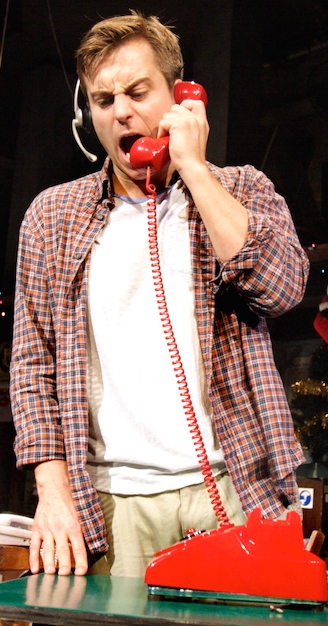
menier chocolate factoryIn 2004, I paid my first visit to the newly-opened Menier Chocolate and fell in love with the place instantly. Even before The Shard towered above it in the near distance and Borough Market had undergone its makeover, something magical had descended upon what had been a dreary and neglected area of London. That first production was Fully Committed, a small-scale, one-man play which gave few clues as to the treasures that were to follow.  Glossing over the ghastly Paradise Found, the Menier has effectively re-defined musical theatre for London, scaling down big shows, many by Stephen Sondheim, to fit into a studio setting. This revival is a happy reminder of that first visit. The play’s only character is Sam, a resting actor who operates the telephones and takes the bookings for a chic, in-demand New York restaurant. Written by Becky Mode and directed by Mark Setlock, who was Sam in the first production here, the play is a frantic hour of non-stop comedy in which Sam speaks not only as himself but also as the voices at the other end of the phones – diners desperately seeking reservations, the ogreish chef, the maitre d’hôte, his own father, his agent, a fellow actor gloating that he has got a part, etc. With no computers in sight, Sam takes all the reservations by hand, thereby making the play look at least ten years out of date, but, otherwise it is as fresh as when it first appeared. Here, Sam is played by the British actor/comedian Kevin Bishop who gives a virtuoso display of voice mimicry and facial contortions, taking us through the piece at breakneck speed; he also brings to the character a quality of real likability which draws us in and makes us root for him as he juggles the priorities of making bucks, furthering his acting career and staying close to his family. Highly entertaining.

photo: Catherine Ashworth

Performance date: 3 October 2014

blueDid you know that William Shakespeare once lived in Shoreditch? He did and, to commemorate the fact, RIFT is presenting two cycles of new short plays, performed at various locations during a walking tour of the borough. On a chilly but dry evening, I saw the cycle of five plays (rather four and a film) on The Hoxton Path. The works reflect an area in which traditional London is meeting modern London, where jellied eel stores and sushi bars trade side-by-side and where social housing estates stand proud, resisting the creeping onset of gentrification. Three Loose Teeth by Thomas McMullan features three characters and takes place in a side alley. Touching upon marital infidelity, domestic violence and vagrancy, it has an edgy feel, but needs a sharper focus. Disnatured by Sabrina Mahfouz takes place in a small flat and is a monologue by a young woman, damaged by a horrific childhood incident and embittered by social injustice in the old Hoxton; rather than seeking revenge, she has reconciled herself to playing the game and becoming part of the new Hoxton. Beautifully written and acted, this play is a moving study of subdued anger. The Isle is Full of Noises is a short film (shown in an open shed) by James Soldan and Katie Lambert; the supernatural story concerns a vagrant who befriends and assumes the voice of a teenage girl. Shot in bleak urban locations, it is intriguing and creepy. Community Payback by Ali Muriel is performed in a small park by two good-humoured rappers with some audience participation; it is witty and has a twist in the tail which, although not new, works brilliantly here. This little gem is pure fun. Finally, The Best Pies in London by Abi Zakarian takes place in a real pie shop, splattered with blood for the occasion; here a lady who looks as if she is auditioning for the part of Mrs Lovett in Sondheim’s Sweeney, recounts a gory tale centring on the contents of her pies. This play is predictable, but well done. It all adds up to an unusual and entertaining Autumn evening stroll.

Performance date: 4 October 2014

Seminar**** (Hampstead Theatre)

Posted: October 2, 2014 in Theatre

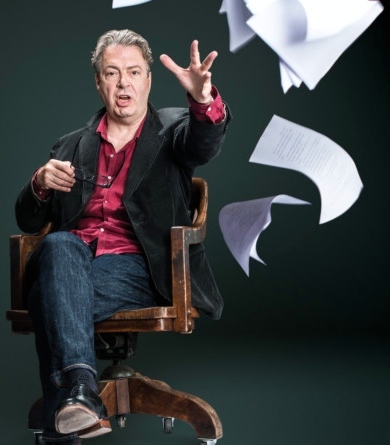
seminarThere is something warmly satisfying about seeing a character actor, who has given immeasurable pleasure in quality productions over the years, finally being elevated to name-above-the-title status. Bill Nighy was an example and now Roger Allam has established himself firmly alongside him. Theresa Rebeck’s play is the sort of semi-intellectual froth that American audiences seem to lap up, but Allam stands astride it like a giant. He plays Leonard, a writer, editor and tutor for aspiring novelists. Paid an exorbitant fee, he takes under his wing four young writers and, in between trips to Somalia, fronts a series of seminars, mostly devoted to dumping heaps of destructive criticism all over their efforts. Kate (Charity Wakefield), a Kerouac-hating feminist, acts as hostess in her dad’s large apartment on New York’s Upper West Side (beautifully realised in Lez Brotherston’s set) and she is the first victim of Leonard’s bilious onslaughts. Next up is Douglas (Oliver Hembrough), who uses long words to mask the fact that he is talking complete rubbish; advising him that his work is hollow, Leonard tells him that he will find a lucrative career in Hollywood. He is kinder to the nymphomaniac Izzy (Rebecca Grant), paving the way to bedding her, but has to reserve judgement on the diffident, hotheaded Martin (Bryan Dick) when he refuses to show his work. Allam revels in playing a monster; his world weary demeanour and sardonic delivery are a joy from start to finish, papering over many of the cracks in the script. Rebeck dissects the modern literary world and charts the shifting relationships between her five characters, but inconsistencies in her arguments and her characterisations abound, credibility often becoming stretched. At least once too often, one character reads about half a page of another’s work and declares it to be “a great novel” or some such. It is tempting to suggest that Rebeck could be the real life equivalent of Douglas, except that her target is Broadway rather than Hollywood; and guidance from a Leonard figure could possibly have taught her how to round off a story rather more convincingly than in this play’s clumsy final scene. Nonetheless, her dialogue often crackles, Terry Johnson’s light-touch direction always ensures that we never take things too seriously and Allam spearheads a quintet of sparkling performances. In the end, despite the play’s flaws, this production provides just about as much good light entertainment as anything currently running in London.

Performance date: 2 October 2014

Ring* (Battersea Arts Centre)

Posted: October 1, 2014 in Theatre

For those of us old enough to remember, the advent of stereophonic sound in the late 1960s was a time of wonder. It seemed a miracle that Paul Simon could sing to us in one ear, whilst, at the same time, Art Garfunkel was singing into the other. This show plays upon the same sense of discovery; we hear voices in the distance, voices closer, voices to our left, right, front and rear and then someone whispers into our ears. The only problem is that the novelty of stereo wore off almost half a century ago. Sitting in complete darkness and wearing headphones, we are firstly told that the seating is being moved to form a circle and we hear the shuffling of chairs. Then the presenter opens a discussion with what he claims to be members of the audience, but that deceit is blown to smithereens in about 30 seconds when it becomes clear that the actor-like voices that we are hearing are, in fact, those of actors. The publicity for this show claims that it “places the audience at the heart of a thrilling attack on their own identity”, but maybe that is as tongue in cheek as a press quote which declares a show, the essence of which is that nothing is visible, to be  “an absolute must see”. The same experience could be achieved by sitting at home and listening to a radio play (hopefully one better than this) with the lights off, which many may feel would have been a more profitable way of spending the evening.

Performance date: 1 October 2014

Electra***** (Old Vic)

Posted: October 1, 2014 in Theatre

electra2014 is turning out to be an unforgettable year for the Old Vic as it moves from one triumph to another. The decision to re-configue the auditorium to in-the-round was inspired, so memo to Messrs Spacey and Warchus: this is a space that London theatre cannot afford to lose. Here, the auditorium becomes a Greek amphitheatre; the stage is set as the forefront of a palace, the imposing doors of which have concealed betrayal and murder. Electra is the female equivalent of Hamlet in the simplest sense, her father, Agamemnon, having been slain and her mother, Clytemnestra, having married his killer. Hamlet is shackled by indecision, Electra by female frailty and she looks to the return of her exiled brother, Orestes to gain the vengeance with which she has become obsessed. Sophocles’ play, here using Frank McGuinness’s lean and lucid translation, is not a tragedy, it is a revenge thriller and director Ian Rickson piles on the tension in every scene, using original music by PJ Harvey to ratchet it up. It never matters that the casting pays little regard to relative ages, because almost every part of the production and every performance is totally mesmerising. Diana Quick is fearsome as Clytemnestra, a woman who, when told that her son is dead, enquires whether there will be anything in it for her. Jack Lowden, a heroic Orestes, could well become regarded as a lucky talisman for leading actresses; in the Almeida’s Ghosts, he played opposite last year’s Olivier award winner and it will be major shock if he does not do the same this year. As Electra, Kristen Scott Thomas is magnificent. Playing very much against type, she appears in a plain robe with hair dishevelled, howling and raging in grief and frustration. She and the chorus of three women turn the stage into a cauldron of hatred, but it is her demonstration of uncontainable joy that is likely to remain longest in the memory – waving her arms, touching, hugging, smelling what she has seen, but still disbelieving what her eyes have told her. The production meanders just a little in the middle, but, at 100 minutes straight through, there is rarely time to draw breath and the final third scales the heights of theatrical magic. Electrafying!

Performance date: 30 September 2014