The Me Plays**** (Old Red Lion Theatre)

Posted: September 4, 2014 in Theatre

the me playsThis review was originally written for The Public Reviews: http://www.thepublicreviews.com

Short, rotund and 30-ish, Andrew Maddock has the look of a miniature James Cordon, which makes him perfect to perform these two monologues in the guises of laddish Londoners, known simply as “Me”. But then he would be perfect, because they are described as “semi-autobiographical” and he wrote them. The plays are humorous and poignant reflections on life at a time when childhood and teenage years are gone and the harsher realities of the adult world are coming into focus. Maddock has taken the risk of writing the plays in rhyming couplets, which could have made them feel over-stylised, but the gamble pays handsome dividends. Each time that he delivers a successful rhyme, Maddock the actor seems to exude a glow of satisfaction which underscores the essential cockiness of both characters. In Junkie, “Me” is a self-conscious loner, addicted to drugs and the internet. He has set up a date with Tabatha, with whom he only communicates by text and, acting on her insistence that must wear red, he visits Top Shop to find only a tight-fitting jumper which accentuates exactly what he most wants to hide.  The digital age is supposed to have made meeting girls easier, but, for “Me”, it has done the opposite. He posts the most favourable images and descriptions of himself on dating sites, assuming that others will do the same, but, knowing that the average first date lasts just 12 minutes, he is overcome by trepidation when the time comes to reveal the truth. Ultimately, the habit which this character finds hardest to break is loneliness. Hi Life, I Win sees “Me” hospitalised, undergoing tests and facing up to his own mortality. He looks back on growing up in the 1990s, fondly remembering Grandad Fred whose death was followed by a family break-up and his own drift into unruliness. To put him back on the straight and narrow, he was sent to a religious centre in London Colney and given guidance by “Arizona Dan”, an adherent of God and Loudon Wainwright III. This “Me” has a not particularly likeable past, but there is something deeply moving about seeing him fall to his knees sobbing, a teenage thug now humbled by fate. As he takes random fragments of his life – family, acquaintances, education, religion – and starts to piece them together, he seems to be realising that his existence could have some meaning, even if he cannot yet figure out what it is. The Me Plays are insightful and sobering, yet they always entertain, adding a touch of poetry to the regular monologue format. Andrew Maddock is a talent to be watched.

Performance date: 3 September 2014

thepublicreview_hor_web copy

Emilia Galotti*** (Barons Court Theatre)

Posted: September 2, 2014 in Theatre

LessingThis review was originally written for The Public Reviews: http://www.thepublicreviews.com

Abuses of power, taking advantage of wealth, position or celebrity, are not a new phenomenon and their examination here give this 1772 play by the German writer Gotthold Ephraim Lessing particular topical relevance. The play concerns The Prince of Guastalla, the overlord of a region in Italy who becomes besotted with the towns girl of its title, setting off a tragic chain of events. Written as a socio-political commentary on 18th Century European life, the play highlights the conflicts between aristocratic rule and the new enlightenment of the Bourgeoisie who sought to cast aside ancient traditions and privileges. Emilia, supported forcefully by her father, claims the right to choose her own suitor and finds the advances of the Prince repulsive. Performed today, plays from this period can often come across as comic melodramas, and Dr Mark Ewbank’s production, which has costumes that look as if they come from last Christmas’s Cinderella, often walks a very thin line between comedy and tragedy. The production crosses the line towards comedy in scenes involving the Prince. Che Watson, bewigged and decked out in green velvet, makes this character a foppish buffoon whose lustful eye would seem more likely to be fixed on the nearest mirror than to wander towards Emilia. Fortunately, Ewbank gets weightier performances in other prominent roles. Samuel Haughton is creepily effective as Marinelli, the Prince’s scheming and duplicitous fixer and Peter Wheal-Jones brings real power and conviction to the role of Emilia’s father. As Emila, Roseanne Lynch has a beguiling innocence, but it is Francesca Burgoyne who steals a large chunk of the second half; as the Prince’s spurned lover, she plots a ruthless revenge and, in a delightful touch, she leads the audience in a slow handclap to celebrate having sown the seeds of destruction. This play is at its most interesting when it focusses on the plight of its female characters who are striving to assert some measure of independence in a male dominated world. In this sense, it was very much ahead of its time. Ewbank’s production does well in bringing these themes to the fore and, although it is at times uneven in its tone, it builds to a strong, dramatic climax.

Performance date: 1 September 2014

thepublicreview_hor_web copy

Henry IV Cinema posterDid Shakespeare invent the comic book super hero? Hal, the dissolute, debauched young man who is disconnected from his family, but transforms into the all-conquering warrior Prince, may have always fitted that bill, but now even more so in Gregory Doran’s production, which re-enforces the image with the emergence of an over-the-top super villain. Trevor White’s Hotspur, with bleached blond hair, crazed for revenge, unpredictable and almost demented, would be the perfect opponent for Superman or Batman and he is the most original and striking feature of this vivid interpretation of what is, arguably, The Bard’s most thrilling play. Alex Hassell makes an affable, but lightweight Hal, more convincing in the taverns of Cheapside than on the battlefields of Northern England, but, in the context of an everyman thrown into “saving the World”, he is perfect. Jasper Britton is also excellent as the newly-crowned King, still uncertain of his grip on power after deposing Richard II so ruthlessly and constantly casting nervous glances over his shoulder. Of course, this is a play that is always there to be stolen by the actor playing Sir John Falstaff and, living up to expectations, Antony Sher is absolutely magnificent in the role, exuding all the charisma that would have drawn the wayward Hal towards him. Sher has distinguished himself in most of Shakespeare’s prominent character parts, but he has now become a brilliant physical comic, as seen when he first appears, emerging from under the sheets at the foot of Hal’s bed, just as two buxom ladies are departing, or when his rotund figure lies prostrate on the battlefield, faced with the near-hopeless task of rising to his feet unaided. Yet, for all the clowning, Sher captures perfectly the pathos of a once gallant knight, now sadly diminished by the ravages of the bottle. Doran’s direction focusses on the play’s traditional qualities, but his production is modern, crisp and quick moving, making full use of the uncluttered, projecting stage. Part II is usually a more difficult play, but it will be fascinating to see how this excellent company tackles it.

Performance date: 28 August 2014

(A review of Henry IV Part II will appear here later in the year, after the transfer of these productions to the Barbican Theatre in London)

Dogfight*** (Southwark Playhouse)

Posted: August 24, 2014 in Theatre

Dogfight 6 Laura Jane Matthewson (Rose Fenney)  Jamie Muscato (Eddie Birdlace) Photo Darren BellAlthough Peter Duchan’s book for this 2012 American musical is actually based on a 1991 film drama, its story – three young US marines go out to enjoy one last night in the big city before setting sail to war the following morning – brings to mind Leonard Bernstein’s On the Town and, once that thought has become lodged in the head, everything that follows looks pale in comparison. Yes, that is an unfair way to view this show, just as it may be unfair to bemoan the fact that it falls below the exceptional standards set by Southwark Playhouse with recent musicals. Therefore, before going on, it is worth saying that there is much to enjoy in this production and, overall it is not really that bad, just flawed. The story is told in flashback – possibly a mistake as the first scene gives too much away. The setting is San Francisco and the date is 21 November 1963 – it is not clear why this is made so specific, as there is no strong connection with the world-shattering event of the day after. The Vietnam war is in its early stages and the marines have little idea of what to expect as they play their traditional game of “dogfight”, the offensive misogyny of which casts an ugly shadow over the first half of the show. The game then leads on to a trite and predictable romance between one of the marines, Eddie Birdlace (James Muscato) and a waitress, Rose (Laura Jane Matthewson). Both leading performance are excellent and they get top class support from a company of nine. Individually, the songs by Benj Pasek and Justin Paul are quite pleasing, but they lack distinctiveness and variety, with the result that, cumulatively, they have a dampening effect, increasing as the show progresses. This feeling of a show that is always diminishing in strength is not helped, in Matt Ryan’s production, by most of the choreography being in the early scenes, leaving very little of it for a generally lacklustre second half. Dogfight is not a disaster, just a disappointment.

Performance date: 23 August 2014

The Lion***** (St James Studio)

Posted: August 22, 2014 in Theatre

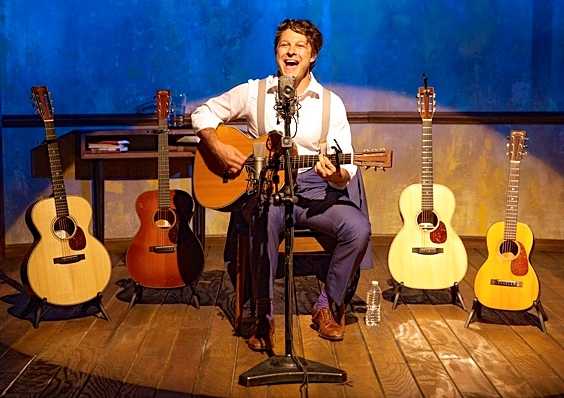
the lionSt James Studio is more like a cocktail lounge than a 1960s-style folk club; gone are the smoke and the seediness, but it is here that the spirit of Guthrie, Seeger and Dylan lives on. Coming from a privileged background, Benjamin Scheuer is perhaps more suited to this air of opulence; financial hardship and political activism do not influence any of his lyrics, yet the songs are heartfelt expressions of the pain and joy of living. This is a 75 minute solo gig in which Scheuer perches on stools and accompanies himself on six guitars (five acoustic, one electric), paying tribute to a father who instilled in him a love of music. “The Lion” is a metaphor for the courage to face life’s challenges head on and, here, Scheuer’s autobiographical lyrics take us through a troubled relationship with his father, an ill-fated romance and a battle with cancer. The storytelling is vivid and deeply moving and the music complements the words perfectly. Scheur’s voice is crystal clear, rich and mellow, with touches of gravel when the lyrics are at their most anguished. There is nothing new or earth-shattering here, but this show is exquisite in its simplicity and very close to perfection.

Performance date: 21 August 2014

Maureen Beattie in The Carousel, in EdinburghThe third of a trilogy of plays by French Canadian writer Jennifer Tremblay, The Carousel relates the stories of three generations of women, all seeking to come to terms with their links to each other and with their places on the carousel of life. A granddaughter speaks to her now departed grandmother who had seemingly cherished her sons, but rejected her only daughter, the girl’s mother; they rake over traumas in the family’s history and and they try to understand how these experiences will help the girl as she moves forward. All three characters in this superbly written but complex piece are played by the same actor, switching frequently from one to another, and this leads to difficulties in connecting with the narrative in the early stages. However, the emotional power increases as the play progresses, thanks largely to wonderful acting by Maureen Beattie. At this performance, Beattie stopped the play early on, because of an unexplained noise, informing the audience that she could not allow anything to interfere with the intense concentration which she needs. Once the play restarted, her reasons quickly became clear. This deeply moving play gets a true powerhouse performance.

Performance date: 15 August 2014

brazoukaIt’s Mardi Gras in August! This carnival of colour, high energy and rhythm is performed by a company of 16 dancers, weaving together lambazouk (lambada dance and zouk music) with other styles, celebrating primarily the culture of Brazil. The show is a collection of spectacular dance sequences, linked very loosely by a script, written by Pamela Stephenson Connolly, which tells of the quest by Braz Dos Santos to bring lambada to Europe. Brazouka does exactly what it says on the tin – it gives solid, undemanding entertainment and there is nothing not to like about it.

Performance date: 15 August 2014

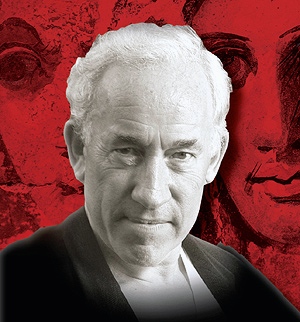
fringe- quarter page template.inddSimon Callow is the master of one-man shows dedicated to cultural icons – Shakespeare, Dickens, Wagner – but who has ever heard of Juvenal? Well, he was a scabrous satirist living in Rome around the 1st Century AD and this show is a collection of his writings, adapted by Richard Quick to give them a modern slant. A vulgar misogynist, he rants against just about everything that comes into his view, but mere rudeness is no substitute for wit and, sadly, the novelty of his outbursts wears thin very quickly. This show could be an uproarious success if performed as an after dinner entertainment for Oxbridge Classics scholars and Callow appears suitably dressed for such an occasion. A few of Juvenal’s observations are relevant to the present day, but the rest are all pretty obscure and there is far too much repetition. Callow’s flamboyant, actorly style is always a joy to behold, but, otherwise, this show has little to recommend it.

Performance date: 15 August 2015

diana riggDame Diana Rigg describes her one-woman show as “an entertainment”, but, for a budding theatre blogger, it is more a tutorial. Developed from her book of the same name, first published 25 years ago, Dame Diana’s talk relates to bad reviews given to herself and to fellow thespians over a period of more than 1,500 years, although she expands it to give a potted history of theatre. Much of the time she reads from a rather dry script (it is very tempting to write something really poisonous at this point in an attempt to get included in volume 2 of the book), enlivened only by occasional delightful anecdotes about “Larry”, “Ralph” and the like in her days as a walk-on – one of these, relating to Vanessa Redgrave, is as cutting as any critic could muster. Eventually, Dame Diana sets the script aside and becomes herself, a delightful, relaxed and witty lady. It is just a pity that she could not have done this earlier.

Performance date: 15 August 2014

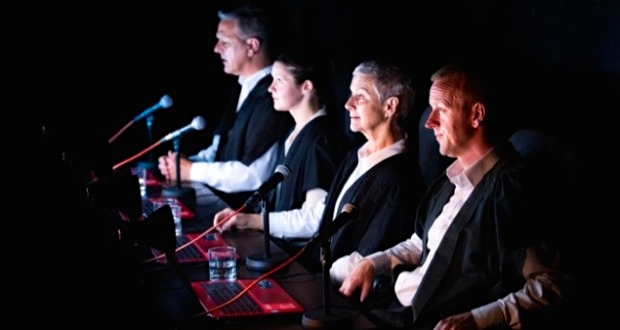
Horizontal-Collaboration-Traverse-Theatre-620x330The technique of getting actors, different for every performance, to read a play “blind” is not new (for example White Rabbit, Red Rabbit which is playing again at this Festival). Horizontal Collaboration, written and directed by David Leddy, requires four actors of either gender, any race or age, to appear in white shirts and judges’ robes, sit behind a long desk and read from computer screens. On this particular occasion, four middle-aged white actors, two men, two women, took the roles. Their characters are presiding over a War Crimes tribunal in The Hague and summarising the testimonies given so far. What follows resembles a suspense thriller of high intrigue, with twists and turns at every corner in a plot which concerns tribal conflicts in an unnamed African country and the less than reputable involvement of United Nations peacekeepers. So, how is this different from listening to an audio book? In reality, not much, except that, with the actors having no prior knowledge of the material, they have little opportunity to dramatise their delivery. Perhaps it is expected that actors will be visibly and audibly taken aback by plot developments, but, at this performance, all four were completely professional and read out their lines in a plain, matter of fact manner. However, all that really matters is that the presentation is effective in getting the story across, because this play is all about that story and it’s a cracker!

Performance date: 15 August 2014

This play is double-billed with a film entitled “City of the Blind”, made exclusively for smart phones or tablets