Photo: Pamela Raith

Writer: Shomit Dutta

Director: Guy Unsworth

⭐️⭐️⭐️⭐️

Neither Samuel Beckett nor Harold Pinter was particularly averse to baffling audiences, but how would the two playwrights have fared if coming face to face with each other? Shomit Dutta’s new short play sets out to answer that question and it is, perhaps inevitably, an absurdist comedy.

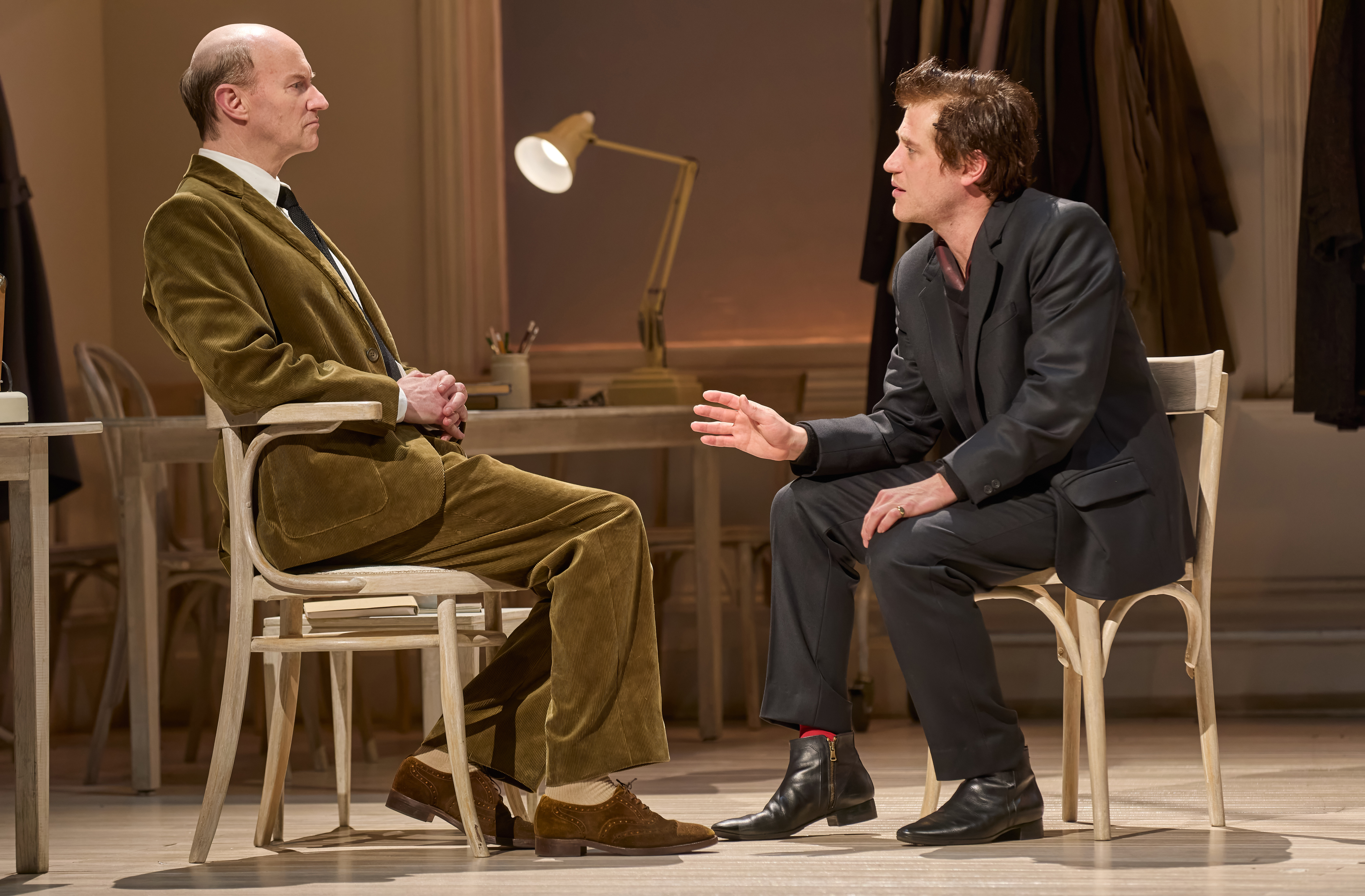
Beckett had earned an entry in Wisden while playing cricket for Trinity College Dubli in 1928, while the much younger Pinter had developed a lifelong obsession for the sport, playing as an amateur in charity match for Gaieties CC. The play imagines a 1963 match taking place in a remote Cotswold village in which both writers play. Dutta’s play was originally staged at Lords’ for streaming and it now finds a home a short walk along the road at Hampstead Theatre.

The play involves a lot of waiting. At first, Beckett and Pinter are in the pavilion, padded up, waiting nervously to be called to bat. After both are out and inquests have begun, they wait again for someone or something. Yes, of course, this is Waiting for Godot meets The Dumb Waiter and references to both works abound, as nonsensical developments become shrouded in mystery.

Stephen Tompkinson’s Beckett has a nonchalant air, brandishing his worldly experience to mock Pinter’s modest skills as a cricketer and perhaps in other respects. Andrew Lancel finds a close resemblance to Pinter’s public persona, making him a dour and humourless man who takes himself, his cricket and everything else far too seriously. Together, they are less Vladimir and Estragon than Morecambe and Wise, opposites who draw the comedy from their differences.

It cannot be denied that some knowledge of theatre or cricket or both would be a helpful aid to appreciating Dutta’s in jokes, but director Guy Unsworth’s breezy production has enough good laughs to get by anyway. David Woodhead’s set design, framed as if it is a painting in the National Gallery, is inventive and bathed in the pastel colours of a Summer afternoon.

Stumped has few more ideas than a typical student revue sketch, but it bats out its 70-minute innings effortlessly, raising many a chuckle along the way. It is all completely pointless and that is exactly the point.

Performance date: 26 June 202

Photo: Johan Persson

Music: Harry Warren

Lyrics: Al Dublin

Book: Michael Stewart and Mark Bramble

Director: Jonathan Church

⭐️⭐️⭐️💫

In the middle of America’s Great Depression in 1933, people needed cheering up and the Hollywood film 42nd Street, drawing from the mythology of Broadway, set out to fill that need. So what has changed in 90 years?

The film was adapted into a stage musical which first opened in New York in 1980 and at London’s Theatre Royal Drury Lane in 1984, where it was revived in 2017. This latest revival, touring the United Kingdom, started life at the Curve Theatre, Leicester. It is scaled down somewhat from the spectacular 2017 production, but it still boasts more than enough hoofers and tappers to set the stage ablaze and choreographer Bill Deamer does excellent work in setting them on their way.

The book by Michael Stewart and Mark Bramble follows rehearsals for a new show, starting out in Philadelphia and moving to Broadway. Director Julian Marsh (Adan Garcia) is a hard task master and he is lumbered with a fading star, Dorothy Brock, who has not had a hit for 10 years. Ruthie Henshall seems to relish spitting out Brock’s bitchy lines. The company is joined by the gifted ingénue, Peggy Sawyer, who clearly has the potential to step into the leading role and, guess what? She does.

Nicole-Lily Baisden faces a stiff challenge to live up to the hype in the script about Peggy’s talents, but she pulls it off with aplomb. Sub-plots pop up and fizzle out, with stalwarts such as Josefina Gabrielle and Les Dennis on hand to bolster the comedy when it flags (as it often does), and the entire company looks gorgeous in 1930s costumes, designed by Roberts Jones.

The songs, including standards such as I Only Have Eyes For You, We’re In the Money and Lullaby of Broadway, roll by and the brass section of Jennifer Whyte’s orchestra works overtime. However, many of these songs were written originally by Harry Warren and Al Dublin for other ventures and were already hits before being parachuted into the 1933 film. When the songs do not fit seamlessly into the action, this is probably the reason. The roots of modern jukebox musicals go deeper than perhaps we thought.

The staging of the musical numbers is exhilarating, but, when the orchestra goes quiet and the chorus lines drift into the wings 42nd Street goes into gridlock and there is little that director Jonathan Church, getting scant help from the book, can do to inject life into the show. Yes the tale of a young girl being catapulted from obscurity to stardom is uplifting, but it is also corny and predictable, lacking sufficient substance to carry an entire musical by modern day standards.

42nd Street can be summed up as a dozen or so showstoppers in search of a show, but, when those showstoppers are laid on with as much piled-up pizzazz as here, audiences can be forgive for not noticing other shortcomings.

Performance date: 14 June 2023

Paper Cut (Park Theatre)

Posted: June 13, 2023 in Theatre

Photo: Stefan Hanegraaf

Writer: Andrew Rosendorfh

Director: Scott Huran

⭐️⭐️⭐️💫

When the Americans finally pulled out of Afghanistan in 2021, they took back with them many battle scars, both physical and mental. Andrew Rosendorf’s incendiary 90-minute dram examines unflinchingly the impact of the conflict, directly or indirectly, on four gay men.

Callum Mardy is remarkably powerful as Kyle, a soldier who has had the bottom half of his body blown away by an IED (improvised explosive device). Returning to the United State, he is faced with the challenges of rebuilding his life, but he is unable to find the confidence or the support that he needs in order to do so. Offers to help arrive, but they are rejected out of misplaced pride and stubbornness. 

Flashbacks to the conflict show Kyle’s burgeoning romance with a lower-ranked soldier, Chuck, played with passion and warmth by Prince Kundai. However, Kyle puts up barriers when they return to the US, fearful that his severe injuries would become a blight on Chuck’s life. He turns to Harry (Tobie Donovan), a former High School friend, but their reacquaintance brings little comfort.

Kyle’s reunion with his estranged brother, Jack (Joe Bolland) brings discussions of the men’s relationship with their late father, also a military man, which allows Rosendorf to interrogate modern values of masculinity. The brothers’ attempts to heal wounds from the past and find unity to tackle the future are quietly touching.

Jumping backwarrds and forwards in time, the play’s early scenes are a little confusing and they need clearer points of reference. However, the writer’s thoughtful approach compensates for other shortcomings and Marty, an actor with disabilities comparable to Kyle’s, is a tower of strength throughout.

Occasionally, the strength of the acting in director Scott Huran’s gripping production tends to over-value the writing, which lapses into slightly stilted dialogue and becomes repetitive. Sorcha Corcoran’s design, setting a dozen hanging strip lights against a plain backdrop, creates an austere vision which suits the play’s stark and visceral elements well, but is less successful in supporting scenes of human emotion.

Paper Cut takes the audience on a painful journey and it belies its title by making deep incisions to explore the psychological traumas  resulting from warfare. It is a sobering reminder that the casualties of conflicts go far beyond any list of fatalities.

Performance date: 12 June 2023

Writer: Jacob Marx Rice

Director: Alex Howarth

⭐️⭐️💫

With no weddings and umpteen funerals, Jacob Marx Rice’s new play certainly lives up to its title, except perhaps for the brevity of the list. It is often said that Shakespeare’s tragedies can be summed up with the words “they all die”, but Marx Rice strives to outdo Hamlet and Macbeth combined.

The play addresses how we deal with mortality, both our own and that of those around us. Grace (Vivia Font) struggles with it first when she is four years old in 1983 and her dog Buster dies. She blames her parents (Alejandro De Mesa and Kathryn Akin) for not allowing her to say goodbye. She grows and forms a close platonic friendship with Jordan (Siphiwo Mahlentle), who suffers from depression and is prone to suicide attempts. Later, she enters into a romantic partnership with Cass (Amelia Campbell), they adopt a son, Melaku (Mahlentle again) and the circle of life and death goes on.

Spanning more than eight decades of loss and renewal, the play is broken down into shortish scenes, each of which is built around the death of a person or a family pet. When every new scene begins, we ask who is for the chop this time, making the play feel repetitive and predictable. It is this lumbering structure that does more than anything else to undermine the writer’s worthy ambitions.

Marx Rice is a New Yorker and the play’s setting is Irish America. Accordingly, the actors assume American accents and it feels that the dialogue would not have sounded right if spoken in any other way. A mix of homespun philosophy and syrupy sentimentality gives the drama a distinctively American feel, its tone bringing reminders of Thornton Wilder’s Our Town. At times, it is almost as if James Stewart could be about to walk in through the door.

For all its gloom, Marx Rice’s script is not bereft of humour and director Alex Howarth applies a light touch to break up the solemnity. Making imaginative use of the Finborough Theatre’s intimate space, his production is particularly notable for the committed and versatile performances of the five actors, who move between ages and emotions with great comfort.

There is no shortage of ideas in this play and often the writer expresses them beautifully. However, they need to be knocked into better shape and packaged with more precision. As the play approaches the end of its 90-minute running time, it seems fair to believe that it has not been brief enough.

Performance date: 18 May 2023

.

Performers: Liza Pulman and Joe Stilgoe

⭐️⭐️⭐️⭐️

Liza Pulman and Joe Stilgoe began their professional partnership during lockdown, she in her kitchen and he in his garden shed. From the worst of times comes the best of times.

After the spectacle of Eurovision, there could be no greater contrast than this. No flashing lights, no dancers, no deafening noise; just two performers singing songs, every one of which is worth douze points. Most noticeable of all is the emphasis put on the songs’ lyrics, all delivered with absolute clarity, so that the work of master lyricists such as Johnny Mercer (‘not the Tory politician”) are dusted down, polished up and presented as if brand new. The melodies are not bad either.

Pulman possesses a pitch perfect musical theatre voice and Stilgoe’s nimble fingers make a single grand piano do the work of a full orchestra. Both come from show business families. She has the philosophy:  “life is too short not to sing the songs that you love” and she sharpened her comedy skills with Fascinating Aida. He could have developed his natural flair for writing and performing routines that combine music with comedy by picking up a thing or two from his famous father.

The primary source of material for this two-hour show (including interval) is the Great American Song Book, updated to include the likes of Billy Joel and Randy Newman alongside Irving Berlin, Hoagy Carmichael and so on. Some of Stilgoe’s original songs are thrown in too, but, oddly, the duet that gives the show its title is omitted. There are cultural references which may go over the heads of anyone in the audience under 70, but, whether it comes from nostalgia or from discovery, the joy is plentiful.

Pulman’s soulful rendition of songs such as the blissfully melancholic The Folks Who Live on the Hill contrasts with Stilgoe’s comic mash-up of pieces ranging from Nellie the Elephant to Duran Duran’s Rio. However, two duets stand out; the Rodgers & Hammerstein songs People Will Say We’re in Love and If I Loved You, from different shows but saying essentially the same thing, merge together wonderfully. After that, the 1925 Henderson/Dixon classic Bye Bye Blackbird is united with the 1968 Beatles’ song Blackbird to memorable effect.

The cue is given to pack up all your cares and woe and head for wherever this couple of swells are on stage next. Summing up appropriately with a line from a Cole Porter song: “What a swell party this is!”.

Performance date: 15 May 2023

Photo: Alesandro Castellani

Writer: Gareth Farr

Director: Tess Walker

⭐️⭐️⭐️⭐️

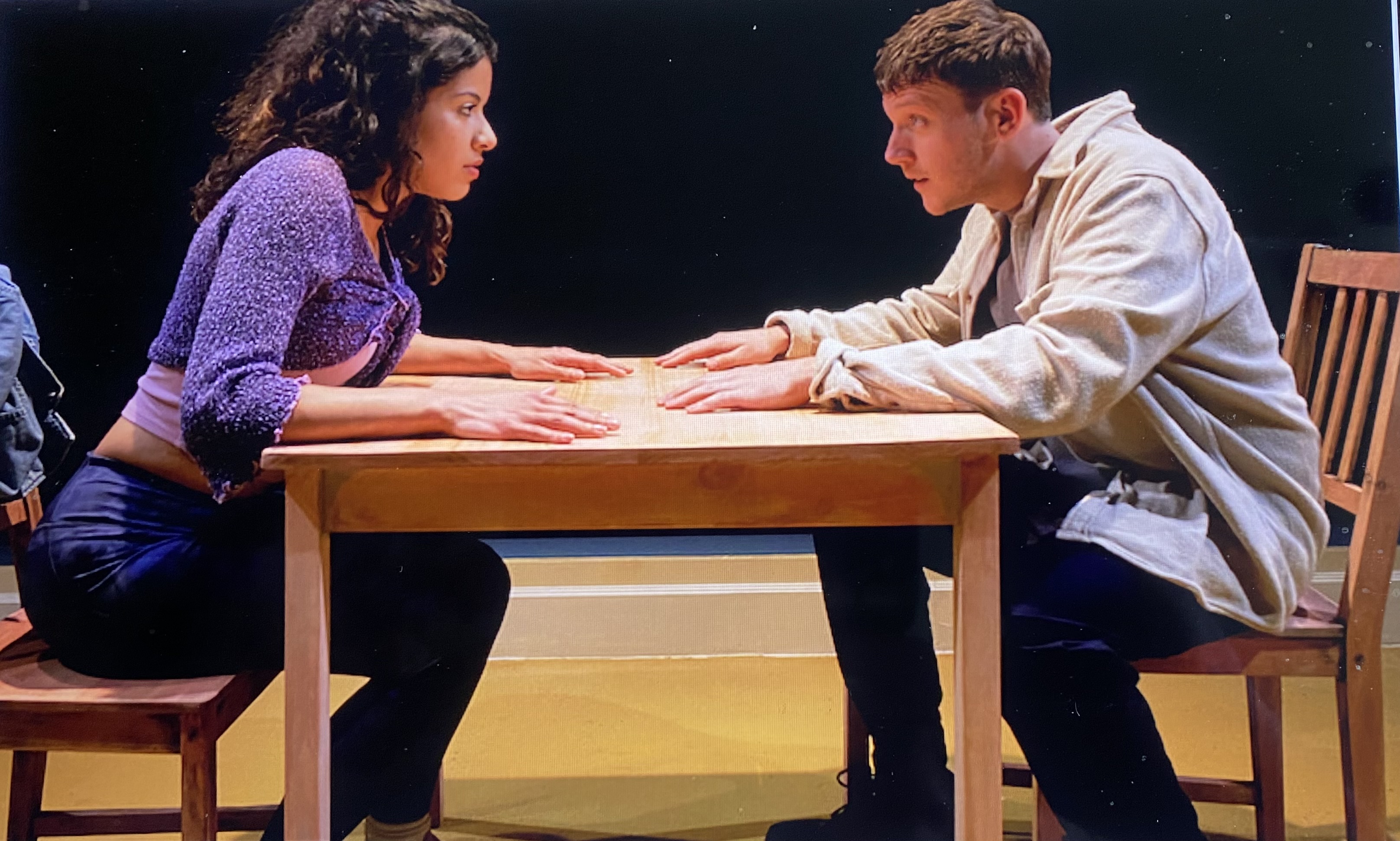
Should the pleas from one generation to “do better” be a spur for members of the following generation to strive for success or a millstone round their necks? Gareth Farr’s new one-act play poses that question. Biscuits for Breakfast is a deeply touching, yet defiantly unromantic relationship drams set in a modern day Britain in which Michelin-star restaurants stand alongside food banks.

When Paul (Ben Castle-Gibb) and Joanne (Boadicea Ricketts) first meet, their defensive walks are already built, constructed out of pride and stubbornness. What divides them is more apparent than what connects them. Persistently, Paul plays tapes of conversation between his younger self and his late father, a humble fisherman, who is urging him to make a better life for himself by developing his flair for cooking. When the play begins, Paul is a trainee hotel chef and Joanne is a cleaner in the same coastal hotel, without any clear goals in life. He conjures up delicious casseroles, while she can only offer pot noodles.

The drama cooks slowly at first. The edgy flirtation is a verbal tango and then Paul invites Joanne to his place to share a fish pie. The closure of the hotel means the loss of both jobs and of Joanne’s accommodation, so she moves in with Paul, thereby sealing the relationship just at the time when the couple’s lives are about to go into free fall.

Farr begins to paint a picture of a society in which ambitions are thwarted and ordinary working people are driven into poverty by limited job opportunities, low wages and soaring inflation. Cleverly, the writer achieves this without letting the play’s focus drift away from the central human story.

Director Tess Walker’s production on a traverse stage has energy, simplicity and intensity. The two actors are superb, conveying the shifting dynamics of their characters’ relationship through turbulent times. They make Paul and Joanne real people, in most ways unremarkable, but each of them is recognisable as “one of us”.

While Paul clings on to his father’s words and his dreams of writing a best-selling cookery book, Joanne becomes the pragmatist, realising that, if the pair can no longer feast on gourmet food, they must at least eat something. Everything about Farr’s play rings true and it should serve as a wake up call to anyone who is prone to taking comfortable lifestyles for granted..

Performance date: 11 May 2023

Photo: Ellie Kurtz

Writer: Somerset Maugham

Director: Tom Littler

⭐️⭐️⭐️

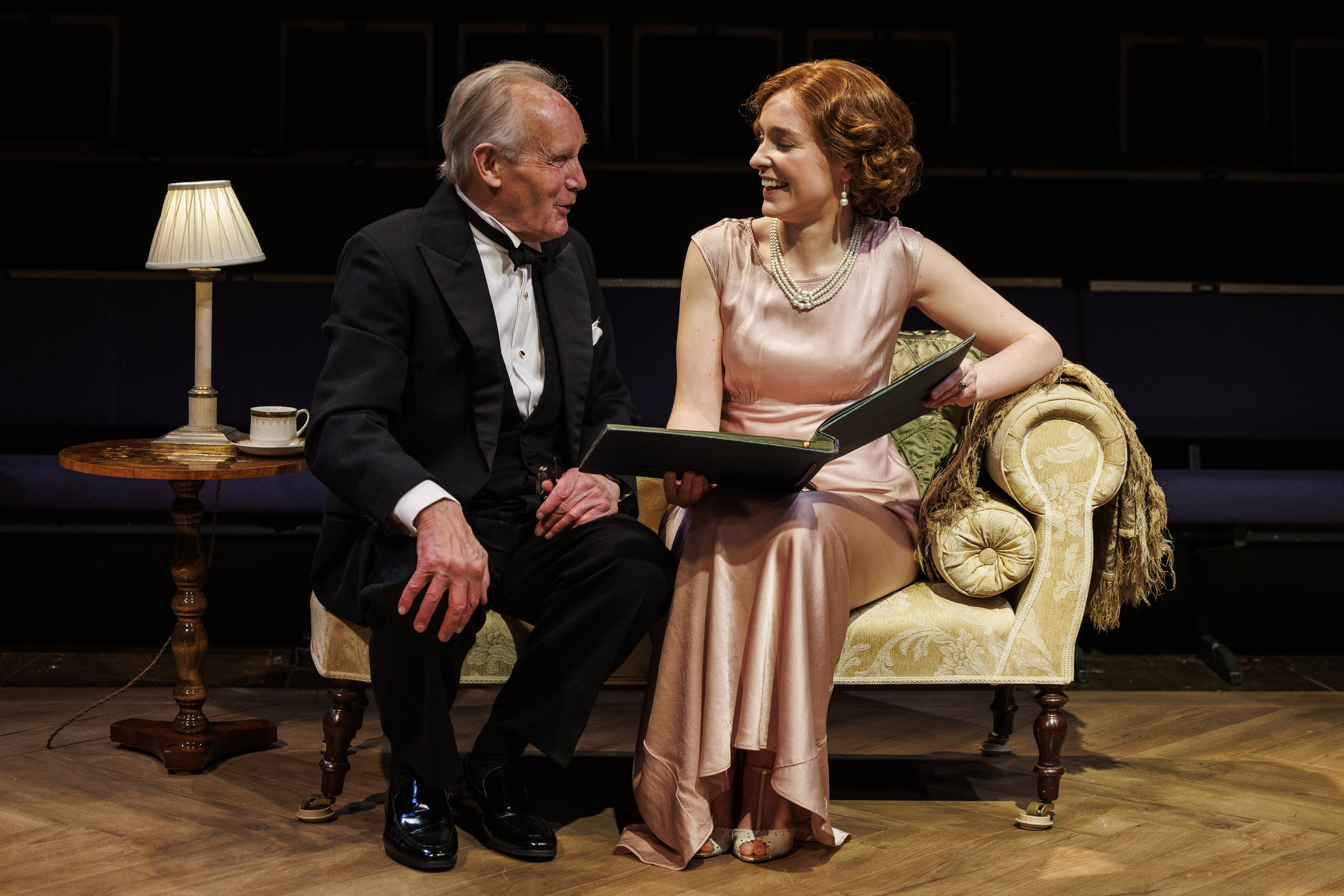
They say that what goes around comes around, perhaps implying that the mistakes of one generation will, inevitably, be repeated by the next. At least Somerset Maugham seems to think so in The Circle, his 1921 play which, having all but disappeared for decades, now parades itself in front of us again.

The play is set just after the end of World War I among the wealthy upper classes in which the men pursue careers in politics for want of something else to do. Devotees of Downton Abbey should love it. In his first offering as the Orange Tree’s new Artistic Director, Tom Littler comes up with a well rounded, traditional revival which balances light comedy with melodrama deftly. However, the production faces two challenges: firstly that this is only a decent play when the comedy comes to the fore; and, secondly, that the comedy only works when one or more of the three most senior actors is on the stage.

Arnold (Peter Ashmore) and Elizabeth (Olivia Vinall) have been married for three years and their union is threatened by mutual boredom and by Elizabeth’s infatuation with the ludicrously excitable visitor, Teddy (Chirag Benedict Lobo). In steps Arnold’s father, Clive (a sprightly Clive Francis), who had been abandoned by his wife, Arnold’s mother, Lady Kitty (Jane Asher in regal mode), who also reappears after a 30-year absence in Italy. She bringing with her Hughie (Nicholas Le Provost looking thoroughly fed up), the man for whom she had left Clive. Robert Maskell hovers around as Arnold’s dutiful butler, reminding us that we are among the privileged classes.

Persistent bickering between Kitty and Hughie gives an instant clue that their three decades together may not have been entirely blissful and subsequent confessions confirm this. So, should history be allowed to repeat itself with Elizabeth’s imminent split from Arnold? Through it all, Maugham’s disdain for the institution of marriage is evident; this could have sent mild shock waves through audiences a century ago, but the play says very little of possible relevance to modern society and relationships.

Maugham’s wit may be sub-Wildean, but the impeccable timing and delivery of Asher, Francis and Le Provost take it up a level. Kitty’s shallow vanity is a marvel, while the twinkle in Clive’s eye tells us that his enforced return to bachelor status may not have been all that bad. The dithering Hughie, we are told, could have been Prime Minister had it not been for the scandal surrounding Kitty’s divorce; thinking of recent holders of that office, this does not seem so implausible.

Little in The Circle speaks to 21st Century lifestyles, but the play gives an amusing glimpse into what much of British theatre could have been like in the days before the kitchen sink revolution of the 1950s. As such, it is good inconsequential fun.

Performance date: 5 May 2923

Writer: Jack Thorne

Director: Sam Mendes

⭐️⭐️⭐️⭐️

In William Shakespeare’s Hamlet, the title character marvels at The Player King and wonders how it can be possible for him to find the motive and the cue for passion. In this new play, Jack Thorn takes inspiration from the Bard to investigate the bridges built by actors between theatrical make-believe and real life.

The action takes place during the rehearsal period for a 1964 Broadway production of Hamlet, starring Richard Burton and directed by Sir John Gielgud, whose own performance as the Prince of Denmark had been widely regarded as one of the greatest in history. Gielgud is also to appear himself, somewhat ironically, as the Ghost. The problem is that Gielgud’s Hamlet could never be Burton’s Hamlet, so where does the latter dig to find his motive, his cue and his passion?

It does not seem like too much of a stretch for Mark Gatiss to find the passion of the inimitable Gielgud, who is perhaps better remembered now for the film cameos of his later life than for his achievements in the classics. Gatiss captures his essence effortlessly, as witticisms and gaffes roll freely from his tongue, but he sulks like a slapped puppy when a very drunk Burton mocks his acting style and the insecurities of a lonely outsider come to the fore. This is particularly notable in a deeply touching scene in which Gielgud invites a male escort (Laurence Ubong Williams) to his hotel room without being sure of the reason why he has done so. Through it all Gatiss is simply magnificent.

Johnny Flynn gives a barnstorming performance as Burton, the son of a Welsh miner whose wild streak makes him the antithesis of Gielgud. His new bride Elizabeth Taylor, the biggest movie star on the planet at that time, has ambitions to hit the stage herself as Portia. She is barred from rehearsals, but wields influence on both leading actor and director from her luxury hotel suite. Tuppence Middleton is a delight, making Taylor smart, coarse and sexy; as the Hell-raising couple, she and Flynn light sparks off each other.

Part mischievous comedy and part docu-drama, Thorne’s play is uneven in places and it shows tendencies to wander away from its central themes. However, it provides a lush setting for many jewels and the writer’s passion for the art of theatre comes through clearly. Allan Corduner as Hume Cronyn (Polonius), Janie Dee as Eileen Herlie (Gertrude), Phoebe Horn as Linda Marsh (Ophelia), Luke Norris as William Redfield (Guildenstern) and David Tarkenter as Alfred Drake (Claudius) are among those who shine brightly, if briefly.

Fewer or shorter extracts from Shakespeare could help to resolve a few pacing issues in director Sam Mendes’ slick, but overlong production. Es Devlin’s design of an extremely grand rehearsal room fills the large Lyttelton Theatre stage, which then shrinks for scenes set in hotel rooms, all made distinctive by Jon Clark’s striking lighting designs.

At the final curtain, The Motive and the Cue leaves its mark as a funny and affectionate love letter from theatre to itself.

Performance date: 2 May 2023

Retrograde (Kiln Theatre)

Posted: April 27, 2023 in Uncategorized

Photo: Marc Brenner

Writer: Ryan Calais-Cameron

Director: Amit Sharma

⭐️⭐️⭐️⭐️

The image of the “Golden Age” of Hollywood has already been tarnished for many reasons and Ryan Calais-Cameron’s new one-act play exposes yet another. Retrograde centres on an episode in the 1950s, during the early career of the great black actor, Sidney Poitier. Poignantly, this World Premiere coincides with the death of Harry Belafonte, who is mentioned in the play several times as Poitier’s friend.

The drama unfolds in the office of prominent lawyer Mr Parks, made by Daniel Lapaine to look like an unscrupulous bully. He takes on the role of defender of American value and he is joined by Bobby, an ambitious screenwriter with liberal leanings (“I’m the blackest white man you know”). Bobby has a screenplay about to be produced for network television by NBC and he wants a black actor to play the leading role, choosing Poitier, who is already a friend. Parks has drawn up the contracts and they are waiting to be signed.

Ivanno Jeremiah’s Sidney is amiable, dignified and determined. He does not actually speak the words “call me MISTER Poitier”, paraphrasing the actor’s most famous line, but his manner says it silently. There is a snag. Parks’ contracts include an oath to uphold American values and a denunciation as a Communist sympathiser of the legendary actor, singer and black rights activist Paul Robeson.

The McCarthy era, rooting out allegedly un-American activities overlaps with the start of the Civil Rights movement to give the play its toxic context. Should Poitier sign the oath to further his career ambitions and avoid being blacklisted by Hollywood? Or should he stay true to his friends and his strong personal beliefs by not signing? The clash of ideals makes compelling drama.

Retrograde is an obvious must-see for film buffs, but it raises concerns that go far wider than just cinema history. At one point, during one of Parks’ right wing rants, Lapaine seems to mimic the gestures and speech tones of a recent (and possibly future) American President. This draws laughter, but it could be a reminder that paranoia and hysteria can overtake reason just as easily now as 70 years ago at the time of the McCarthy witch-hunts.

Amit Sharma’s fiery production is given a handsome look by Frankie Bradshaw’s set design of Parks’ office and, in the climactic clashes, the writing and the acting are outstanding. The play takes its time to get to the point, but, when it arrives there, the heat that it generates is intense.

Performance date: 26 April 2023

Kindling

Posted: April 21, 2023 in Cinema

Writer and director: George O’Hara

⭐️⭐️⭐️⭐️

“When something is burned, its particles are released into the atmosphere to last on forever”. These words resonate strongly with Sid, a novice astronomer who is soon to leave this universe and seeks ways of leaving some tiny mark of his existence.

Kindling tells Sid’s story during a brief Summer period when he is reunited with boyhood friends. He is about to celebrate the third anniversary of being told by doctors that he has up to three years to live. Written and directed by George O’Hara, the film sets out to be a celebration more than a wake, telling us to value family and friendships while we still have them.

The film also pays homage to a perhaps dying vision of rural England; green rolling hills, rustling woodlands, rippling streams and water lilies sleeping peacefully on a small pond. Captured beautifully by David Wright’s cinematography, it all seems much too idyllic, but O’Hara is reminding us that we only borrow the places that we treasure; we cannot own them forever. Likewise our friends.

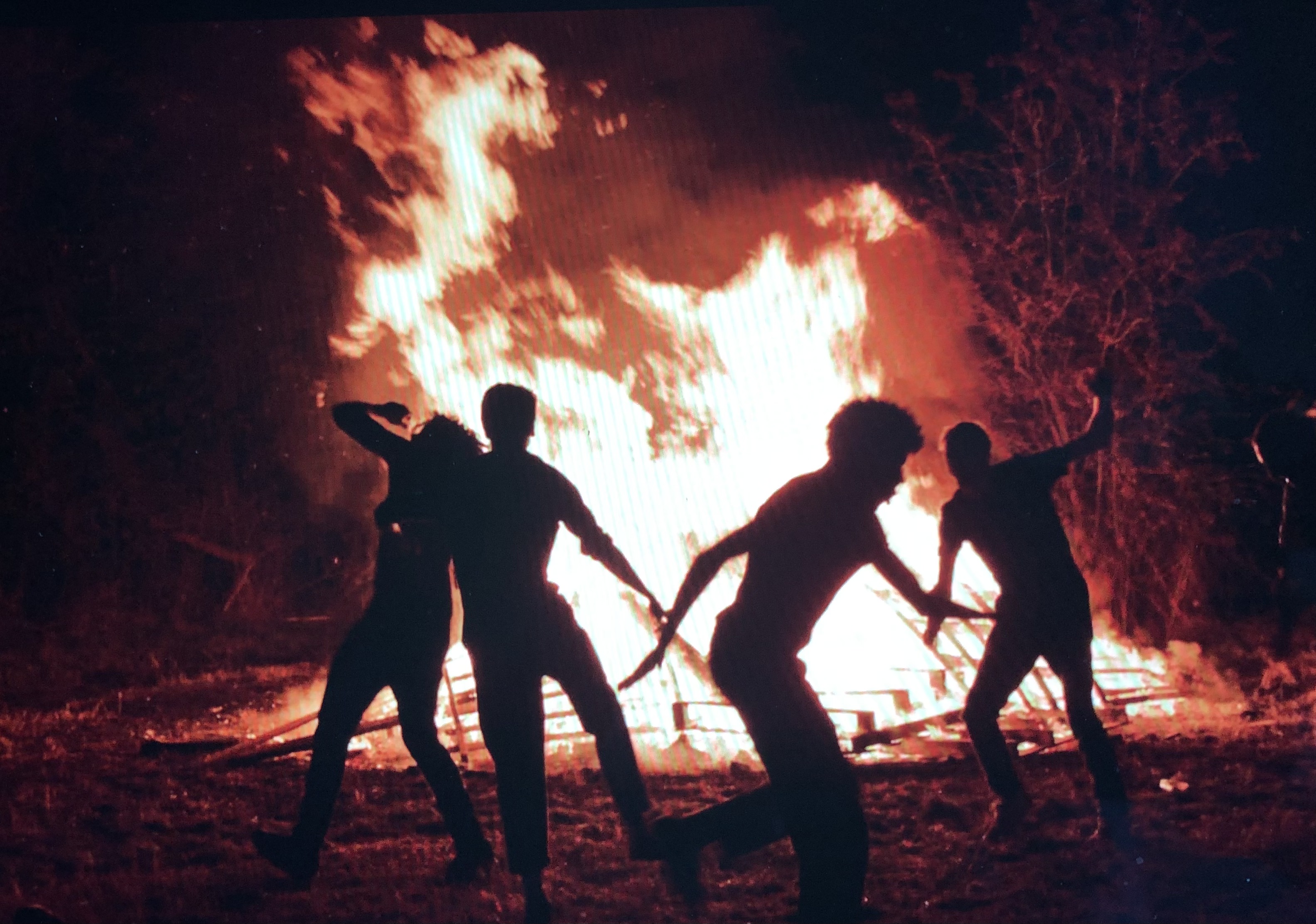
As Sid, George Somner gives the film is beating heart, embodying the spirit of resilience that pushes the character forward. For him, life goes on until it doesn’t and bonds of friendship are unbreakable. The return of his four friends who have left to build lives elsewhere, sparks the idea of having a huge bonfire onto which each will throw items of personal significance. The friends, Digs (Wilson Mbomio), Dribble (Conrad Khan), Plod (Rory J Saper) and Wolfie (Kaine Zaijaz), each given distinct characteristics by O’Hara, are acted superbly and perhaps their stories deserve to be developed further.

Equally touching is Sid’s platonic friendship with Lily (played with great charm by Mia McKenna-Bruce), a young lady who is unaware of his condition and not part of the group of five. She has low self-esteem, unable to find a direction or purpose in her life. Sid’s efforts to encourage and strengthen her, perhaps hoping that a part of him will live on, illustrate the writer/director’s themes of loss and renewal.

The drama is bolstered by stirring performances from Tara Fitzgerald as Sid’s over-protective mother and Geoff Bell as a father who just wants to be a bigger part of his son’s short life. They are struggling to function as normal while grieving inside for Sid, who is still among them. Harry Brokensha’s soft rock music enriches the film’s youthful spirit and its mood of melancholy.

Kindling is at its most powerful when it is understated, but it walks a fine line between solid drama and mawkish sentimentality. When, particularly in the final third, it crosses that line, it feels forgivable because of the film’s overriding tone of positivity. Nonetheless, best advice is to watch it with a box of strong tissues to hand.