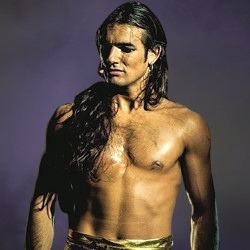
siddhartha-the-musical_2014SIDDHAR_8VInspired by Herman Hesse’s novel, which has something to do with the journey of a prince to discover the meaning of life, this is an Italian musical, written and directed by Isabella Biffi, with music by her and Fabio Codega. It is difficult to think of a successful musical from Italy since Turandot, but, true to its origins, it boasts lush melodies and beautiful singing, particularly by Giorgio Adamo in the title role. With the exception of narration by the older Siddhartha (Michael Nouri), the show is spoken and sung in Italian, but it is only necessary to glance occasionally at the American surtitles, because the book is a load of tosh and all the lyrics seem to be about the same thing – the joy of living. What makes this show special is the full-on staging of the songs, which range from soaring ballads to pounding club anthems and include a novelty number. Yes, this is a live mini version of the Eurovision Song Contest – incomprehensible lyrics, glittery costumes in lurid colours, half naked dancers gyrating all around the singers, flashing lights and lasers, psychedelic back projections and all of it unashamedly camp. Just like Eurovision, occasional suspicions that someone may actually be taking it seriously add to the amusement. The only things missing are (thankfully) the roll call of results and (sadly) Graham Norton’s commentary. Spectacularly entertaining.

Performance date: 14 August 2014

trial-of-jane-fondaIn June 1988, the double Oscar winning Hollywood actress Jane Fonda went to Waterbury, Connecticut to shoot scenes for Stanley and Iris, along with her co-star Robert De Niro. She found herself a pariah in a town which was populated by an unusually high proportion of war veterans, branded a traitor for the stand that she had taken against the Vietnam War in the 1960s and early 70s. This play, written and directed by Terry Jastrow, tells of a confrontation between Fonda and a group of the veterans which was, in effect, a trial. Somewhat ironically, the play takes the shape of Twelve Angry Men, one of the most famous films of Fonda’s father Henry, as we see a single figure seeking to convert dissenters, one by one. Ironically also, Fonda was seen as little more than a nuisance by the US Government and Military who she opposed, but as a demon by the fighting men whose cause was closest to her heart. Here, she admits that she had been hot headed and made mistakes, but she remains passionate in her beliefs that the Vietnam War was wrong and that the actions of US Presidents, particularly Nixon, amounted to genocide. From the perspective of the modern day, it is impossible to argue with her, but, in 1988, the wounds were still open. This is all fascinating and the arguments are generally well presented, with the aid of newsreel footage, except that the same points are repeated too often. Anne Archer is cool and composed as the beleaguered film star, as indeed Fonda may have been in 1988, unlike the fiery image of “Hanoi Jane” of a decade and more earlier. Occasionally, when the verbal interchanges become a little stodgy, dramatic flash points, that look somewhat cooked up, are inserted and the ending is 110% Hollywood. Otherwise, this is an intelligent and intriguing play.

Performance date: 14 August 2014

my-obsession-2014MYOBSES-PH-300Suki Webster’s short play has the feel of a pilot episode for a sit com that was never taken up. The writer herself plays a woman so obsessed with Danny Heywood, a television comedian, that she breaks into his hotel room in the middle of the night. Heywood seems a little like Paul Merton, so, rather conveniently, he is played by Paul Merton, who makes full use of his trademark expression of bewilderment when confronting the intruder. The comedy is inoffensive and light as a feather, steering well clear of the darker side of stalking and it doesn’t go on for a second too long. Indeed, some may reflect that the play lasts for little longer than it takes us to get to and from our seats, but it’s fun while it lasts anyway.

Performance date: 14 August 2014

TheCuringRoom-620x330What better way to spend a lunch hour in Edinburgh than in the company of a group of naked cannibals? In the Spring of 1944 in Southern Poland, a group of seven Soviet soldiers is taken prisoner by the Nazis, thrown naked into a cellar and abandoned with no means to escape. As days become weeks, the seven become hungrier and they realise that there can be only one source of sustenance available to them. A little like Agatha Christies’s Ten Little….., the question now becomes who will be the first and next to fall? In common with all stories of incarceration, David Ian Lee’s play relies upon the development of strong characters and he is served well by excellent performances all round. Stand outs are Marion Solomon as a reluctant leader, Matt Houston as a boastful Georgian ex-farmer and Thomas Holloway as a simpleton. However, this is a grizzly affair that makes us long for a return to the days when suggestions of unpleasant things were enough to trigger an audience’s imagination; the gratuitous offal on display in this production actually works against the drama by distracting our attention from the characters and making us divert our eyes in disgust. Stark realism is a positive feature of this production, but it is taken just a little too far.

Performance date: 14 August 2014

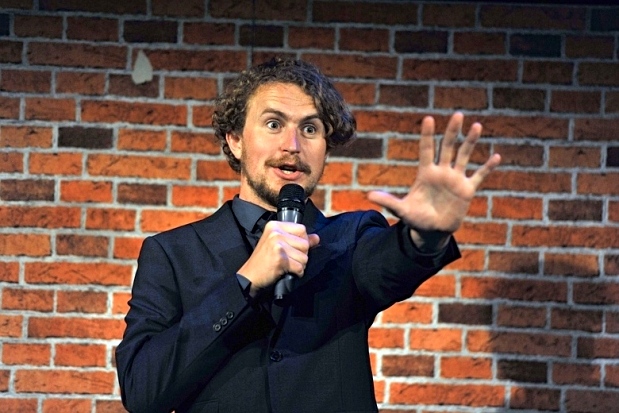
cuckooedMark Thomas is a stand-up comedian, but this is not a stand-up routine. Yes, Thomas uses all his skills for working an audience and he incorporates plenty of humour, but the story that he is telling is serious and even alarming. It is a story of friendship and betrayal that leads into a political rant over corporate malpractices. Thomas is an active member of CAAT (Campaign Against the Arms Trade) and, using video interviews with others involved, he tells of protests and demonstrations over a period of several years against arms dealers and of the underhand tactics used by those dealers to infiltrate the activists. The most affecting aspect of the show is Thomas’s descriptions of others involved with him, particularly an individual known only as Martin. This show is gripping, informative, relevant and moving.

Performance date: 14 August 2014

donald robertsonI cut back on seeing stand-up comedians some while back on the basis that they had all begun to sound the same. Gary McNair certainly does not fit into that category, although, as “play texts” were being sold at the end of his performance, it may be fair to deduce that he is no more a stand-up comedian than Donald Robertson, the badly bullied schoolboy that he bumps into regularly on a bus. Let’s just say that McNair presents the piece as if it were a stand-up routine and then takes it to all sorts of fascinating places. It would be unfair to divulge too much of the story that unfolds, but the narrative is always inventive and it leads to a very clever deconstruction of the natures of comedy, bullying and their inter-dependence. McNair, also the writer, is an accomplished comedy performer, who holds the audience in the palm of his hand for the entire show and, at the end, we are treated to a really wonderful punchline, which fully endorses everything that has preceded it. So, if Gary McNair is not a stand-up comedian, then, for sure, he is a consummate storyteller.

Performance date: 13 August 2014

riding-midnight-express-billy-hayes-76The 1978 Alan Parker/Oliver Stone film Midnight Express lives long in the memory for its brutal depiction of the experiences in a Turkish jail of Billy Hayes, a young American drug smuggler. Release of the film cut Turkish tourism by 95% instantly and the effects may still be felt today. This presentation gives us a chance to meet the real Billy Hayes who did not play himself in the film, even though he became an actor after regaining his freedom in 1975. Hayes never suggests that any part of the film is fiction, but the version of events which he gives here is somewhat different. He shows little contrition for having been an habitual drug smuggler up to the time of his arrest in 1970, acknowledging only his foolishness and talks of his actions in this period as if he had been a youthful prankster. He places much less emphasis than in the film on the horrors of the years in jail and says hardly anything about the friends he made there. However, he goes into much more detail on his escape, painting a picture of himself as a sort of Indiana Jones. Being an actor Hayes knows how to put on a slick and polished show, which may be the reason why some of the story seems not quite as real as it obviously is. Nonetheless, We are given a considerable amount of interesting detail and a lot to enlighten film buffs.

Performance date: 13 August 2014

Have we now heard so much of the damaging effects of sexism on women that we no longer take any notice? This unusual show takes the stories of problems encountered by many women but tells them with a difference. The performers are six smartly-dressed young men who all look like models for GQ magazine; they are: John Askew, Dominic Attenborough, Aled Bidder, Hugo Bolton, Stanley Elridge and James Lawrence. The result is startling and quite unsettling at first, although it becomes less so as the novelty wears off. Rebecca Hill directs a smooth and fast flowing production which provides a thought-provoking and occasionally eye-opening 50 minutes.

Performance date: 13 August 2014

animal farmFollowing Headlong’s 1984, George Orwell adaptations seem in vogue at the moment. This one is adapted and directed by Guy Masterson and performed by the Tumanishvili Actors’ Theatre of Tbilisi. It is seen here as a piece of physical theatre, with the story of animals taking over their farm from its two-legged owners being told on surtitles above the stage. The chief problem with Animal Farm Is that, even more than 1984, it is an obvious allegory – “animalism” in the story is, of course, really communism. On the page, the allegory can work, but, transferred to the stage it is exposed as a thinly disguised political tract, something like the antidote to Das Kapital. Orwell’s prescience in showing exactly how and why communist systems of government would disintegrate 45 years before they actually did so is astonishing, but, otherwise, the novel holds much less interest now for the British than, perhaps, for Georgians. However, the performers create many striking visual images which hold the attention and make this production worthwhile.

Performance date: 13 August 2014

UNFAITHFUL0508AIn the cocktail bar of a modern city centre hotel, a middle-aged man, a plumber, is quietly enjoying an after work drink when he is confronted by a young girl, a college drop out now working on Tesco checkouts. She is not a hooker, but she offers him anything he wants. He phones his wife and he lies, but exactly what does he want? The man’s deception triggers a chain of events involving himself (played by Benny Young), his wife (Cara Kelly), the girl (Amiera Darwish) and a male escort (Owen Whitelaw), which leads the four to reappraise the nature of their relationships and how they are faithful or unfaithful to their partners and to themselves. Owen McCafferty’s new play is Pinteresque in structure and full of plain, direct dialogue that probes deep into each of the characters. There is also a fair amount of self-deprecatory humour as the characters come to terms with the absurdities of love and sex. Confidently directed by Rachel O’Riordan, this play is likely to be seen as one of the best pieces of new writing on the 2014 Edinburgh fringe.

Performance date: 13 August 2014