Attachment-1-2This review was originally written for The Public Reviews: http://www.thepublicreviews.com

The tragedy of Lucrece is mentioned by William Shakespeare in several of his plays, but his narrative poem which recounts the full story is known to most of us only from the page. This bold and imaginative production by the Royal Shakespeare Company, which was first staged at the Swan Theatre in Stratford-upon-Avon in 2011, brings the poem to vivid life. Part spoken and part sung, the poem is performed by the Irish singer and actor Camille O’Sullivan, accompanied on piano by Feargal Murray. Together, they have written the haunting music, which is in the rock ballad style, ranging from soothingly melodic when matching Shakespeare’s lyrical descriptions of Lucrece’s beauty, to loud and discordant in harrowing scenes of violence and anger. O’Sullivan’s clear and powerful voice do full justice to both the words and the music throughout. O’Sullivan’s style as a concert performer is always intensely dramatic, but here, not content to just stand in front of a microphone, she deploys her considerable acting skills, playing at first the abuser, Tarquin, and then the victim. She begins wearing a full-length black coat and, with her hair pinned back tightly, she has the severe appearance of a prison warder. Once the foul deed has been committed, she discards the coat and becomes Lucrece. Wearing just a pure white night dress, her hair now dishevelled and falling forward, she writhes on her bed in pain and disgust. Lily Arnold’s simple designs represent a grand, unfurnished room, with large windows at the back and littered with manuscripts piled high. The production is marked throughout by exceptionally effective lighting by Vince Herbert. A square block of light represents Lucrece’s bedroom and, inside it, a smaller white square is her bed. At the end of the performance, a thin shaft of light across the stage links a heavy pair of men’s black boots at one end to a pair of white ladies’ slippers at the other, leaving us with an indelible summarising image. This 80 minute interpretation of Shakespeare’s work is a unique and memorable fusion of of poetry, drama and music. It is also a personal triumph for the extraordinary Camille O’Sullivan, providing a showcase for the full range of her talents.

Performance date: 9 July 2014

thepublicreview_hor_web copy

p.txtMartyn Hesford’s writing credits include a television bio-pic of Kenneth Williams and, although no-one actually talks in Polari in this new comedy, he extends a line of gay humour which stretches from Julian and Sandy in the 1960s through Larry Grayson to Julian Clary. In other words, Hesford extracts most of his laughs from mocking exaggerated stereotypes, but, sadly, the comedy is shallow and lacking in the kind of insight found in, for example, Kevin Elyot’s soon to be revived My Night With Reg, which features similar characters and situations. Marcus (Michael Begley) is boring, fussy about stains on his John Lewis carpet and touchy about his expanding paunch; understandably, his partner of 20 years, Colin (Owen Sharpe) has turned to drugs. They have moved recently to a cottage in Hampshire and their solitude is interrupted by the unexpected arrival of a gruff businessman, Steven (Michael Feast) with his promiscuous and very camp 18 year old toy boy, Jamie (Alex Lawther). The two couples had met on a cruise a year earlier and enjoyed each other’s company in every sense. The visitors also bring in tow Steven’s slutty and coarse ex-wife, Wendy, played with relish by Michelle Collins, who looks as if she could well build a fruitful post-soap career in theatre. Hesford offers a flimsy explanation for Wendy’s presence, but, in effect, she is little more than a catalytic device for getting the comedy moving. It would be dishonest to deny that a lot of what follows is very funny, particularly when Collins is in full drunken flow during the raucous second act, but the absence of any real depth leads to a guilty feeling whilst laughing, like when watching an old episode ‘Allo, ‘Allo. Intermittently entertaining this play is for sure, but, if there were to be any suggestion that these irksome characters represent 21st Century gay lifestyles accurately, it could be enough to nudge even the most liberal minded of Hampstead audiences in the direction of homophobia.

Performance date: 8 July 2014

Attachment-1-3Ivan Turgenev’s novel Fathers and Sons first appeared in 1862, preceding Chekhov’s greatest plays by more than 30 years, yet Brian Friel’s adaptation is marked by the same feelings of wistfulness and melancholy as those plays. The setting is rural Russia on the estates of aristocratic landowners, but, whereas Chekhov used similar settings to depict a social order in terminal decline and on the cusp of being overturned, Turgenev sees the emergence of revolutionary forces which will make waves, but ultimately leave the status quo intact. There is much talk of disturbing “the natural order of things”, but not displacing it and, taking a longer view of history from a modern day perspective, perhaps Turgenev got it right and even the 1917 Revolution was no more than a temporary blip. Arkady and Bazarov are close friends who return together from university in St Petersburgh to their family homes, both claiming to be nihilists, without agreeing with each other on the word’s definition. Arkady cannot entirely detach himself from his heritage and bonds of affection, but Bazarov, a brilliant student and radical thinker, is dispassionate towards his family and lovers, until he meets the lovely widow Anna and finds it impossible to rein in his emotions. There are flaws in the narrative which emanate from the novel itself and from condensing it, but Friel’s script is rich with insight and wit. There can be no complaints about Lindsey Turner’s production – she strikes the perfect balance between pathos and humour, paying great attention to detail and her casting choices are impeccable. Tim McMullan shines as Arkady’s Uncle Pavel, debonair, droll, waspish and the staunchest defender of the established order. Seth Numrich, the American actor who was so good in Sweet Bird of Youth at the Old Vic last year, impresses again with his commanding stage presence as Bazarov, showing us the inner turmoil beneath the character’s outward fervour. Joshua James is a naive and impressionable Arkady, devoted and loyal, but rueful that he lacks both the intellect and dynamism of his friend. As the two fathers, Anthony Calf and Karl Johnson are loveable eccentrics, both touching us as they face their families’ ordeals. The set, built almost entirely from planks of wood, is magnificent, rounding off what is a highly accomplished work of theatre.

Performance date: 4 July 2014

This review was originally written for The Public Reviews: http://www.thepublicreviews.com

In a world where shoals of cod can sing in a 17,000 point harmony and whales can communicate with each other across thousands of undersea miles, the human race struggles to make itself heard, blocked by censorship and inarticulacy. Fine Chisel has devised this musical entertainment, building upon these themes in a loosely linked story which moves between a marine biology station off the Alaskan coast to a pirate radio ship in the North Sea. Set very vaguely in the early 1960s, the story concerns Ted (Robin McLoughlin), an academic who is researching marine mammal bioacoustics, living a solitary life and obsessed with tracking singing whales across the Bering Sea. He is able to distinguish between the accents of individual whales, but, impaired by a brain tumour, he has difficulty in finding words to pass on his knowledge to his student, Fiona (Holly Beasley).  Fiona is more obsessed with human communication and, springing from an aversion to the BBC’s Light Programme (something like the modern Radio 2), she establishes an illegal radio station to broadcast whatever she chooses. However, when she airs provocative views and reads extracts from the then banned Lady Chatterley’s Lover, Ted tries to persuade her that she would be more suited to a sedate job in Belgium. This bizarre narrative provides a framework and ambience to showcase some lively music, which is themed on the life aquatic, ranging from emulating whale noises to rocking a pirate boat. George Williams plays guitar and provides vocals, Tom Spencer plays banjo and percussion and Carolyn Goodwin also vocalises and plays woodwind, contributing some outstanding jazz saxophone segments. Beasley adds a couple of dances to add to the entertainment, showing little regard for the lecture room setting, surrounded by blackboards and charts. Dumbstruck is, in essence, about connectivity, yet, itself, it does not quite connect to make a coherent whole. Nonetheless, if not taken too seriously, it provides an unusual and pleasantly entertaining evening.

Performance date: 3 July 2014

thepublicreview_hor_web copy

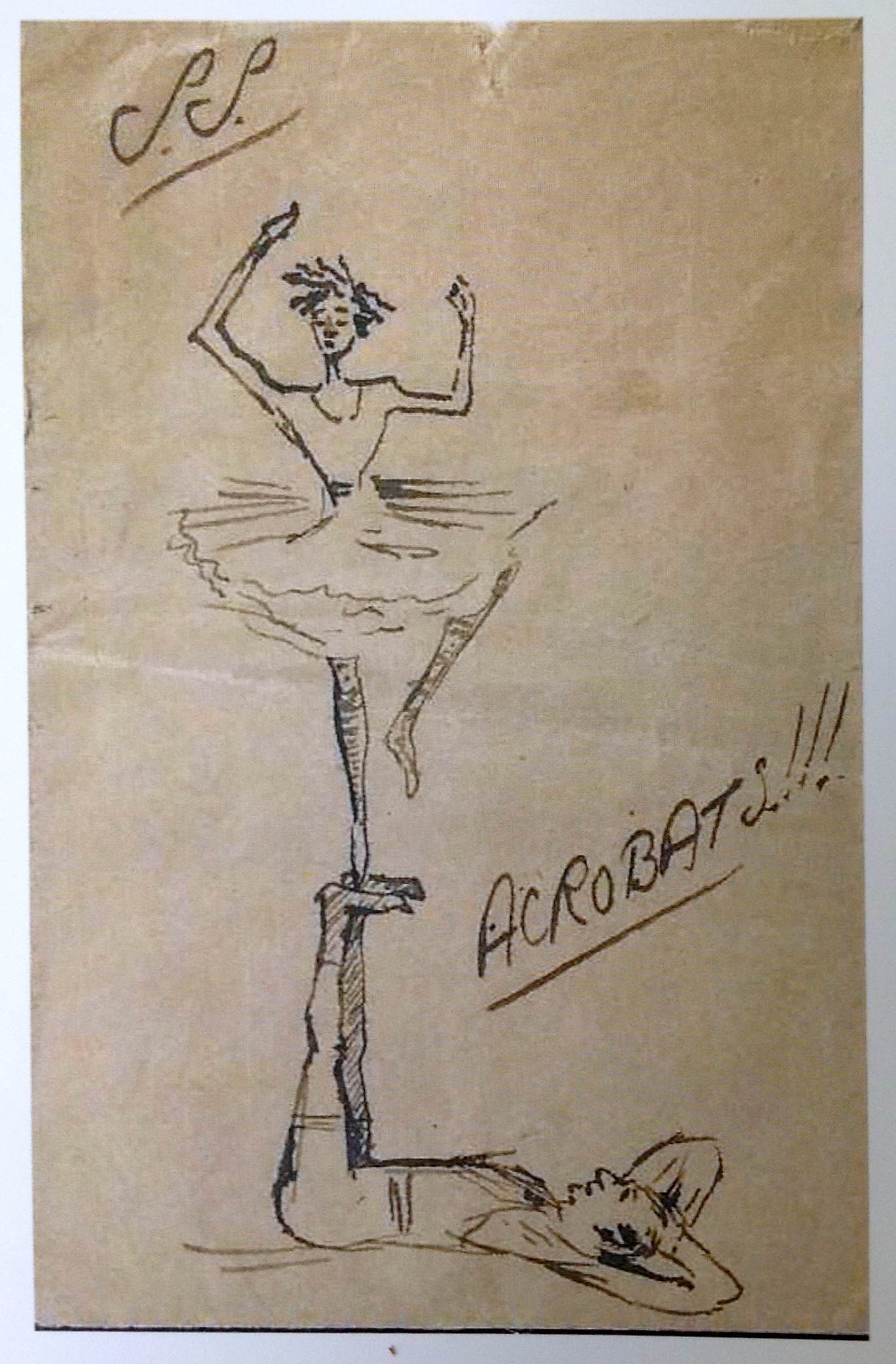
photo-132This show begins very badly, with its writer/presenter, Danny Braverman, handing round  cold fish balls to the audience and, with the unpleasant taste still lingering in the mouth, he embarks on a rather unpromising anecdote about a bowel operation. His style is relaxed and amiable but not witty and he seems to be rambling, which makes it all the more surprising when I realised, after about 15 minutes, that I had become totally enthralled. The true story concerns his great aunt, Celie and her husband Ab Solomons, an employed Jewish shoemaker living in London’s East End. They married in 1926 and, from that time for over half a century, Ab received his weekly pay in a small, brown, dated envelope and, on the reverse side, he drew sketches depicting the couple’s life together. Having found these envelopes in shoeboxes, Braverman projects them onto a screen and relates the couple’s story, in some cases illuminating the sketches with supposition, in others leaving them to explain themselves. As Ab grows in confidence, the sketches become bolder and more explicit; they tell of young lovers, proud parents, wartime hardship, heartache and illness. Ab and Celie’s younger son was afflicted by severe autism and epilepsy and, as was normal in those times, he was incarcerated in a “loony bin”. Ab was a “schlump”, but Celie had style and aspirations, always wanting to move from the squalid East End to the middle class Golders Green. Overwhelmingly, this is a story of undying love, constantly tugging at the heartstrings, but never resorting to excessive sentimentality. It is also a story of fortitude, endurance and of overcoming life’s trials and it is told by Braverman with great affection and family pride, as shown when he finds himself as a child amongst the figures in the sketches. The story also has symmetry and irony – Ab and Celie’s older son was (and still is) an art dealer who owned a Rothko and lunched with the likes of Francis Bacon, yet he never realised the value of the treasures lying in shoe boxes beneath his own bed. In all, this is the most beautiful and moving piece of story telling that I can remember experiencing.

Performance date: 3 July 2014

Attachment-1-4It could be argued that the Miners’ Strike of 1984/85 was the closest thing to a civil war seen in these islands since 1651 and, fittingly, Beth Steel’s compassionate new play views the Strike as a conflict in which, as in all wars, the greatest losers were the fighters and their families. The chief protagonists, Margaret Thatcher and Arthur Scargill are never seen, although some insight into the political background is given in discussions between the “wet” Energy Secretary Peter Walker (Andrew Havill), Transport Secretary Nicholas Ridley (Paul Cawley) and the Chairman of the National Coal Board Ian MacGregor (Michael Cochrane), who is seen as a man with a genuine mission to rebuild the mining industry, not to destroy it. It is refreshing that Steel does not promote the simplistic view favoured by delusional socialists that the Strike was only about the evil witch Thatcher crushing the noble workers; she is clear that Britain at that time was on the brink of economic ruin as a result of two decades of Trade Union domination and that mining and most other industries were in need of urgent and drastic reform to make them viable; she sees the miners as being led blindly by politically motivated Union leaders who called the illegal Strike at a time when conditions were least favourable to them and then prolonged the agony of their members by remaining intransigent well after the point when defeat had become a certainty. However, the play’s political content is only there to provide background, because Steel’s chief focus is always on the miners who were caught in the middle, bound by tradition and by their loyalty to each other. The first half is a vivid and detailed account of working in a coal mine, arduous, hazardous and unhealthy; the staging is starkly realistic, with metal cages descending from above the stage to well below it and, under Edward Hall’s superb direction, the miners moving around constantly as they perform their daily labours. Songs (composed by Simon Slater who also plays the Pit Manager), help to illustrate life in this hellish underworld. In the second half, the stage is cleared and we are taken through key points in the Strike itself, with pitched battles, extreme hardship and indignity, family members set against each other and, inevitably, the bitter pill of defeat. We see dirty tricks played by both sides, most notably those involving David Hart (Dugald Bruce-Lockhart), a wealthy eccentric residing in Claridge’s, who is sent to infiltrate Nottinghamshire miners. The acting in the roles of the miners is exceptionally strong, but, strangely, all Steel’s characters are male and we see no signs of the women who suffered alongside their men. This production is theatre on an epic scale, thrilling, enthralling and often deeply moving.

Performance date: 2 July 2014

photo-127This review was originally written for The Public Reviews – http://www.thepublicreviews.com

Traditional folk songs, passed down from one generation to the next through decades and centuries, form part of out cultural heritage, but, until relatively recent times, they were never written down nor recorded. Kevin Mandry’s new play is set in 1916 when recording techniques were in their infancy and he sees the onset of an age when the songs could be taken away to be heard by wider audiences, whilst the people to whom they belong would remain rooted in their own place and time. Mary (Hilary Burns) is selling her small Sussex farm to George (Ian Mairs), who is unable to do military service due to disability. It is accepted that, as part of the deal, George will marry Mary’s foster daughter, Sarah (Isabella Marshall), who is seen by herself and everyone else as plain.Their world is disturbed by the arrival from London of Archie (Josh Taylor), a young army captain who is taking leave to research folk songs. He turns up on foot, towing a cart containing recording equipment, cylindrical discs and a Fortnums’ hamper. Much of the first half of the play is taken up with discussions over what is or is not an authentic folk song. Archie is a condescending toff who uses long words to emphasise that he has had an education; he is the sort of man that everyone has nightmares about being stuck with on a long train journey – when talking folk music, he can bore at international level. We are told that he has had an inglorious military career, has a drink problem and dislikes the Irish, but, otherwise, we know very little about him and the failure to flesh out this character may be the play’s biggest flaw. Inevitably Sarah sees Archie as her way to escape, but the story does not turn in this direction until after a first act which tends to ramble aimlessly. It is not clear why it is deemed necessary to have an interval in a play which would otherwise run for under 100 minutes and has no scene changes, but, when we return to our seats, the first 20 minutes of the second act is played in semi-darkness, making it rather like an episode of The Archers. In fact, Marshall’s performance becomes more credible during this period, because she is actually nothing like as plain as her character is described. The drama ignites briefly in the later stages, but mostly it remains laboured and clumsy. The four actors, plus Mac Elsey as an elderly farm hand, and director David Cottis do all they can to bring the production to life, but Mandry’s dialogue, for the most part prosaic and humourless, ultimately defeats them. Sadly, Flowers of the Field fails to blossom.

Performance date: 25 June 2014

thepublicreview_hor_web copy

photo-126Having developed an aversion to Sean O’Casey’s three most famous plays during schooldays, I initially decided to give this a miss. However, generally positive reviews led to a change of heart and a decision to catch Howard Davies’ production of this rarely performed O’Casey play late in its run. There has been no shortage of Irish drama on the London stage in the last couple of years and, when the long and unmemorable first scene of this play settles into the familiar pattern of a group of jocular Irish eccentrics bantering aimlessly, it induces a deep sigh of “here we go again”. And then, before we realise that the scene has ended, a series of loud and blinding explosions shatters the serenity abruptly. When the smoke clears, we see the ruins of an old abbey and we are now in the middle of a World War I battle zone for an extraordinary and surreal second scene which depicts the horrors of war, mostly through verse, song and stark visual images. After the interval, it is back to Ireland to see lives that have been changed irrevocably or wrecked. No complaints here about the use of the wide Lyttelton stage – the sets and the staging are magnificent. There are strong performances too, most notably from Aidan McArdle and Stephen Kennedy as a sort of Irish Laurel and Hardy, Ronan Raftery as a star footballer who becomes paralysed in battle and Judith Roddy as a religious zealot who blossoms out. Looked at as a drama, there is an uneasy mix of comedy and tragedy and the play is too episodic, lacking a strong enough central narrative thread. However, judged as a work of literature, much of it is simply superb, written more like an epic poem than a play, it is a moving elegy on the ravages of war and its cost to humanity.

Performance date: 24 June 2014

Carousel**** (Arcola Theatre)

Posted: June 24, 2014 in Theatre

photo-125

This review was originally written for The Public Reviews: http://www.thepublicreviews.com

June is bustin’ out all over London’s East End right now and Morphic Graffiti’s scaled down revival of this familiar Rodgers and Hammerstein hit deserves to draw in lovers of musicals from far and wide. It is a show that relies heavily on dance and it is famed for its big orchestral music, so the decision to perform it on the Arcola’s small stage, backed by just a five-piece band, is a big gamble. Thankfully it is one that pays off with director Luke Fredericks realising that what is lost on the swings can be gained on the carousels – less spectacle for the eye and ear, but more intense drama and character development. Carousel is both blessed and cursed by its songs – blessed because of their matchless quality, but cursed because they are so absurdly good that they make everything that comes between them feel anticlimactic. Oscar Hammerstein’s book is adapted from Liliom, a 1909 Hungarian play by Ferenc Molnar, and the action is transplanted to a New England coastal town during the Depression era. Moving into the realms of the supernatural in its final third, the show has an awkward narrative structure, but the downsizing process does not magnify the difficulty, rather this production seems to transcend it better than some larger ones. Gemma Sutton makes a charming Julie Jordan, stubborn and loyal, falling instantly for the feckless and philandering fairground barker, Billy Bigelow, not out of naivety, but out of certainty that this is the man for her regardless of his faults. What’s the Use of Wond’rin? she sings resignedly, knowing that she can only play the cards that fate has dealt her. Tim Rogers is the perfect Billy, headstrong and fiery, but with low self-esteem and easily led. He holds the stage solo for over five minutes with his passionate interpretation of Billy’s Soliloquy, bursting with pride and optimism.  A sub-plot involving the courtship between Julie’s friend Carrie (Vicki Lee Taylor) and an ambitious fisherman, Enoch Snow (Joel Montague), provides light relief; he returns from work, stinking of fish and they duet When the Children Are Asleep, planning their future family from either side of a shower curtain. There are other strong performances, most notably from Valerie Cutko as the Carousel owner, Richard Kent as a small-time criminal and Amanda Minihan as Julie’s Aunt Nettie. Minihan’s voice may not have the power to belt out You’ll Never Walk Alone in the traditional style, but her alternative version, almost whispering it into Julie’s ear, is just as effective.  After their success with Oklahoma, the writers came to this show with the confidence to incorporate dark themes of death and brutality into it. Amongst such themes is marital violence and modern audiences may be disappointed that this is not condemned more robustly by the script, particularly in the overly sentimental closing scenes, during which the tone is one of acceptance and forgiveness. Such a failing could possibly be glossed over in a big production, but, in this intimate setting in which the drama is more sharply focussed, it is laid bare. With the audience seated on three sides of this steeply raked auditorium, Lee Proud’s choreography is thrilling throughout, making imaginative use of the small space, and it hardly matters that the dancers are not always step perfect. Circus performers ascend ladders to the upper levels of Stewart Charlesworth’s simple sets and Susie Porter leads the company to dance the long second act ballet beautifully. It is a rare treat these days to hear a musical performed without electronic amplification and Richard Rodgers’ lovely melodies lose very little from being played by a small acoustic band. The singing, mostly excellent, has a crispness that allows Hammerstein’s lyrics to be appreciated fully. Fredericks’ lively production runs for a full three hours, indicating that he has not shied away from any of the challenges that scaling down this show presents. Like the fairground attraction of the title, revivals of Carousel come around at regular intervals, but here we have one that is fresh and distinctive, breathing new life into a timeless classic.

Performance date 23 June 2014

thepublicreview_hor_web copy

photo-124This review was originally written for The Public Reviews: http://www.thepublicreviews.com

Sleep,“’tis a consummation devoutly to be wished” according to the Bard and so ’tis here, as we see an elderly couple edging inexorably towards eternal sleep and their insomniac son tortured by his past. American writer Kevin Kautzman’s 90 minute one act play, a reflection on mortality and inter-generational tensions, is getting its World Premier at the Finborough and it is nothing like as downbeat as a summary of its storyline might suggest. Mary and Gene are septuagenarians, a devoted couple who have been married for over 40 years, but she now suffers from dementia and he has been diagnosed with cancer, knowing that he has little time left. It is not December, but they have invited home their son Robert and adopted daughter Melissa to celebrate a “random” Christmas, rekindling family traditions and, effectively, giving everyone the opportunity to say their goodbyes. Touchingly played by Susan Tracy, Mary drifts in and out of the real world, rejecting her medication and scouring the room to find the remote to control an imaginary television. At one moment she is alert and vital, at the next she stares vacantly into space and imagines herself to be Queen of the Underworld. As Gene, Martin Wimbush dons a Santa hat and shows us a man who remains outwardly strong, but is beset by growing frailty and fearful of his inevitable fate. The couple’s last wish is to complete their lives with dignity. The family is already fractured, with the two children having lived apart from their parents for many years, rarely communicating with them and never with each other. Robert (Cory English) is boorish, argumentative and absorbed with the failures in his own life; Melissa (Lisa Caruccio Came) is a shallow, pot-smoking new-ager. They are an irritating and unsympathetic pair, which poses problems for the middle section of the play, when it is difficult to accept that they are genuinely concerned about their parents’ dilemma. However, when the story moves towards family reconciliation and the healing of old wounds, we warm to them much more. Kautzman’s writing is stronger on mystical imagery than on the natural language of everyday life, but he tackles serious themes without ever being heavy-handed or too earnest. Holly Seager’s set is an old fashioned oblong living room with a Christmas tree hanging upside down in one corner. The audience forms each of the two long walls of the room, giving the production a feeling of intimacy that it perfect for this moving and truthful little play.

Performance date: 19 June 2014

thepublicreview_hor_web copy