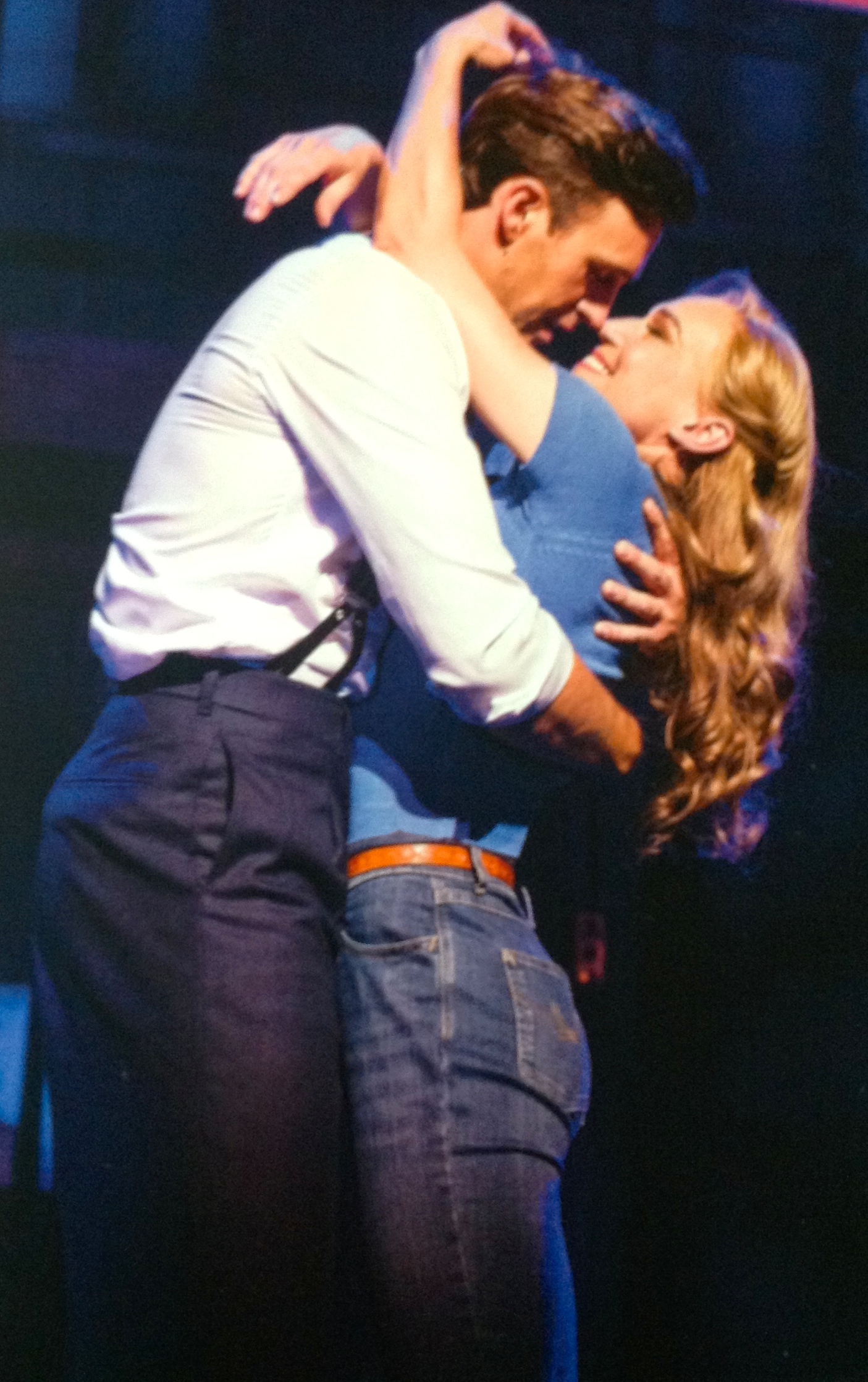
photo-65Every cloud has a silver lining. The failure of Tim Rice’s latest musical left a window for this revival, first seen in Chichester last year, to get a West End staging before the next musical moves in in the Autumn, and the early closure of Andrew Lloyd Webber’s latest released Joanna Riding from a bit part so that she can return to her starring role. As a general rule, maybe it is not such good news that new work is nudged out by old favourites, but it is worth making an exception here. With words and music by Richard Adler and Jerry Ross, this show opened in 1954 and the songs – Hey ThereOnce a Year Day, Hernando’s HideawaySteam Heat, etc, etc – play like the 1950s song book. There is not a single dud amongst them. The book by George Abbott and Richard Bissell, something to do with a strike in a pajama factory, is not so hot, more corny as candy in August, but with songs like these, it is hard to care. The show has connections with and some similarities to Guys and Dolls, which Richard Eyre directed at the National Theatre in the 1980s, and he tackles it with similar panache, always avoiding the danger of making it seem like a museum piece. Riding is perfect as a 2014 Doris Day, playing Babe, the feisty strike leader, but Michael Xavier steals the show; playing Sid. the superintendent with one eye on proving himself to management and the other on Babe, he is a real find. There are a host of superb comic cameos and a hard working chorus line that gives exuberant energy to the many big production numbers. Nostalgic and fun, a real treat.

Performance date: 26 May 2014

The good news is that, thanks to St James’ benevolent advance sales policy, tickets for this cost just a fiver each. The bad news is that they were a rip-off. Even at knock down prices, the auditorium was less than a third full, giving rise to suspicions that other theatregoers are connected to better grapevines than mine and had picked up on the news that this would be a stinker. At the end of a really poor week of theatre, it may seem appropriate that I should end up in a NHS hospital, seated almost on the linoleum floor. In fact, the set is the most realistic feature of this production.  Stella Feehily’s terminally ill play is a mish-mash of theatrical styles, ranging from sombre drama to surreal comedy; it is something like One Flew Over the Cuckoo’s Nest meets Carry on Nurse on the set of Casualty. But, sadly, it is the kind of drama to make us laugh and the kind of comedy to make us weep. The plot involves a nonagenarian lady (Stephanie Cole) who suffers a fall and is taken to hospital by her son (Brian Protheroe) who has already been diagnosed with prostate cancer; every plot contrivance that follows is designed to make an unsubtle point about a health service that is on its knees. Guest appearances by Winston Churchill, Aneurin Bevan and the Grim Reaper fail to awaken our interest, breaks in the play for cast members to give us factual lectures fail to convince us and a couple of bizarre musical numbers fail to liven things up in a production that goes onto life support within five minutes of starting. The central tenet, which is rammed home with a sledgehammer over and over again, is that the NHS should remain rooted in the socialist ideology of the 1940s, unchanged, whatever the cost. However, it hardly matters that the messages are nonsensical, because any political view advanced is sure to become discredited by association when something is as bad as this. Finally (I cannot bear to write much more about it), it needs to be asked whether there are grounds for a prosecution under the Trades Description Act. This play hurts A LOT.

Performance date: 23 May2014

Privacy** (Donmar Warehouse)

Posted: May 23, 2014 in Theatre

photo-62The first half of James Graham’s new “play” resembles nothing so much as a late afternoon session at a high-powered business conference – a bombardment of facts delivered in an ultra-slick presentation and served up with a lightness of touch designed to put the participants in the perfect mood for cocktails and a splendid dinner. We are told all the ways in which the internet is subverting our privacy every time we use Google, Facebook, Twitter, supermarket loyalty cards, etc, etc,  or even when we move from place to place with our mobile phones switched on. We are then shown how all this data can be stored, collated, used for corporate profit and become accessible to almost anyone to use in whatever way they wish. The presentation begins with a highly unusual announcement asking the audience to leave their internet devices switched on. At this point, I have to make a confession: whilst this production was in preparation, I attended a test run of its audience participation elements, with the result that I already knew a large chunk of its content beforehand. Therefore, I accept that it was for this reason that, whilst the usual audience of middle-aged theatregoers, bolstered on this occasion by young techno geeks, were gleefully playing with their smart phones, I sat and yawned. Oh, I also took a selfie (see above), e-mailed it to the Donmar and, childishly took delight in seeing it displayed with others on a screen at the back of the stage. I must also confess to a lifelong aversion to having problems presented without any suggestion as to possible solutions; so, if internet intrusions into our privacy are out of control and individual governments are powerless to legislate to tackle a global problem, what are we supposed to do? Opt out of the modern world and go to live on a desert island maybe? There is still plenty in the first half to cause alarm and consternation, although the impact is diminished somewhat when the device used to convey many of the most striking facts is later revealed to be a deceit. The overlong second half consists mostly of a scripted discussion centring on the Edward Snowdon affair and the potential misuse of private data by governments. The resemblance now is to an edition of Newsnight, albeit one that lacks balance and concision. Snowdon, Wikileaks and The Guardian are presented very simplistically as heroes, all Western governments as villains. At this point, a plot which has promised to surface from the beginning breaks through very briefly, as we see “the writer” (engagingly played by Joshua McGuire) becoming involved with the backlash from Snowdon whilst he undertakes his research. However, this glimpse of real drama turns out to be no more than just a glimmer. Of course, theatre should be able to educate and stimulate debate, but theatre offers opportunities to achieve such objectives through drama and the failure of his production to harness these opportunities and come up with an effective dramatic framework for its messages reeks of laziness. It is simply not good enough to do little more than replicate lectures or television programmes and, to illustrate this, we need look no further than the current West End dramatisation of 1984 which speaks a thousand times more powerfully about the threat of “Big Brother” than anything heard here. The performances by a cast of seven are all good and Josie Rourke’s direction is imaginative, indicating that, if and when her tenure at the Donmar comes to an end, she could find a lucrative career in devising presentations for large corporations. However, in the meantime, she may want to contemplate that rivals such as The Almeida, The Young Vic and Hampstead theatre have raised their games significantly in recent times and this quickly forgettable effort may do little to help the Donmar to regain lost ground. The presentation ends with a request, tongue-in-cheek I assume, not to reveal any of its “secrets”. I am afraid that I may have done so herein, but, if it is alright for Edward Snowdon to blab, why not me?

Performance date: 22 May 2014

Kathleen Turner and Ian McDiarmidA double hander pairing a Hollywood star, best known for jaunts around the Amazon jungle and the Egyptian desert, with an elder statesman of British classical theatre seems, at first sight, something of an oddity. However, Kathleen Turner’s stage credits now take up more space in the programme than her film ones and Ian McDiarmid shows a deft touch for light comedy not often seen before. She is “trailer trash”, living in Bakersfield, California, he is a New York City art expert assigned to determine whether or not a painting which she has chanced upon is an original Jackson Pollock. The early comedy, which comes from a clash between her brazenness and his pomposity, is bright and promises well, but Stephen Sachs’ play then moves into a debate about what is genuine and what is fake, both in art and in life. In short, it is picking up the baton from Yazmina Reza’s Art, but not running very much further with it. Unfortunately, the dialogue often feels unnatural and the development of the two characters is inconsistent, so that Polly Teale’s production relies heavily on two charismatic performances to carry it through dull patches. The plot also dries up very early, leaving the play to meander on until it fizzles out like a damp squib. Tom Piper’s set, the interior of a trailer, is a marvel of detail, littered with every conceivable form of bric-a-brac. a fridge barely visible under magnets and prints of paintings that hang as monuments to bad taste; but, sadly,  the set deserves better than the play that it is home to. Running at just 75 minutes, the production is 25 minutes shorter than stated in the programme, which suggests that a considerable amount of cutting could have already taken place during rehearsals; with a little more trimming, the play could have been fun in a small fringe venue, but in the West End, it feels overblown and, of course, overpriced.

Performance date: 21 May 2014

SavedPicture-201441622521This review was originally written for The Public Reviews: http://www.thepublicreviews.com

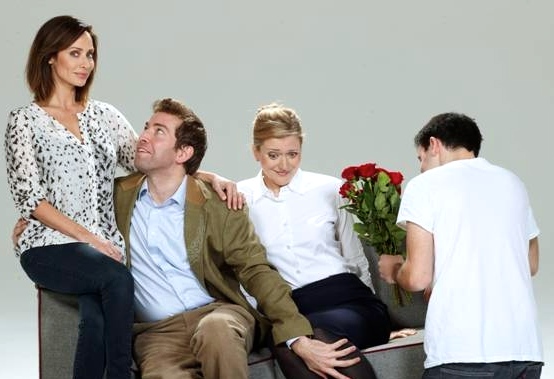
The highlight of  this comedy comes with what is probably the most ferocious man/woman fight scene conceived for the stage since Private Lives. High praise perhaps, but any comparison with Noel Coward must be the thing that Alan Ayckbourn dreads most. He built his reputation in the 1970s-90s with sharp observational comedies set mostly amongst the suburban English middle classes, but, increasingly, it is looking as if time has been rather unkind to some of his plays, robbing them of topical relevance and thereby exposing them for their lack of Coward-style wit.  For all the flippancy of Private Lives, that play still has something meaningful to say about the nature of human relationships, whilst this one, Ayckbourn’s 51st, now feels vacuous, ! lacking in purpose and horribly dated, even though it is less than 20 years old. The play was generally well received on its West End opening in 1998, so have times changed that much or is it simply misjudgements in this production that have damaged it? In a converted Victorian house in Fulham, Barbara (Claire Price), a frigid career woman and committed spinster, is occupying the ground floor flat and letting the upstairs one to new tenants, Nikki (Natalie Imbruglia), an old school friend and her fiancé Hamish (Edward Bennett). These characters are post-Thatcher London yuppies, something of a departure for Ayckbourn, and he never seems quite comfortable with them or able to develop them to become credible. As soon as it is established that Barbara hates Hamish for being Scottish and a vegetarian and that he hates her for being Barbara, it is clear that a love triangle is sure to develop, even though the chemistry between Price and Bennett is most notable for its absence. However, the central point of the play does not emerge until just before the interval and, until then, we need to endure almost an hour of laboured, inconsequential chitchat.  The actors, desperate to hear even the smallest ripples of laughter, often succumb to the temptation to overplay. This is seen in Imbruglia’s jumpy and excitable Nikki, but more so in a fourth character, basement-dweller Gilbert (Simon Gregor), a postman and a handyman who has a talent for fixing central heating and a fetish for wearing Barbara’s discarded clothes. Gregor makes a passable drunk, but, when sober, the weird inflections in his voice and his exaggerated postures seem as if they could be more at home in a cartoon. This production emphases the fact that Gilbert is a sad little working class man, then reiterates it and finally double underlines it. If this character was ever intended to have any dignity, Gregor never comes close to finding it. Multi-room sets are a common feature in Ayckbourn and here Giles Cadle’s design is rather effective. Barbara’s flat is in full view over a small section of the upper part of Gilbert’s; above is the lower quarter of Nikki and Hamish’s flat. The production looks handsome enough, but there is no escaping it – the main problem here is the play. The best of Ayckbourn’s later comedies tackle the darker undercurrents running beneath ordinary lives, but it is very difficult to find any depth at all to this one, still less anything to make us laugh. Eventually it just fizzles out in an awkward and unconvincing ending. Over two hours in the company of this irritating and unlikeable quartet could just be bearable were it not for the production’s quest for cheap laughs through its sneering and condescending depiction of Gilbert. This leaves a very nasty taste in the mouth and it flies in the face of modern day sensitivities every bit as much as the entire effort flies in the face of exciting new theatre.

Performance date: 19 May 2014

thepublicreview_hor_web copy

This review was originally written for The Public Reviews: http://www.thepublicreviews.com

Faced with a drunken man staggering around and rambling incoherently, most of us would make a dash for a corner at the back of the pub and hope that he stays at the front. However, on this occasion, we are invited to the back of the King’s Head to meet just such a man and spend 80 minutes in his company. The unnamed young man in question appears wearing a crooked bow tie and a dinner jacket with a pink carnation in the lapel; he looks as if he is about to give the best man speech at a wedding reception after all the guests have departed. He is not happy, describing himself as “not a person, but a person-shaped black hole”. He arrives already drunk and then empties four gin bottles, literally drinking himself under the table. Is he doing this to celebrate, to console himself or just to forget? He decides that it must be to forget, because he can no longer remember the reason. Edmond Digby-Jones captures the man’s state of advanced inebriation very convincingly, struggling to keep his balance, his mind racing and his tongue racing well ahead of it. One minute morose, the next regressing to childhood, he apologises to an imaginary female friend for his transgressions and promises not to do it again, without having a clue as to what he has done. He pours gin into her glass and when, after a couple of minutes, the glass is still full, he empties it himself. He coughs and then repeatedly reassures himself that he is still alive by exclaiming “still able to cough”, until it occurs to him that he might have got drunk to forget that he has an incurable chest disease. In fact, we conclude long before him that the most likely reason for his drunkenness is that he is using gin as an antidote to loneliness. Despite the obvious humour, the overall tone of Timothy Turner’s monologue, directed by himself, is rarely comic. Backed by slow, repetitive piano music, it is more melancholy and, eventually, nightmarish. In taking us into the darker zones of alcohol abuse, the play is not likely to do much for the King’s Head’s bar sales, but it serves as a salutary warning to the audience. ! ! As Being As I Am is at least 20 minutes too long, Digby-Jones has to work harder than he needs to, making it tempting to offer to buy him a drink at the end. On second thoughts, perhaps that would not be such a good idea.

Performance date: 18 May 2014

thepublicreview_hor_web copy

p.txt-2This review was originally written for The Public Reviews – http://www.thepublicreviews.com

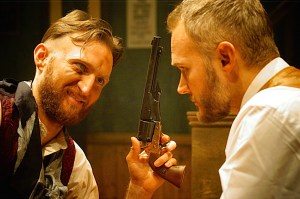
Theatre versions of well-known films have become increasingly common of late, but who would ever think of adapting a western? The wide open prairies of the American West would not be easy to replicate on a North London stage, but John Ford’s 1962 film, an acknowledged classic of the genre, is an unusually intimate piece, shot mainly in a studio on interior sets, and it undergoes the transition naturally. Bypassing the film, Jethro Compton has based his adaptation on the original 25-page short story by Dorothy M Johnson, which could have helped him to reimagine the characters and distinguish them from James Stewart, John Wayne, Lee Marvin and the like. Certainly the actors never seem inhibited by those long shadows and we forget about making comparisons with their film equivalents even before the end of the first scene. A British cast could also have led to problems with authenticity, but such worries are dispelled equally quickly, helped somewhat by hearing the recorded voice, as narrator, of Robert Vaughn; he is the last survivor of the original Magnificent Seven and, therefore, about as authentic as it is possible to get. Ransome Foster (Oliver Lansley), a lawyer from the East, arrives in the small Western town of Twotrees, having already taken a beating on the road from the merciless outlaw Liberty Valance (a menacing James Marlowe) and his gang. He is rescued by Bert Barricune (Paul Albertson), an ageing, gunslinging cowboy, and given refuge by the town’s saloon owner, Hallie Jackson (Niamh Walsh), who Bert believes to be his girl. Foster takes on the challenge of educating Hallie and her barman (Lanre Malaolu giving a stand-out performance), a gifted young black man nicknamed “The Reverend” because of his ability to memorise passages from the Scriptures. In the eyes of Valance, education will inevitably be followed by law and order and result in the end of his reign of terror, so a showdown between him and Foster becomes inevitable. On the face of it, this is a simple morality tale setting good against evil, but, in fact, there is much more complexity and depth to it. Barricune represents a dying breed of pioneers who had paved the way for a civilised society and Foster represents a new breed of men in suits and ties who take over the reins and drive forward to a world dominated by lawyers and politicians. The play asks which of these different codes is fairer and more honest, who are the real heroes and what separates truth from myth. A cleverly conceived and very satisfying ending highlights the ambiguities in the story and the irony in its title, bringing secondary themes to the fore. Varying the tone, the story also involves a touching love triangle, which is played out with great sensitivity. The heart sinks upon first sight of Sarah Booth’s set, a traditional saloon bar with swing doors, but fears that the play would be just another pastiche of a cinema genre so full of cliches are quickly dispelled. Compton’s script contains much natural humour, but never veers towards comedy and he shows good judgement in ensuring that sequences which could have been risible occur offstage or in darkness. Building tension for the impending arrival of Valance, the pace is slow and deliberate throughout, thesombre and reflective mood being heightened by atmospheric lighting from Julian McCready and original music composed by Jonny Sims. It would probably take around half an hour to read the original short story, so it is remarkable that there is enough in it to stretch to over two hours. But indeed there is and this version provides a consistently absorbing, often moving and very unusual evening of theatre.

Performance date: 16 May 2014

thepublicreview_hor_web copy

photo-66After four extraordinary successes, everyone now takes notice when Southwark Playhouse puts on an American musical. This is a Tony award winner from five years ago, set in the largely Hispanic district of New York City, Washington Heights, and amongst first and second generation immigrants from Puerto Rico – the young and the not so young, cab company and coffee stand owners, an ice cream seller, a hairdresser, a promising student, etc. We follow them through life’s trials and tribulations – financial hardship, a lottery win, courtship,  celebration, death and a power cut. Lin-Manuel Miranda’s tuneful score owes little to traditional Broadway and a lot to Latino artists such as Gloria Estefan, thereby making the songs refreshingly different and perfect for the exhilarating and colourful dance routines which crop up at regular intervals throughout the show. Directed by Luke Sheppard and choreographed by Drew McOnie, the mostly young company throw themselves across every inch of the small stage with energy and vigour; if the pace ever lets up, they have the simple answer – bring on the dancers. Miranda’s lyrics work well with Quiara Alegria Hodes’ book, both being lively and witty, but the only real problem lies with the narrative, which is too scattered and riddled with cliches; the stories manage to hold our interest for the first half, but fall away badly after the interval, leaving only the characters and the songs to drive a show which ends in slight disappointment that it did not turn out to be quite as good as it had promised. There are some terrific performances, most notably from Sam Mackay as the constantly rapping Usnavi (named after the ship that brought him to America) and seasoned players such as David Bedella and Eve Polycarpou are on hand to preside over the youngsters. However, in general, the script does not allow the performances to be developed into more than delightful cameos. As with other musicals staged by Southwark Playhouse, here and at its previous location, the big thrill is being able to sit in such close proximity to the performers for a flat-out song and dance production. This show is far from faultless, but it provides entertainment of a pretty high order.

Performance date: 15 May 2014

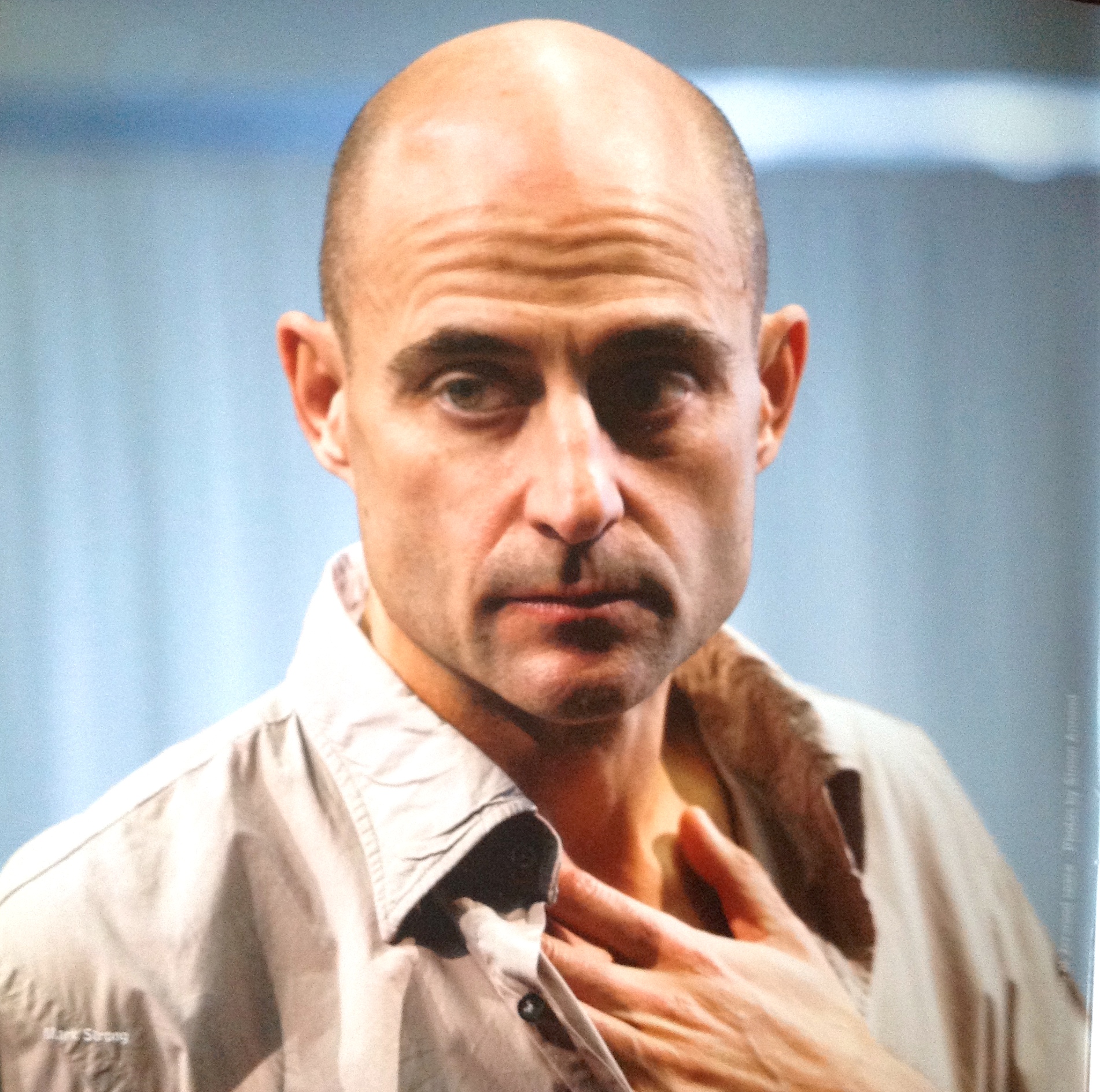
photo-68Belgian director Ivo van Hove’s reputation preceded him to the Young Vic, but few could have expected anything like this. He has taken Arthur Miller’s play, a masterpiece of modern drama, stripped it down to its bare essentials and rebuilt it piece by piece so that it comes to resemble a spoken opera. Clues that we are in for something special come from the very beginning. With the audience seated on three sides of an all-white oblong stage, a surrounding curtain rises slowly and, to the sound of solemn church music, reveals two men washing after their day’s hard work as longshoremen in 1950s Brooklyn, New York. One of them is Eddie, a legal Italian migrant who lives with his wife (Nicola Walker) and her 17-year-old orphaned niece, Catherine (Phoebe Fox). Their lives are disturbed by the arrival, illegally, of two relatives from Italy who need accommodation. An attraction forms between Catherine and one of them, Rodolpho (Luke Norris) and its growth is matched by that of Eddie’s uncontrollable jealousy. Miller moulds his play from Greek tragedy, with a lawyer acting as the chorus, commenting on events to the audience and to Eddie, the outcome seeming inevitable and unavoidable from the beginning. It is an enormous challenge for any writer and actor to express the emotions of an inarticulate man who cannot even understand them himself. Miller rose to the challenge and now Mark Strong, a hard man in many films, gives what must be a career-defining performance as Eddie. The visceral power, intensity and authenticity displayed by Strong are, at times, staggering. The other performances are also impeccable, but it is the director who is behind making this production of the play stand out from any other; there is no set and only one prop is used throughout the uninterrupted two hours running time; the actors are all barefoot, as if treading on sacred ground; the religious music persists at decreased or increased volumes, accompanied at times of high tension by a slow, soft drum beat. Occasionally, it benefits to look at actors who are peripheral to the scene taking place, in order to observe how they are staying in character and reacting. It seems as if every tiny detail matters to van Hove in his quest to develop and heighten the drama, but taking note of each of the details is impossible whilst we are reeling at their cumulative impact.  The climactic scene sees an unforgettable coup de theatre that is visually shocking, but entirely appropriate to the drama leading up to it. It is still only Spring, but, if London theatre sees anything better than this production during 2014, it will have been a truly blessed year. A shattering experience.

Performance date: 14 May 2014

225450_2_previewThe exterior of a modern double-fronted executive home occupying the entire stage is an imposing sight on entering the Olivier. Then the lights dim, the stage revolves and the whole of Act I takes place indoors. At the interval, the exterior re-appears and then revolves out of sight at the start of Act II, never to be seen again. So why is the National Theatre, which is subsidised out of public funds, wasting money and manpower resources on building a set, for which every one of hundreds of bricks is painted meticulously, when it is not even used in the course of the play? Notwithstanding this, there are no gripes about the ingenious six-room interior set, which trebles up to be three different homes with several scenes taking place concurrently, typical of the style of this play’s writer, Alan Ayckbourn. It was written in the mid-198os and performed on this same stage, with Michael Gambon in the lead, in 1987. It is a satire on greed, materialism and corruption in Margaret Thatcher’s Britain, telling how Jack McCracken (Nigel Lindsay), an upright and totally honest man, takes over a family business from his retiring father-in-law only to find it riddled with criminal malpractices. At first he stands firm and tries to uphold his standards of morality and decency, but he finds himself getting sucked more and more into the mire. The satire is just as biting and relevant now as it was in the 1980’s, but, somehow the play does not seem as consistently funny as it did back then. Ayckbourn built his reputation on his ability to make astute observations on the lifestyles and language of middle class Britain, so can it be that British society has changed in ways that make the playwright’s characters less readily identifiable? If so, then the play will have lost some of the humour arising from recognition of people and situations and, as Ayckbourn’s writing contains little wit of other kinds, it is funny only intermittently and just mildly amusing for the rest of the time. More Ayckbourn is lined up for next week, so it will be interesting to see whether this view holds or is refuted. Adam Penford’s direction, with a capable, non-starry cast, is slick and entertaining. It is difficult to pinpoint anything seriously wrong with this production, except that it never really catches fire.

Performance date: 13 May 2014