Posts Tagged ‘review’

The Maids (Donmar Warehouse)

Posted: October 26, 2025 in Theatre
Tags: , , , ,

Photo: Marc Brenner

Writer: Jean Genet

Adaptor and director: Kip Williams

⭐️⭐️⭐️💫

“Everybody ought to have a maid” asserted Stephen Sondheim famously in song, but the great lyricist could well have had second thoughts after seeing French writer Jean Genet’s 1947 play The Maids, which is revived here. The tale of two mischievous, murderous chambermaids was originally seen as a parable about a crumbling class system, but adaptor and director Kip Williams packs it with up-to-date references and transforms it into a satire on the cult of celebrity worship.

When we first encounter the sisters Claire and Solange, they are stepping aside from their daily duties in the boudoir of their employer, “Madame”. They take turns to impersonate Madame, they wear her expensive clothes, they scheme to undermine her latest boyfriend, who  is facing trial on fraud charges, and they plot her murder. Madame is expected home soon and her fans are congregating on the street below; like them, the sisters adore Madame, but they also loathe her in equal measure.

Madame eventually arrives, frantically worried about the fate of her boyfriend, and she is every bit as ghastly as the sisters’ impersonations have warned us, cruelly taunting each of her maids in turn. The point is made that all three characters are essentially the same and confrontations continue in a similar vein, whichever two of the three are on stage. Herein lies the play’s chief problem – repetition. Almost every scene begins to feel like a re-run of the one that preceded it.

Williams never asks the audience to invest in the characters emotionally, sustaining a surreal feel to the drama throughout. Exceptionally forceful performances by Yerin Ha, Phia Shaban and Lydia Wilson energise the production and lift it out of the play’s most sticky patches. Together, the three young actors resemble a group of lovestruck schoolgirls forming a fan club for, say, a pop star, although it is always clear that evil lies on the horizon.

This is a very grand production of a very small play. one that, arguably, could have been staged just as effectively at a small fringe venue with no formal set. As it is, set designer Rosanna Vize pulls out all the stops with a stunning boudoir bedecked with all things beige. The opening scene is performed entirely behind net curtains, thereby mystifying (and irritating) the audience and giant mirrors double as video screens, playing their part in Williams’ assault on our senses. However, there are concerns that gimmicks are being used to divert attention from the play’s shortcomings and paper over obvious cracks.

There is much to enjoy in Williams’ radical re-working of Genet’s obscure classic, but 100 minutes of this weird and often anarchic spectacle is more than enough.  Nonetheless, the points that it makes about the dangers of modern celebrity culture hit home strongly.

Performance date: 22 October 2025

Photo: Manuel Harlan

Writer: David Lan

Director: Stephen Daldry

⭐️⭐️⭐️⭐️

The alleged removal of children from their family homes in Ukraine to Russia has been one of the most horrific features of the current war in Eastern Europe and it gives topicality to The Land off the Living, David Lan’s new play which tells of events during and after World War II.

In 1945, Ruth is a 20-year-old United Nations aid worker in a devastated German city. Thomas, a 10-year-old  Polish boy, comes under her care. He is one of thousands of children who had been taken from their homes in German occupied territories to be tested for “pure blood” and, if deemed suitable, to be re-homed with Nazi supporters. Ruth leads Thomas on a perilous journey across Europe, avoiding the grasp of the Soviets, and eventually to a new home in the United States. Thomas finds safety and prosperity, but he loses his sense of belonging, his language, his culture and his heritage. The play asks where Ruth was right to consign Thomas to this fate rather than to help him in finding his own birth family.

Lan tells the story in flashback from the perspective of a reunion in 1990 between Ruth (Juliet Stevenson) and Thomas (Tom Wlaschiha). Events are acted out on Miriam Buether’s extraordinary set, which runs the entire length of the Dorfman Theatre’s auditorium. At one end there is a domestic living area and at the other there is a grand library, the two separated by a polished wood walkway which appears to be mounted on a multitude of filing cabinets. It may not be entirely clear how any of this connects to the play, but Buether gives director Stephen Daldry what he needs most – the space to stage a production on an epic scale – albeit at the expense of this theatre’s most precious asset, its intimacy.

Daldry’s staging is, at many times, thrilling. The chaos of post-war Germany and the race across a hostile continent are realised vividly and imaginatively with a company of 15 adults and children. However, there are moments when it feels as if the production is at odds with the play, overwhelming it. Lan has realised that events pf such magnitude can only be dramatised by condensing them into the lives of individuals, but Daldry chooses to paint the bigger picture. It is significant that the play’s most moving and memorable scenes come when fewer numbers occupy the stage. Specially, Stevenson and Wlaschiha give astonishingly powerful performances that shine through all the spectacle that surrounds them.

A fractured narrative structure does little to add clarity to the storytelling and the production could be viewed as overblown, but The Land of the Living deals with issues of profound importance, both historically and still today.

Performance date: 18 September 2025

Rhinoceros (Almeida Theatre)

Posted: April 5, 2025 in Theatre
Tags: , , , ,

Photo: Marc Brenner

Writer: Eugène Ionesco

Translator and director: Omar Elerian

⭐️⭐️⭐️⭐️

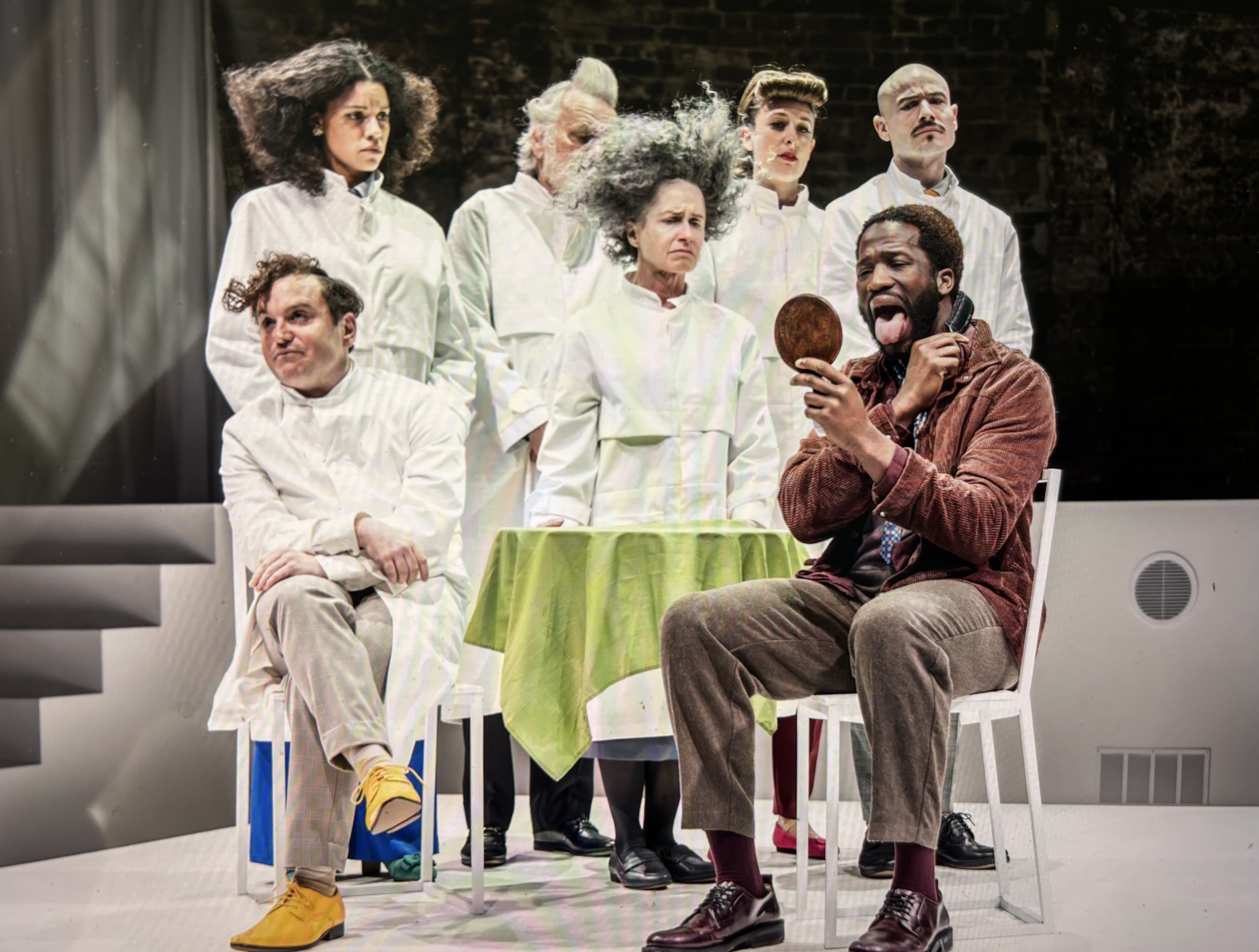
Top marks for timing must be given to the Almeisa Theatre’s decision to hold the press performance of its revival of Rhinoceros on April Fools’ Day. Eugène Ionesco’s 1959 satire remains a classic piece of absurdism and, potentially, offers a feast for the fools in all of us. However, this is a play that parades itself as a folly and then asks to be taken seriously.

Romanian-born Ionesco thrived in a France that was still recovering from Nazi occupation, in which the literati of Paris had become infatuated with existentialism and absurdism. Breathing fresh life into a piece which, at first glance, seems horribly dated in style and content, presents a double challenge to Omar Elerian, who acts as both translator and director. By presenting his production as a play within a play, he invites modern viewers to see it with even more mocking eyes, assisted by a narrator (Paul Hunter), who also conducts audience participation.

The play’s central character is Berenger, played with an air of puzzlement and growing conviction by Sopé Dìrísù. He is a depressed alcoholic who drinks as a way to find reality. In a French provincial town, he sits at a roadside café, chatting idly with his friend Jean (Josh McGuire), when a rhinoceros charges past them. Did it have one horn or two and would that mean it was African or Asiatic? They decide that it would be racist to speculate. Berenger’s prospective girlfriend Daisy (Anoushka Lucas) appears, carrying a dead cat, trampled on by a herd of rampaging rhinos. What is happening?

The action shifts to Berenger’s workplace, an office bossed by a fluttering M Papillion (Alan Williams) and a dithering M Dudard (John Biddle). Workers are ‘phoning in sick and confusion begins to reign as it seems that all the townsfolk are growing horns and turning into rhinoceroses. But Berenger stands firm, vowing that he will never join them.

The production is given a surreal look by Ana Inės Jabares-Pita’s all white set and (except for Berenger) costume designs, which become progressively darker as the play moves on. Ionesco’s depiction of one individual standing resolutely against an overwhelming majority represents a them common in 1950s drams, reflecting the politics of that era, but, here, it is made to be taken as a warning against present day trends in which populist movements appear to be gaining ground across Europe and elsewhere. Maybe the messages are put across crudely, but they are, nonetheless, effective.

Elerian takes as much licence as is needed to bring Ionesco’s preposterous pachyderm parable up to date and keeps his production fizzing with consistently inventive staging and impeccably timed ensemble playing. Yes, the translator/director succeeds in making this old play feel relevant to the modern world, but, far more importantly, he succeeds in making it fun.

Performance date: 1 April 2025