Posts Tagged ‘Theatre’

Photo: Helen Murray

Writer: Richard Greenberg

Director: Blanche McIntyre

⭐️⭐️⭐️

They say that Christmas begins earlier every year and, as if to prove the point, it has already arrived at Hampstead Theatre. American writer Richard Greenberg’s comedy The Assembled Parties, which premiered on Broadway in 2013,  centres around a New York family gathered together on two Christmases, 20 years apart. Much of the play’s humour draws from the irony of members of the Jewish faith (albeit npn-practicinh) celebrating a Christian festival.

The play opens in 1980, when Ronald Reagan has just been elected to serve his first term as United States President. In their Manhattan apartment, Ben (Daniel Abelson) and his wife, former actress Julie (Jennifer Westfeldt) play hosts; their elder son Scotty (Alexander Marks) has just graduated from university and is seeking direction in his life; he brings along old school friend Jeff (Sam Marks). The assembled party is completed by the arrival of Ben’s sister Faye (Tracy-Ann Oberman), her husband Mort (David Kennedy) and their daughter Shelley (Julia Kass).

Family members meet in pairs or groups to discuss politics, careers, finances, relationships and so on. James Cotterill’s impressive set design is dominated by a huge, fully decorated Christmas tree and a revolving stage ushers us from room to room. Director Blanche McIntyre’s solid production moves along briskly; it is all mildly  amusing, but rather inconsequential.

Act two jumps forward to 2000, when Bill Clinton has just entered the final month of his eight-year Presidency. The family, numbers now depleted, gathers again at Julie’s rented home. The Christmas tree is smaller, but the apartment is more spacious, expanding to the full width od the Hampstead stage. The focus now falls on Julie’s younger son Tim (also played by Alexander Marks), a college drop-out who works as a waiter and is involved in a secret relationship with a gentile woman. Introducing themes of loss and regeneration, the later stages of the play have added poignancy.

Greenber’s flair for feeding his characters with acerbic one-liners shines throughout and, with the lines being delivered with precusion by this highly accomplished cast, they become the main joy of the evening. Otherwise, there is nothing to dislike about The Assembled Parties, but nor is there much to rave about and, on this evidence, it is not easy to understand why the play received three Tony Award nominations. This comedy is a Christmas trifle, like a light dessert served without a main course.

Performance date: 23 October 2025

Photo: Manuel Harlan

Writer: David Lan

Director: Stephen Daldry

⭐️⭐️⭐️⭐️

The alleged removal of children from their family homes in Ukraine to Russia has been one of the most horrific features of the current war in Eastern Europe and it gives topicality to The Land off the Living, David Lan’s new play which tells of events during and after World War II.

In 1945, Ruth is a 20-year-old United Nations aid worker in a devastated German city. Thomas, a 10-year-old  Polish boy, comes under her care. He is one of thousands of children who had been taken from their homes in German occupied territories to be tested for “pure blood” and, if deemed suitable, to be re-homed with Nazi supporters. Ruth leads Thomas on a perilous journey across Europe, avoiding the grasp of the Soviets, and eventually to a new home in the United States. Thomas finds safety and prosperity, but he loses his sense of belonging, his language, his culture and his heritage. The play asks where Ruth was right to consign Thomas to this fate rather than to help him in finding his own birth family.

Lan tells the story in flashback from the perspective of a reunion in 1990 between Ruth (Juliet Stevenson) and Thomas (Tom Wlaschiha). Events are acted out on Miriam Buether’s extraordinary set, which runs the entire length of the Dorfman Theatre’s auditorium. At one end there is a domestic living area and at the other there is a grand library, the two separated by a polished wood walkway which appears to be mounted on a multitude of filing cabinets. It may not be entirely clear how any of this connects to the play, but Buether gives director Stephen Daldry what he needs most – the space to stage a production on an epic scale – albeit at the expense of this theatre’s most precious asset, its intimacy.

Daldry’s staging is, at many times, thrilling. The chaos of post-war Germany and the race across a hostile continent are realised vividly and imaginatively with a company of 15 adults and children. However, there are moments when it feels as if the production is at odds with the play, overwhelming it. Lan has realised that events pf such magnitude can only be dramatised by condensing them into the lives of individuals, but Daldry chooses to paint the bigger picture. It is significant that the play’s most moving and memorable scenes come when fewer numbers occupy the stage. Specially, Stevenson and Wlaschiha give astonishingly powerful performances that shine through all the spectacle that surrounds them.

A fractured narrative structure does little to add clarity to the storytelling and the production could be viewed as overblown, but The Land of the Living deals with issues of profound importance, both historically and still today.

Performance date: 18 September 2025

Rhinoceros (Almeida Theatre)

Posted: April 5, 2025 in Theatre
Tags: , , , ,

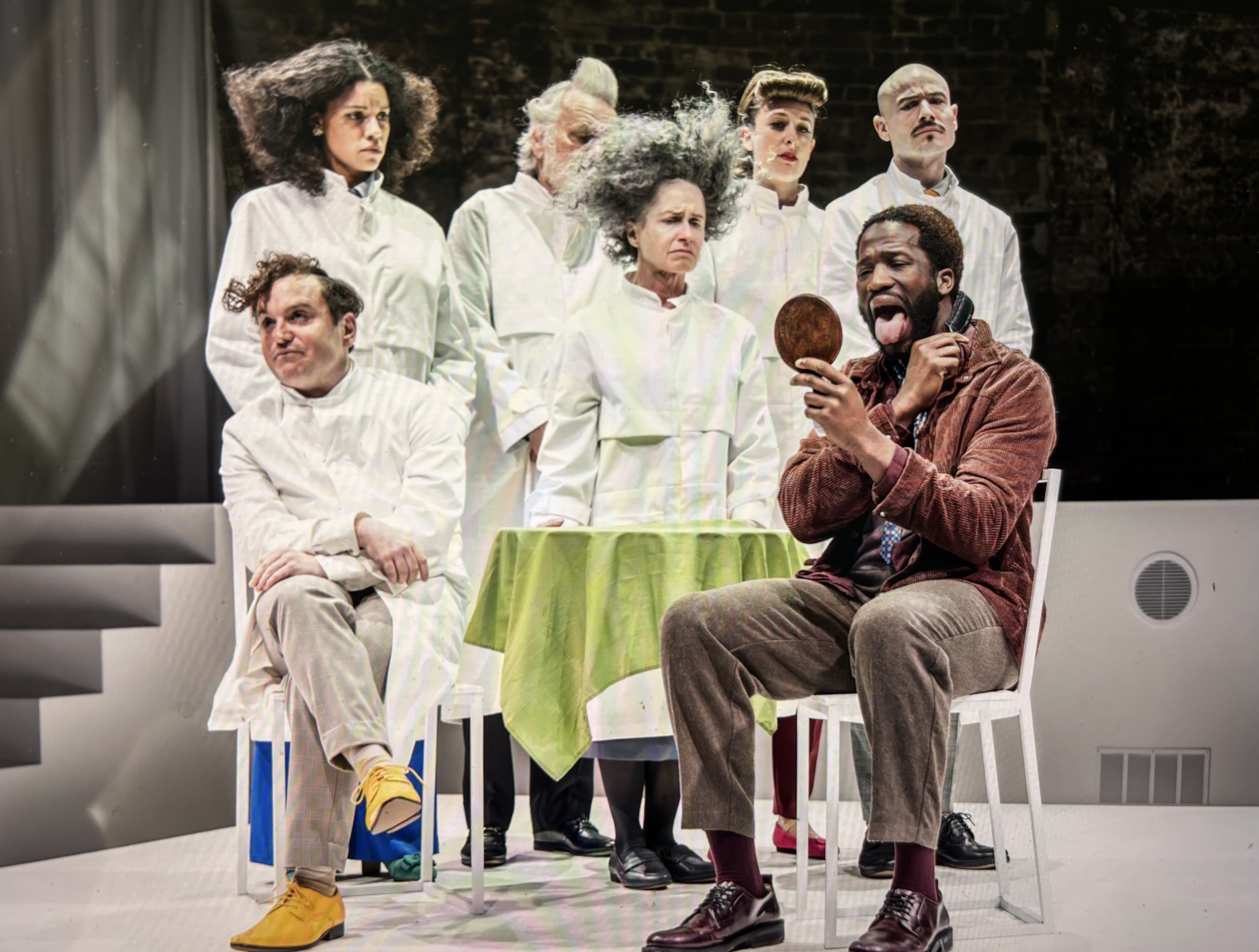
Photo: Marc Brenner

Writer: Eugène Ionesco

Translator and director: Omar Elerian

⭐️⭐️⭐️⭐️

Top marks for timing must be given to the Almeisa Theatre’s decision to hold the press performance of its revival of Rhinoceros on April Fools’ Day. Eugène Ionesco’s 1959 satire remains a classic piece of absurdism and, potentially, offers a feast for the fools in all of us. However, this is a play that parades itself as a folly and then asks to be taken seriously.

Romanian-born Ionesco thrived in a France that was still recovering from Nazi occupation, in which the literati of Paris had become infatuated with existentialism and absurdism. Breathing fresh life into a piece which, at first glance, seems horribly dated in style and content, presents a double challenge to Omar Elerian, who acts as both translator and director. By presenting his production as a play within a play, he invites modern viewers to see it with even more mocking eyes, assisted by a narrator (Paul Hunter), who also conducts audience participation.

The play’s central character is Berenger, played with an air of puzzlement and growing conviction by Sopé Dìrísù. He is a depressed alcoholic who drinks as a way to find reality. In a French provincial town, he sits at a roadside café, chatting idly with his friend Jean (Josh McGuire), when a rhinoceros charges past them. Did it have one horn or two and would that mean it was African or Asiatic? They decide that it would be racist to speculate. Berenger’s prospective girlfriend Daisy (Anoushka Lucas) appears, carrying a dead cat, trampled on by a herd of rampaging rhinos. What is happening?

The action shifts to Berenger’s workplace, an office bossed by a fluttering M Papillion (Alan Williams) and a dithering M Dudard (John Biddle). Workers are ‘phoning in sick and confusion begins to reign as it seems that all the townsfolk are growing horns and turning into rhinoceroses. But Berenger stands firm, vowing that he will never join them.

The production is given a surreal look by Ana Inės Jabares-Pita’s all white set and (except for Berenger) costume designs, which become progressively darker as the play moves on. Ionesco’s depiction of one individual standing resolutely against an overwhelming majority represents a them common in 1950s drams, reflecting the politics of that era, but, here, it is made to be taken as a warning against present day trends in which populist movements appear to be gaining ground across Europe and elsewhere. Maybe the messages are put across crudely, but they are, nonetheless, effective.

Elerian takes as much licence as is needed to bring Ionesco’s preposterous pachyderm parable up to date and keeps his production fizzing with consistently inventive staging and impeccably timed ensemble playing. Yes, the translator/director succeeds in making this old play feel relevant to the modern world, but, far more importantly, he succeeds in making it fun.

Performance date: 1 April 2025