A rape trial, no witnesses, just the testimonies of the alleged victim and the accused; this is the scenario for a piece of interactive theatre in which members of the audience form the jury and ultimately deliver their verdict. Remembering back to Jury Service at the Old Bailey, the setting and the atmosphere are just about right and the proceedings have a realistic feel to them, up to the point when the jury is allowed to question the pair; however, this adds to the sense of involvement. In the absence of independent evidence, it is simply a case of which version of events the jury believes; in Scottish law, a verdict of “not proven” would surely have been forthcoming in a case like this, but it is not allowed here. The verdict at this particular performance was followed by a delicious twist and it would be interesting to know what would have happened had the opposite verdict been given. Good Fun.
The Shawshank Redemption**** (Assembly Rooms Edinburgh, 18 August 2013)
Posted: August 19, 2013 in Theatre In the programme, the writers (Owen O’Neill and Dave Johns) attempt to answer the obvious question – why? Transferring any subject that is already an iconic film to the stage is inevitably risky, but the particular film in this case is rated the greatest of all time on IMDB and figures in the top ten of almost every poll of the film-going public. The writers state that they were not allowed to use anything from the film and sourced their play directly from the original Stephen King novella (yet note that they use the film’s title rather than the full title of the novella). However, the film casts a giant shadow and it would be futile to try to avoid comparisons with it. As the “fixer” Red, Omid Djalili could hardly be less like Morgan Freeman; on the other hand, as the wrongly-imprisoned Andy, the American actor Kyle Secor looks very much like Tim Robbins and plays the role similarly. Both actors are excellent. It is difficult to argue against the view that this story of de-humanising prison brutality, friendship, determination and unbeatable optimism stands re-telling many times; the biggest assets of this production are the assured, imaginative direction (by Lucy Pitman-Wallace) and the striking set designs (by Gary McCann). The stage version is less successful than the film in conveying all the meticulous detail that is so crucial to appreciating the “redemption”, but, to its credit, it does not over-sweeten the ending. Judged on its own merits, this is gripping theatre that brings a huge lump to the throat. But is it or could it ever have been better than the film? No.
A two hour walk around Edinburgh city centre during which all four seasons gave of their best, this is an interactive theatre experience designed to test each participant’s reactions to unusual and diverse situations. I got lost once during a heavy downpour, but managed to get back on track without resorting to opening the emergency envelope and completed the course successfully. During the journey, I took part in a robbery, posed as a fashion model, went on a blind date and got arrested. The various characters I chatted with all had interesting stories; of course they were all actors and all the stories were fictitious, so complete suspension of disbelief was essential. A pleasant surprise awaited at the end of the trail and nothing about this journey was not good fun, apart from the weather.
Originating from the Abbey Theatre in Dublin, Owen McCafferty’s 70 minute play covers what is now familiar territory – forgiveness and reconciliation after an atrocity. Two middle-aged men (Declan Conlon and Patrick O’Kane) meet in a Belfast bar; they are perpetrator of and bereaved from a bombing in the same bar almost 40 years before. A Polish barman (Robert Zawadzki) looks on. That is about it, all very predictable and saying nothing that is new. However, “Quietly” is quality, the writing and acting being so superb that it becomes impossible not to be drawn in and moved very deeply.
The venue, more a room than a theatre and badly ventilated, ideally suits this play which is set in the flat occupied by four young men ( three of the students) on their last night together we are promised a sort of “Train-spotting” for a new generation, drug and alcohol fuelled mayhem, and, for the first hour in the company of this fairly obnoxious bunch, that is more or less what we get. Written by Ella Hickson and convincingly performed, the play builds nicely towards a powerful climax. With civil unrest on the streets outside, old wounds are opened up and pent up anger is vented; these characters are probably tomorrow’s unemployed who already know that they will never be able to afford homes like the ones they grew up in, their frustration and rage are understandable. Unfortunately, the climax is followed by the most tortuously drawn out ending imaginable, taking almost a third of the play’s running time and only serving the purpose of demonstrating that these guys are not so bad after all. Yes, but that should not be the point. The play really needs the hard edge that it achieves and then throws away wantonly. A clue to the reason for this could lie in the gender of the writer who introduces two female characters and then seems to view events through their eyes, even giving us hints of romance. This play has so much to say, but ultimately it reeks of a cop out. Such a shame.
Who’s Afraid of Rachel Roberts?*** (Assembly Roxy Edinburgh, 17 August 2013)
Posted: August 18, 2013 in TheatreRachel Roberts was a gifted stage and screen actress, recipient of many awards, who was swept up on the crest of the new wave of British cinema in the early 1960s and deposited in Hollywood. Married to a-lister Rex Harrison, who we are told “liked a bit of rough”, she could not escape her humble Welsh roots and, beset by insecurities, embarked on a downward spiral of drugs and booze, leading to four suicide attempts only three of which failed. Playing her in this monologue, Helen Griffin (co-writer with Dave Ainsworth) revels in displaying all the falling star’s increasingly outrageous behaviour, making us both cringe and howl with laughter at each ghastly faux pas. She also conveys the tragedy of a woman whose life is out of control. A little too long at 70 minutes, but as small scale showbiz bios come, it is probably amongst the best.
Entering the theatre, we see a statuesque figure in a transparent cube, looking like a Damien Hurst exhibit at Tate Modern. As the cube lights up, the figure becomes animated and we see that it is a US Air Force fighter pilot, superbly played by Lucy Ellinson. George Brant’s play is a monologue recounting how the pilot is grounded when becoming pregnant and then assigned to the Nevada Desert to join the “chair force” and operate drones that are engaged in a war thousands of miles away in Afghanistan. As she spends her days looking at monochrome pictures, distant conflicts and real life become blurred. Presenting a story that is never predictable and a unique perspective on a terrible modern world, this is a totally riveting hour.
The Secret Agent**** (Traverse Theatre Edinburgh, 16 August 2013)
Posted: August 17, 2013 in TheatreWorking from Joseph Conrad’s prescient story of an anarchist terror cell, agents and double agents, set in the 1890s, this is a bold and imaginative theatrical work, created by theatre o, Matthew Hurt and the entire company. As the terror cell operated on the principle that nothing terrifies the public more than threats that cannot be understood, so this piece uses absurdist comedy, stylised movement and bizarre images to baffle and unsettle the audience. The lighting bathes the stage in sinister colours and casts long shadows, the actors exaggerate their speech and mannerisms, all creating a nightmarish world in which anything terrible can happen and nothing is ever as it seems. Challenging, but well worth going along for the ride.
I’m With the Band*** (Traverse Theatre Edinburgh, 16 August 2013)
Posted: August 17, 2013 in TheatreTim Price’s intermittently enjoyable play depicts the disintegration of a four man Indie rock band, pulled apart by personal egos, chaotic domestic lives and a huge VAT bill. The band is called The Union, the members being English, Scottish, Welsh and Northern Irish, making the events in the play a thinly disguised metaphor for the potential break-up of the United Kingdom. It is at its most entertaining in set pieces, including musical numbers, but there are too few of them and the play often rambles aimlessly, leaving the overriding impression of a great idea that has only partially been brought to fruition.
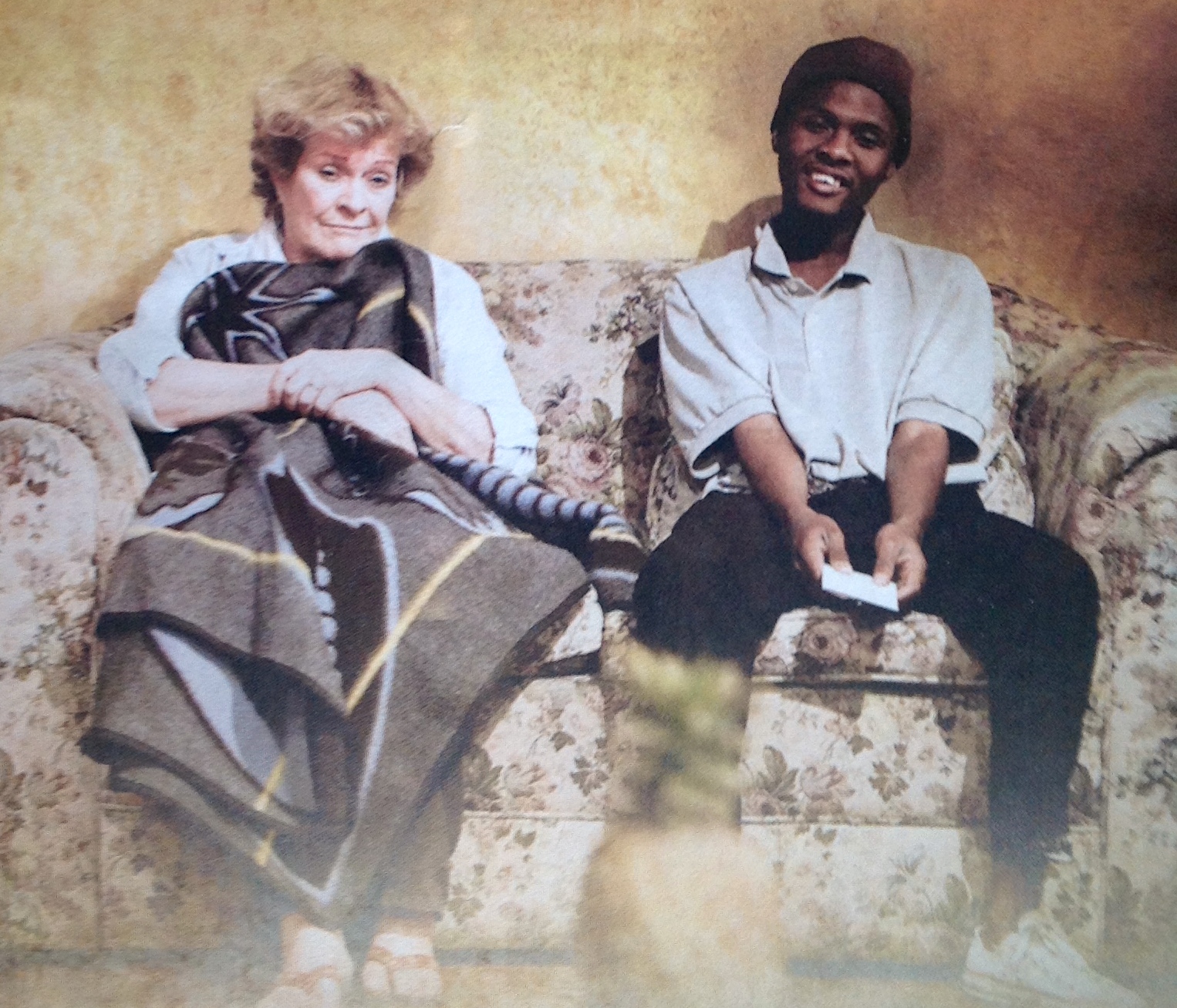 Set in a remote farm house in South Africa, the central theme of this 70 minute play is said by its writer, Lara Foot, to be isolation. Marion is white, ageing, unwell and, since the departures of all members of her family, completely alone and waiting for death to come knocking on the door. Instead Solomon, the 20 year-old black grandson of a former home help, arrives and the play charts the development of a relationship between the two. No this is not “Driving Miss Daisy” minus car, it is a completely original drama that deftly dodges all the usual cliches. Whilst there are obvious parallels with racial tensions and reconciliation in post-Apartheid South Africa, the writer wisely does not get distracted by wider themes and concentrates only on the central human story. The production is blessed with towering performances from Janet Suzman and Khayaletha Anthony which tear at the heart. If this is not as good as one act plays can get, it comes pretty close.
 The Beast's Pen