Conor McPherson’s play is set in a rural Irish bar in which four male regulars encounter a female newcomer to the area. For more than an hour, the five stand around telling each other spooky tales, drawing from Irish folk lore; whilst this is happening, the characters are developing, but the play is in desperate need of a stimulus to drive it forward and prevent it from becoming an infallible cure for the worst cases of insomnia. Then, miraculously, the tales become personal and the characters open out, climaxing in a final 30 minutes that is deeply moving, during which fine performances from Brian Cox and Dervla Kirwan begin to look like great ones. Peter McDonald, Ardal O’Hanlon and Risteard Cooper are also excellent, fleshing out their characters perfectly. This play is about belonging – to places and to people – and, ultimately it packs quite a punch. It is just a pity that it takes so long to get going.
This review was originally written for The Public Reviews: http://www.thepublicreviews.com
Coming in the wake of the Leveson Inquiry, a revival of this richly comic satire on London’s18th Century chattering classes could hardly be more timely. Sheridan paints a picture of a society dominated by idle gossipers and hypocrites to whom nothing matters less than the truth, a group that could easily be seen as the equivalent of certain sections of the modern media. Unfortunately, opportunities to highlight and explore these parallels are largely missed in Zoe Ford’s rather conventional interpretation for Turn of the Wheel Productions. Inexplicably the evening begins with flashing disco lights and a Eurythmics track blaring out, but, apart from this and some other curious music choices at scene changes, there are no attempts to update the play from its original period. The actors appear in splendid costumes and wigs and only the sparsely decorated sets suggest that this is a modest production. Grace Fairburn, as Lady Sneerwell and Alicia Bennett, as Mrs Candour, make excellent Queen Bitches and Sebastian Aguirre is suitably loathsome as their cohort, Joseph Surface. Sadly, the actor playing the key role of Sir Peter Teazle needed to withdraw at a late stage; replacing him, Rob Maloney was reading from the script in some scenes, but he has managed to capture the essence of a character that displays exasperated rage when confronting his wife yet is always a kind and honest man, capable of exposing the antics of the gossips. Playing Lady Teazle, Tabitha Becker-Kahn is the evening’s biggest comic delight, excelling as a country girl who has married a much older man and becomes intent on social climbing, only to face rejection by the elite gossiping circle. Sheridan is disdainful of the scandalisers and firmly on the side of their victims. He condemns those who take the moral high ground, seeking to profit from it, and he forgives those who may be guilty of minor aberrations but remain fundamentally decent. The production, which is is bound to improve once it has fully recovered from its unfortunate setback, occasionally sparkles and rarely falls flat. Maybe it could have brought more that is new to Sheridan’s work, but, nonetheless, it is always a joy to see this delicious classic revived.

It seems that Harold Pinter intended this 1958 play to be a Kafkaesque satire on authoritarianism and human rights violations, aiming it specifically at the Soviet Union. However, it comes across as more typical of Joe Orton than of the style that was to become Pinter’s trademark and, if there are indeed serious themes, they are well and truly submerged in Jamie Lloyd’s production, which is performed as broad comedy throughout. The establishment of the title is some sort of state-run rest home, managed by a ridiculous martinet (Simon Russell Beale) and his scheming lieutenant (John Simm). This clown/straight man double act dominates the production, squeezing every possible laugh out of a script which mixes verbal gymnastics with physical slapstick. It all has the feel of a very protracted sketch from “The Two Ronnies”; but that was a very funny show and, for much of the time, so is this.
This review was originally written for The Public Reviews: http://www.thepublicreviews.com
The City of York is described in this play as built on a graveyard above another graveyard and we are told that, whilst it was once famed for trains and chocolate, it is now known chiefly for its ghosts. The evening begins with the audience being ushered into a room above a pub where we encounter Mr Richard Baraclough sitting next to a small table, ready to sup a pint of Abbot’s ale. He appears a sombre figure, dressed in a black cloak and top hat, sporting a moustache and bushy sideburns. He admits to being a failed actor and an alcoholic and it transpires that he is a ghost hunter or, to be more precise, a tour guide showing visitors around locations in York where ghosts have reportedly been sighted. What we hear in this one hour monologue is eerie, but the creepiness is diluted by tongue-in-cheek scepticism. As a result, the tales Barraclough tells are all mildly amusing, sometimes gruesome but seldom particularly frightening. He tantalises us with early mentions of the ghost of George Pimm, a 19th Century ogre, before revealing the full story which forms his centrepiece. The structure of the monologue relies heavily upon repeatedly overturning expectations, so that a scary tale comes to a humorous end and a humorous tale turns scary. This device works in the beginning but it becomes much too obvious as the evening progresses. This production comes from Theatre of the Damned whose mission is to explore the “neglected world of the Theatre du Grand Guignol”. Playing Barraclough, Tom Richards makes piercing eye contact with every member of the audience individually and he fits the part well (this is not a backhanded compliment as he is clearly not a failed actor and probably not an alcoholic). However, the writer has miscalculated by putting his words into the mouth of a character who is, like most of us, dubious about the supernatural, as we did not come just to hear our views confirmed; what we really wanted was to be scared witless. The management of the Old Red Lion could also have made a big mistake by starting performance at 7.30 and thereby missing a trick to sell both more tickets and more beer. A 9.30 start would have allowed us to enjoy a couple of hours of merriment in the bar before wandering upstairs clutching our full glasses of Abbot’s to join Mr Barraclough and listen enthralled to his tales. Surely this is the context in which this monologue was meant to be performed. Unfortunately, making a sober judgement with things as they are, this does not add up to much of a night out at the theatre.
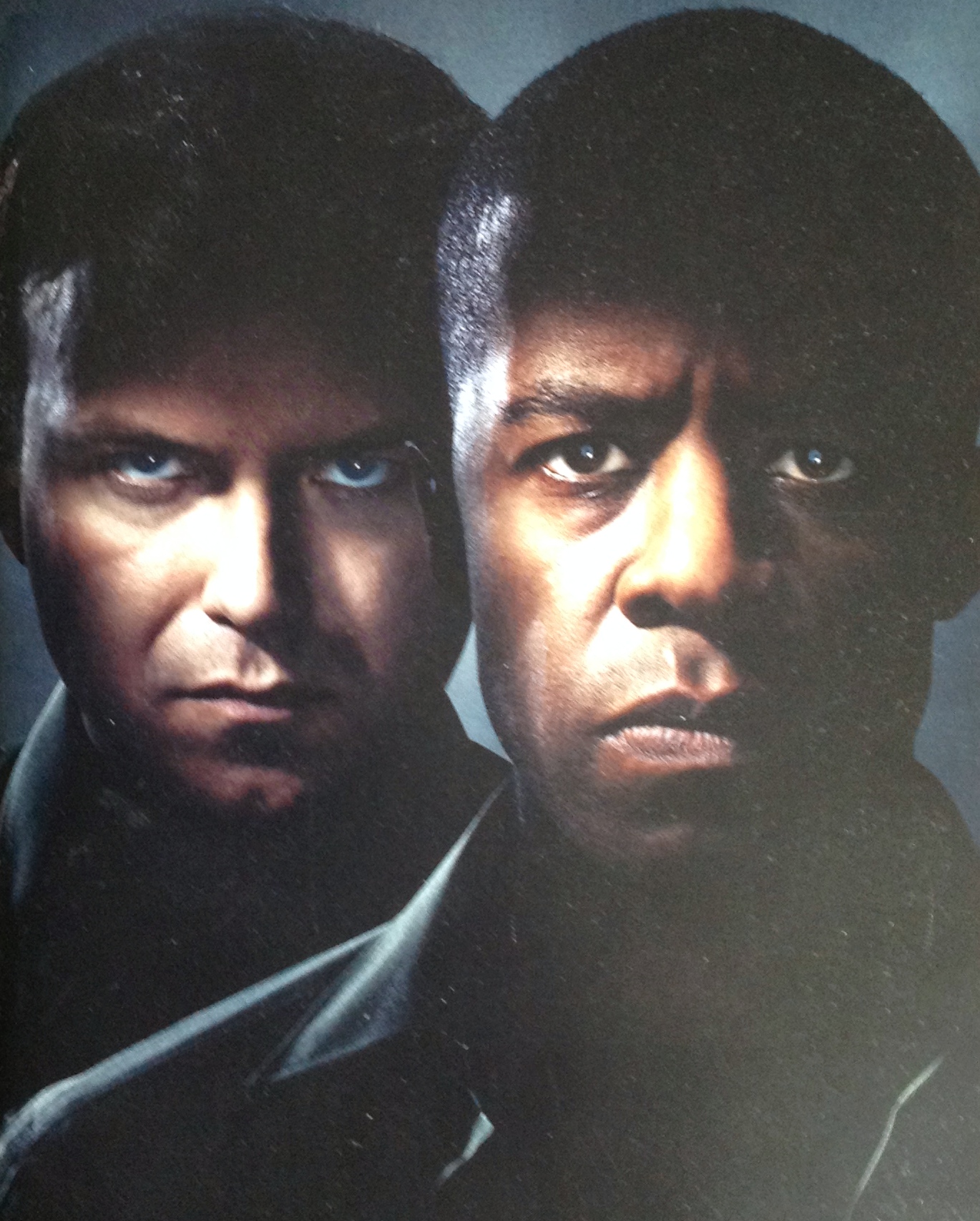 In Nicholas Hytner’s production, Cyprus becomes a modern day war zone looking something like Afghanistan and the chief protagonists are clearly defined by their class, Othello appearing as if a Sandhurst-trained officer, Iago a soldier from the ranks. Confined to an army base, the characters have little to do but idle time by gossiping, kicking around footballs by day and swilling beer by night; it is an environment in which it seems inevitable that petty resentments will fester and personal jealousies will be nurtured. Setting the play in this context proves to be a masterstroke as it gives greater clarity to all the plot developments and helps to throw light on the two great enigmas – Iago’s motivation and Othello’s gullibility. Preconceptions that Adrian Lester could be too lightweight for the title role are confounded as emphatically as suspicions that Rory Kinnear is turning into the finest Shakespearean actor of his generation are confirmed. As Iago, Kinnear gives a towering performance, smirking at his own duplicity, often standing front of stage plotting and scheming in collusion with the audience and lacing his words with sardonic humour; his delivery is so modern and true to character that it is often easy to forget that he is speaking the language of Tudor England. Relative newcomer Olivia Vinall is an endearing Desdemona, slightly built, tomboyish and vulnerable and the rest of the company is solid. There was a hitch with scenery at this performance which caused a five minute interruption near the beginning but, otherwise, the sets change smoothly from open exteriors to small claustrophobic rooms with fluorescent lighting. This is a production which exemplifies the National Theatre at the peak of its form.
Ruth Ellis, seems to have lost none of her fascination for dramatists almost 60 years after she became the last woman to be hanged in Britain. Many others, men and women, suffered the same fate, some of them even innocent, but few have stuck so firmly in public consciousness. After a slow and uncertain start, Amanda Whittington’s new play builds to a dramatic crescendo and is unequivocal in advocating that Ellis, although not technically innocent, was very much a victim. Beginning work as a hostess in a seedy Soho night club, Ellis appears as a bubbly if fragile young woman; we then see her gradually transform into a quivering neurotic, totally besotted with her secretly gay boyfriend, her body wrecked through beatings, miscarriages, abortions, drugs and alcohol. The murder she eventually commits is made to look more like an obligation than a crime, although, as the man she kills never appears in the play, we are not given the chance to understand the reason for her infatuation with him. This version of events becomes believable mainly because of a magnificent performance by Faye Castelow as Ellis. However, the play’s main weaknesses are its lack of balance and its failure to paint a wider picture of Britain at a time when rigid post-War morality codes were beginning to clash with the liberal era that was to follow. Without an understanding of the times in which the events took place, modern audiences may be bewildered as to how such a draconian sentence could have been imposed for an offence which, in the circumstances presented here, could result in little more than a reprimand in 2013.
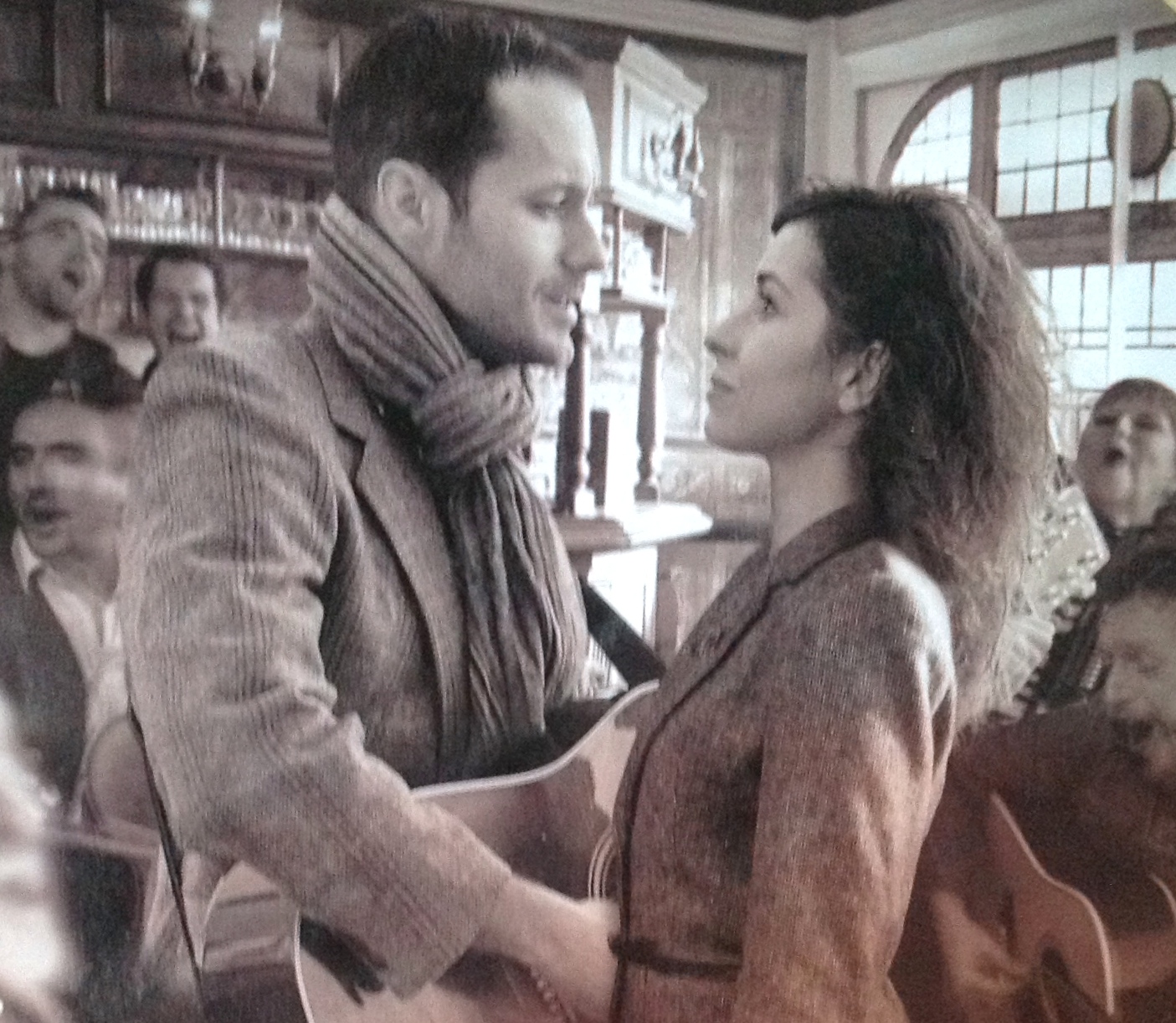 Oscar winning film, now Tony winning musical, this small scale Irish love story punches well above its weight. The single set is a Dublin bar, with a mirror at the back which reflects the audience and it even serves as a real bar with the audience being allowed on stage for interval drinks. The two main characters are an Irish guy (Declan Bennett), a singer/songwriter who is down on his luck and a Czech girl (Zrinka Cvitesic) who helps him to regain his confidence; both performers are excellent as is the supporting cast, playing characters more fleshed out than in the film. The Irish folk/rock songs are tremendous and beautifully performed. This show scores by being different, deftly sidestepping all the familiar cliches of musical theatre and of romantic drama. It is a little slow to get going and, occasionally it becomes so laid back that it almost grinds to a halt, but it has real warmth and charm throughout and it thoroughly deserves the plaudits it has received.
This review was originally written for The Public Reviews: http://www.thepublicreviews.com
With the audience seated around the performance area, this is a collection of monologues which effectively become intimate one-way conversations. Three experienced and accomplished actors play very different unnamed characters linked only by the fact they they are residents of California. Firstly Los Feliz, which opens with the character, a travelling salesman who claims to know every road in the State, sitting in a roadside diner finishing his burger and beer. He reflects that this makes a change from pizza and cola in his solitary apartment. He is 34 and he describes a life dominated by a routine but demanding job in which the only prospect for improvement is early retirement. He goes on to tell of a failed marriage, alienation from his daughter and his obsession for a woman who he knows to be out of his league. Playing him, Robin Holden is completely convincing, making him outwardly brash and macho but also giving us glimpses of his low self-esteem and his resignation to being one of life’s losers. Bennie and Joe’s is a reflection on life in a gay bar of that name where the character is a regular amongst the afternoon clientele. He is in late middle age, overweight and the others at the bar are either similar or younger men who aspire to Hollywood stardom; together they drink, gossip and flirt with the handsome barman before going home to “a lover, a pet or a memory”. He is describing a type of family wrapped up in its own concerns and looking on newcomers and passers-through with great suspicion. He talks only of events affecting the others and his own life outside the bar remains a mystery. John Vernon plays him as laid back and cynical, relishing his catty observations and lapsing into a slight stutter at points of tension in the story. Finally, Sunset sees an elderly lady chatting to her absent husband as sunset approaches in the day and perhaps in her life. She remarks on how sad it is that sunsets must always come to an end and remembers her youthful exuberance when first meeting him, the only real love of her life. However, she believes that it was because he later began seeing her as “his homemaker and sour-faced mother of his children” that he entered into a series of infidelities. She responded with a brief affair of her own, but eventually the couple were drawn back together to spend eight blissful years of retirement in the Californian Hills. Carolyn Lyster gives the most touching of the performances, animated and excited when describing the early days, but becoming wistful and melancholy as the story progresses. These monologues are about small lives and, with no dramatic high points, they are low-key and understated. However, each being of the perfect length, fine descriptive writing and skilled acting ensure that our attention never wanders.
Back to Hoxton to continue on from last Saturday. The organisation of this event has been shambolic, with nothing having been known about part 2 when part 1 ended and only a couple of days notice having been given for us to return for our trial. Therefore, no apologies are offered for the derision poured on last Saturday’s proceedings, even though completion allows the whole of the event to be seen in a different light. On this occasion, we believe we are to face trial for an unspecified offence, but arrive to be told that we have already been found guilty of future crimes by “The Machine” (a favourite Kafka-ism obviously) and face cleansing (ie execution). The Machine in this case is an advanced computer, able to predict future events with total accuracy and, as an add-on, it also carries out the cleansing. On a purpose built set, we are led individually through inter-connecting rooms to meet interrogators and confessors before arriving to watch through a two way mirror as The Machine carries out its work. The interactive meetings are inevitably tongue-in-cheek, but the cleansing is quite stark and harrowing. Part 2 turns out to be an altogether more satisfying experience than part 1.
This is the third theatrical interpretation of Franz Kafka seen in just a few weeks. It involved a foray into Docklands on a sunny afternoon, crossing the Thames via cable car to reach disused warehouses directly opposite the O2 Arena. It is a slightly eerie setting that serves as the Project Colony, somewhere South of the Equator. We are there to join a visitor looking around a community that purports to be Utopian. We begin in something like a village school hall, with smiley happy people singing, dancing and playing party games until the celebrations are ended abruptly with a double door opening to let in a glare of light from which white-shirted guards emerge. We are then escorted to an underground prison where we see the true nature of the authoritarian regime that underpins this society. We witness dehumanising processes and a demonstration of “The Machine”, a horrific new device for correcting anyone who steps out of line. Returning to the “school hall”, we see the reality of life in this community and the true effects of the brutality that lies beneath its surface. The production is all about contrasting light and dark, so maybe it worked particularly well at this performance because of assistance from the glorious weather outside. With around 30 young actors involved, it is possible that numerous restaurants will be short staffed for a while.
 The Beast's Pen