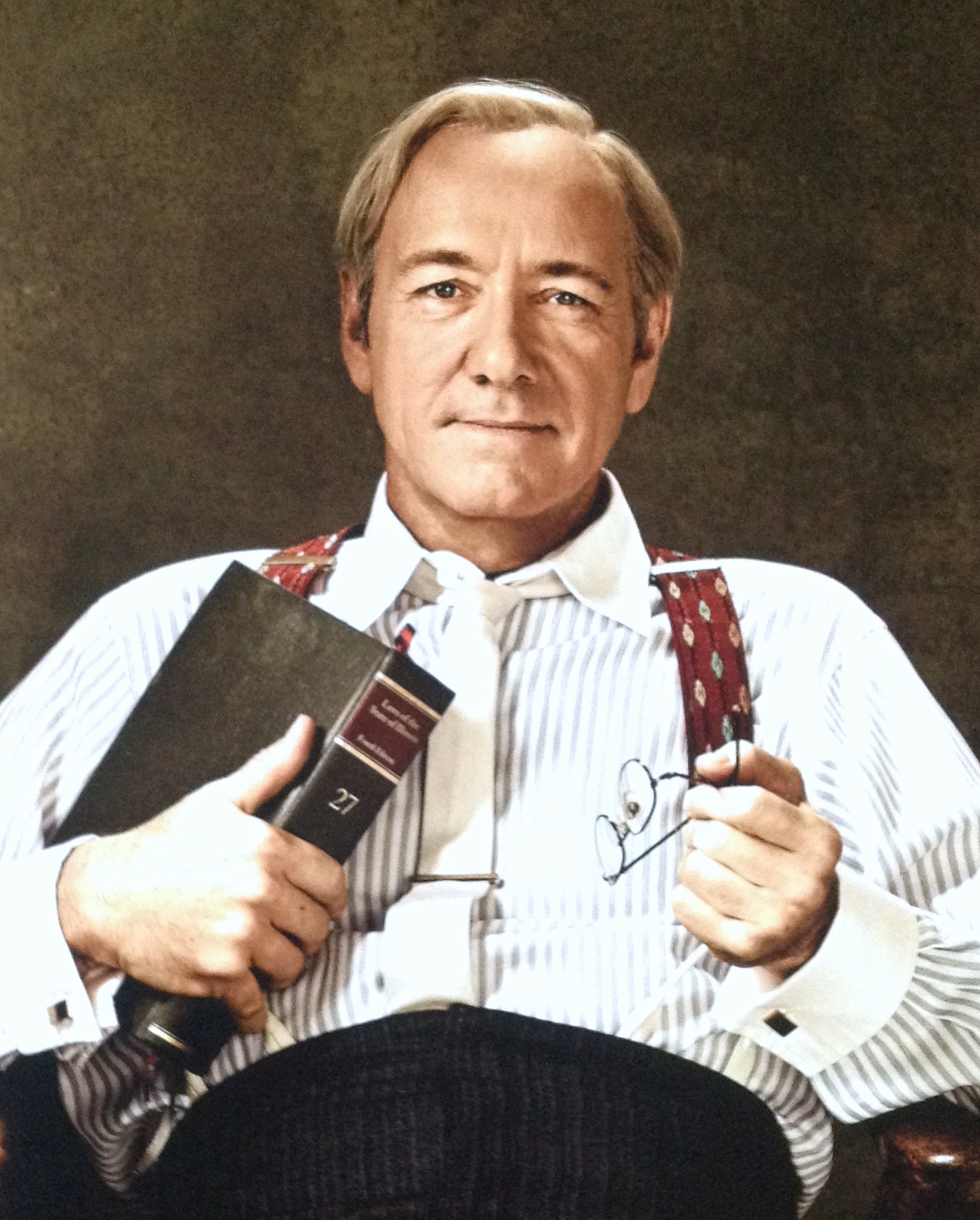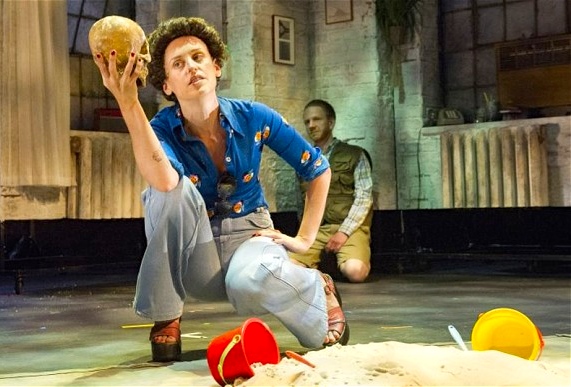
PX*4185958Janet Adler and Margaret Gibb were (fictional) American conceptual artists working during the last three decades of the Twentieth Century. They were collaborators and lovers, their work was innovatory, their appearance eccentric and their lifestyle unconventional. Tim Crouch’s new play (which he also co-directs) follows two modern film makers (Brian Ferguson and Denise Gough) as they try to demythologise the artists’ lives and works in order to uncover the truth about them. Giving the play an over-elaborate structure, we also hear from a young student presenting a paper on the artists and this proves to be an unnecessary distraction. Furthermore, the production’s style, which seems to assume that, if the play is about conceptual artists, it needs to be presented as if it were itself a piece of conceptual art, baffles more than it informs. Early parts of the play consist of absurdist conversations and surreal images, with children used as non-speaking extras, and there seems to be a lack of purpose, as we get only occasional glimpses of the very strong themes that are struggling to rise to the surface. Fortunately, the second act is altogether more focussed and Crouch now delivers his messages with clarity and force. He shows us that all the love, pain, ecstasy and suffering that form part of living are integral to art in all its forms and that they are themselves art. Gibb’s revelatory speech is superbly written and enhanced by Amelda Brown’s understated performance. A filmed sequence which is sheer perfection could and should have given the production a memorable conclusion, but, perversely, Crouch then chooses to remind us of the misjudgements that have dogged Act I, by tagging on a jokey postscript which misfires completely and comes close to destroying the reflective mood that everyone had worked so hard to create. In all, flawed but still intriguing.

Performance date: 17 June 2014
Incognito*** (Bush Theatre)

Posted: June 16, 2014 in Theatre

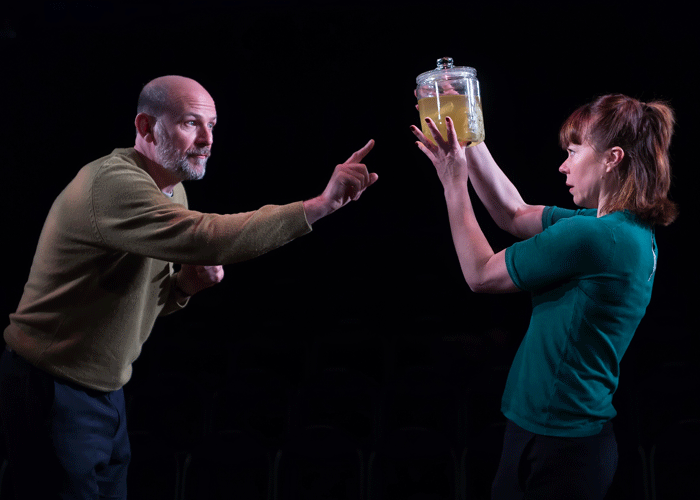
incognitoThroughout Nick Payne’s play, we can see what purports to be Einstein’s brain in a large jar of formaldehyde, so that it is almost as if the audience is being taunted by being told that this is what we would need in order to understand what is going on. “Incomprehensible” could have been a more appropriate title for this theatrical equivalent to the Rubik’s cube. In fact, we are told that Einstein’s brain, when dissected and examined under a microscope, looked like any other and that is as far as Payne goes in considering anatomical questions. His play is about the brain in a metaphysical sense, its functions and malfunctions. Several connected stories, spanning different decades and different continents, are intertwined in a complex structure, with four actors taking all the roles, switching rapidly from one to another, sometimes whilst on stage, with only changes in accents to help us to identify them. The play’s text is on sale at the Bush and it needs to be read before seeing the play performed, or maybe before seeing it performed for a second time. Not having read it, I often needed to glance at surtitles for the hearing impaired to get help with character identification. All that said, the feelings of bewilderment and disorientation which the play generates could well add to enjoyment of it by heightening dramatic tension. Maybe we are just meant to savour the individual components and not attempt to piece them together to make a cohesive whole. The actors, Paul Hickey, Amelia Lowdell, Alison O’Donnell and Sargon Yelda are all superb and Joe Murphy’s production moves at a lightning pace to give a constant bombardment on the senses. An entertaining and accomplished 90 minutes, so who cares if the brain hurts a little at the end of it?

Performance date: 13 June 2014

This review was originally written for The Public Reviews – http://www.thepublicreviews.com

Our first sight of Judith comes as she sips a glass of red wine (one of many) and staggers around her cramped London bedsit which is cluttered with cardboard boxes surrounding her unmade bed (an IKEA futon to be precise). Roger Glossop’s very realistic set design, which may owe a little to Tracey Emin, is a reflection of a life in chaos. Judith has been dumped by her longstanding boyfriend and, under the influence of the wine, she calls him and gets through to his answering machine to leave a message informing him that she has bought a packet of henna and some razor blades and will decide in the morning whether to dye her hair or slash her wrists. The plan misfires when Judith’s message is received by her ex’s new partner, Ros, and it is she who arrives at the bedsit to sort things out. Amy Rosenthal’s one act play, first staged in 1999, examines the tensions between the two women, victor and vanquished. In the opening stages, Rosenthal’s crisp and observant dialogue consists almost entirely of gentle sarcasm, but, as the balance of the women’s interaction changes, the emotions felt by both are brought out touchingly. Can it be that sisterly bonds may form notwithstanding the rivalry between the pair? Hatty Preston’s Judith is a ditzy extrovert, and we are never quite sure if she is genuinely heartbroken or if her pride has merely received a superficial wound. She acknowledges that she may have lost her man because she tried too hard to keep him, never realising that all he truly wanted was a steadier relationship. Ros is a less exciting school teacher, charitable in that she buys The Big Issue and exudes sympathy for Judith, but, as played by Nicola Daley, she shows a steely determination to hold on to what she has gained. This is not a play to set off fireworks. It is low-key throughout, lacking in dramatic high points and real bite. However the development of the two characters through sharp writing and well rounded performances is ultimately satisfying and, running for just 50 minutes, it never threatens to outstay its welcome.

Performance date: 12 June 2014

thepublicreview_hor_web copy

Attachment-1When seeing Putting it Together, the recent revue of Sondheim songs, the problem was disassociating the songs from the shows from which they originated. With this revue of musical theatre songs by Andrew Lippa, the opposite problem arises – not being able to associate them with their source material – and the problem is an acute one because some of them are so completely brilliant that they spur a desperate need to see the shows without delay. Lippa, Leeds born and American raised, has been a victim of the difficulties that have arisen in recent years in transferring original works of American musical theatre across the Atlantic, but, hopefully, that could be about to change. The Menier’s own David Babani conceived this review jointly with Lippa and he also directs, so could that mean that he has an eye on bringing one of the shows here to this small venue which has already done so much to further the cause of musical theatre in London? Maybe, but, in the meantime, the ball is already rolling as Lippa’s The Addams Family is being staged at the Assembly Hall throughout the Edinburgh Fringe Festival in August. This show is performed by three of the most accomplished stars of musicals – Damian Humbley, Caroline O’Connor and Summer Strallen – joined by Andrew Lippa himself, who anchors the show, shares piano duties and performs several of the numbers. He proves to be a ready-made cabaret act with smart anecdotes, quick wit and the gift for forming a natural repartee with the audience. He begins by telling us how, in the early 1980s, he had a date which included listening to the cast recording of Sweeney Todd and how this led to him falling in love, not with his amorous companion but with Stephen Sondheim. Clearly the love affair continues, because the prime influences in Lippa’s work both as a composer and a lyricist are Sondheim and everything that influenced Sondheim. There can hardly be a higher compliment and what a cause for celebration it is to suddenly discover that the great man has an heir who is 35 years younger and probably has his best years still to come. Delights here include, from The Addams Family, Humbley plastered in white make-up as Fester chanting The Moon and Me and the company performing the gloriously optimistic (Death is) Just Around the Corner. The song that gives this review its title is performed by Strallen as a drunk struggling to stay upright and, also from The Wild Party, the utterly hilarious lesbian lament An Old Fashioned Love Story  gives O’Connor the opportunity to stop the show for five minutes. The songs range from the outright comic to the heartbreaking and Lippa ends with extracts from his new choral work I Am Harvey Milk. This is an evening of marvellous melodies and magical rhymes that tickle the funny bone one second and pierce the heart the next and, throughout, there is a synchronicity between music and words that seems extra special because both come from the same writer. On its own, this sampler box merits a long run, but what makes it more exciting is that it could be only a foretaste of goodies to come in the shape of productions of the full shows. A terrific appetiser.

Performance date: 8 june 2014

This review was originally written for The Public Reviews – http://www.thepublicreviews.com

Given its wafer-thin storyline, it comes as a surprise to find that Harvey Fierstein’s book for this musical is based upon a film and television play for which writing credits went to heavyweights Gore Vidal and Paddy Chayefsky. A young couple announce that they plan a simple civil wedding within a week and are faced with their families insisting on a church ceremony and a reception with hundreds of guests, notwithstanding the fact that the parents of the bride-to-be have little money to pay for it. That is the plot in total, meaning that the show is almost entirely character driven. Janey (Aimee Gray) and Ralph (Calum Melville) are a likeable if slightly dull couple who express their feelings for each other in the charming duet Don’t Ever Stop Saying “I Love You”, but the main focus is on Janey’s family – her parents Aggie (Maggie Robson) and Tom (Howard Samuels), both still mourning the loss of their only son in the Korean War, and her Uncle Winston who sleeps on a sofa in their cramped apartment in the Bronx of the 1950s.! ! Robson sings beautifully throughout, but takes some time to get into her character, making little impression in the first half. It is not until after the interval that she becomes genuinely moving as a grieving mother wanting to give something to her surviving child whilst questioning the worth of her own marriage. Similarly, Samuels is somewhat anonymous until late on when his character finds that his marriage could be threatened and he pleads his case strongly in the dramatic I Stayed. Given his other best known work, it comes as no surprise that Fierstein has most fun with the flamboyantly gay Uncle Winston and he took the role himself in the original American production. Here, David Anthony revels in playing him; wounded at his exclusion from the wedding invitation list, he gets gloriously drunk and performs Immediate Family with splendid comic indignation. However, this character apart, Fierstein does not fully tap the potential for comedy in the piece; for example, Ralph’s snooty mother (Judith Street) appears only fleetingly and we want to see more of her. Fierstein’s problem could have been that songs eat up time, but, if they are allowed to nudge out comedy, it opens up the question as to whether this might have been better left as a straight play. John Bucchino’s score is pleasing on the ear, if occasionally repetitive, and there is little seriously wrong with his lyrics, except that a few are slightly bland. The best of the songs work well with Fierstein’s book, adding to the comedy or heightening the drama. A five- piece band of strings, woodwind and piano is tucked neatly into a back corner of Edward Iliffe’s impressionist set and, under the musical direction of David Keefe, they make a rich sound which does full justice to the music. This is not a dance show, but Ray Rackham’s production cries out for more fizz. The stage at this venue is adequate, but not vast and does not need to be reduced by having unnecessary furniture lying around to impede the performers’ movement. Songs ought to be interpreted physically as well as vocally and too often in this show singers are static, and actors who are peripheral during a song, are seen just standing or sitting and gazing into space. The show’s brief Broadway run in 2008 (around four months) suggests that it has deep- rooted problems and it may have been asking too much for this modest production to resolve them. What we see here is a curate’s egg of a musical – good only in parts, moderately entertaining but quickly forgettable.

Performance date: 6 June 2014

thepublicreview_hor_web copy

This review was originally written for The Public Reviews – http://www.thepublicreviews.com

Wearing dark suits and ties, Pat and Ed enter the empty lounge bar of a pub in the Peak District, don a fez and a straw hat respectively and begin their game of darts. It is clear that they have come from a solemn event and the pub is their haven from the worries of the world, a place where they can soothe their minds by going through the repetitive, rhythmic actions of stepping up to the oche alternately and slinging their arrows. So begins Eddie Elks’ one act play, described as a black comedy, in which barely a word is spoken for the first five minutes. It is slow, very slow to get going, but then it gains momentum as the characters open up and reveal more of themselves. Pat has a father suffering from dementia, has gone through a failed marriage and, earlier in the day, has run over a cat outside the crematorium. Ed is jobless and hides a very dark secret. Their interaction switches between bonhomie and aggression, but their darts match is hardly competitive, just a means to deactivate their troubled brains. Elks’ writing is full of mordant humour, bringing to life what would otherwise be mundane conversation, and he has a neat way of springing the unexpected on us, thereby giving the play an edgy feel and accentuating tensions which are simmering beneath the surface. Rhys King gives a very strong performance, playing Pat as a man close to breaking point, repeatedly referring to the deaths of animals as if his own existence is similarly imperilled – the squashed cat, a dog dead from an excess of vodka, head butting goats, a beak-less chicken and sheep trapped by a late Winter snowfall which results in a Spring of “crocuses and carcasses”. The writer himself plays Ed as a man whose macho exterior masks a deep inner fragility. The arrival of Sarah (Chiara Wilde) threatens the sanctuary which Pat and Ed have found. Coming from Guildford, she plans to replace real ale and pies with cocktails and tapas, repaint the pub in Egyptian blue and refurnish it. She taunts and teases the men, but will her plans be enough to tip them over the edge? The play builds to a startling and dramatic conclusion. Ken McClymont’s production does well in sustaining the fine balance between comedy and drama until reaching an overdone climax which culminates in a surreal sequence of physical theatre. This adds nothing to the play, but, once it has been overlooked, it is the inventive writing and truthful characterisations that linger in the memory.

Performance date: 5 June 2014

thepublicreview_hor_web copy

Theatre Bloggers United

Posted: June 3, 2014 in Theatre

S1250041The idea that any two theatre critics could agree entirely about anything sounds fairly unlikely, but there was unanimity amongst the 30 or so bloggers present at Central and Co (adjacent to the stage door of the London Palladium) on 2nd June – all concurred that this was a splendid evening. Generous tastings of Martin Miller’s Gin, neat, with tonic and in cocktails, enlivened the discussions, which centred on the theme that united everyone – London’s brilliant (mostly) theatre. It is now 30 years since professional critics disgraced themselves with their condemnation of Les Miserables and, to their shock, found that the public completely ignored them. For those of them still surviving, a walk along Shaftesbury Avenue continues to remind them that they no longer have the power to close shows or guarantee long runs. There is still a place for professional critics, but nowadays, thanks largely to the growth of the internet, theatre criticism has become much more democratic, with ordinary theatregoers being able to express their appreciation or disapproval of productions and find a wide readership. We bloggers have the simple aim of adding our views to discussions about shows and, in so doing, hopefully increasing the enjoyment that others get from a theatre experience, whether or not they agree with us. Enormous thanks for organising this event go to Rebecca Felgate of Official Theatre – http://www.officialtheatre.com . Many intriguing possibilities for future collaborations were discussed and even ideas for creating shows were floated. Rebecca, a musical based on the World War I exploits of a gay cannibal who glows in the dark sounds inspired. Believe and it could happen.

Other bloggers in the photo include, from the left: Ian Foster (London Editor of The Public Reviews), Jessica of The Theatre Tourist and Christopher Hong.

Clarence Darrow***** (Old Vic)

Posted: May 31, 2014 in Theatre

photo-72With most monologues it takes less than an hour before fatigue sets in for both the actor and the audience. This one lasts for almost two hours (with interval) and leaves us wishing that it could have been four. David W Rintels’ play first appeared on Broadway in 1974 and in the West End in the following year, performed on both occasions by Henry Fonda. Rintels was present at this performance, taking applause at the end. Based upon Clarence Darrow for the Defense by Irving Stone, the play gives an account of the life and extraordinary career of the legendary American lawyer, defender of the weak and sometimes the strong, but never the strong against the weak. Darrow (1857-1938) was a lifelong opponent of capital punishment and his success rate in defending against it was 102 out of 102, he was a pioneer of progressive liberal thinking and a towering court room orator. The play uses many extracts from Darrow’s own speeches and mingles them with anecdotes about his most famous trials and his private life. He defended Leopold and Loeb (subjects of the play/film Rope), Ossian Sweet, in which he took a defiant stand against racism, and John T Scopes in the infamous “Scopes Monkey” trial, which also inspired a play, Inherit the Wind, performed at this theatre in 2009. In that production, Kevin Spacey played a character taken to be Darrow and, going from memory, he assumes the same characterisation here – the same voice, stoop, faltering walk – and becomes a man roughly in his 60s/70s, looking back on his life from the time when commitment to his work wrecked his first marriage to old age when he is content to spend all day in his favourite armchair. The set is an old-fashioned office, with files and papers scattered untidily around the desk and floor, Darrow moving them around, finding documents of particular interest and sharing their contents with the audience. The programme tells us that this is the first time that Spacey has performed in the round or in a one-character play, but he meets both challenges effortlessly, addressing members of the audience as if a jury and frequently walking amongst us, making impassioned pleas for justice. Whilst we savour the privilege of witnessing one of the greatest actors on the planet in full flow, we should not allow this to overshadow the quality of the writing. There is not a second of this production that is not totally engrossing.

Performance date: 30 May 2014

This review was originally written for The Public Reviews – http://www.thepublicreviews.com

Great things can sometimes crop up in the most unexpected places – like, for example, an angel in a prison or perhaps a theatre in a church. Tucked in behind Harrods, St Saviour’s is still used part time as a place of worship and, for the rest of the time, it is put to several other very worthwhile uses, including serving as a small theatre. An original pointed Gothic arch stands in well for a proscenium arch and performances take place in altogether splendid surroundings. Darren Raymond’s one act play is set in a prison and he takes on the central role of Ryder himself. Ryder is 10 years into an 18 year sentence, hoping for but not expecting parole; he is hostile to prison officers, he refuses to share his cell with any other inmate and he has disconnected himself from his wife and son. His world changes with the arrival of a young first offender, Charlie (Eddie Thompson). Ryder reluctantly accepts him as his cellmate for one night only before proceeding to bully and intimidate him, but Charlie stands his ground and then makes the astonishing claim that he is, in fact, an angel on a mission. An opening scene in the Governor’s office seems to be paving the way for a bleak drama depicting the cruelty of prison life, but, once Charlie sets foot in Ryder’s cell, what we get is a riotous comedy, reminiscent of Porridge. The dynamics of the pair’s relationship are similar to those between the old lag Fletcher and the naive newcomer Godber in the classic sitcom, but here the humour is edgier, slightly surreal and peppered with up to date references. Raymond and Thompson make a memorable double act, their comic timing being spot-on throughout. However, as in most good comedies, the humour is underpinned by the main characters being given depth and becoming fully fleshed out. Ryder is proud but damaged, resentful of the solitude that has been forced upon him, but only responding by adding to it. Charlie is streetwise yet innocent, refusing to allow Ryder to trample over him and never wavering in believing his supernatural claims. There are times when religious themes threaten to encroach on the comedy, but Raymond the writer deftly sidesteps temptations to preach and he comes up with a genuinely touching ending. St Saviour’s does much excellent work in amateur dramatics and deserves wider support, but this should not be the main reason for going to see Prison Wings. This is a professional production and can only be fairly judged as such. Although a little rough around the edges, it is, in terms of writing and acting, top class and it offers a highly entertaining evening.

Performance date: 29 May 2014

thepublicreview_hor_web copy

This review was originally written for The Public Reviews – http://www.thepublicreviews.com

“Good friend for Jesu’s sake forbear, To dig the dust enclosed here. Blest be the man that spares these stones, And curst be he that moves my bones”. So pleads William Shakespeare in the epitaph that appears on his own tombstone, but the man upon whom he based one of his most famous plays has not been allowed to lie undisturbed. The skeleton of King Richard III was found recently after spending many winters of discontent beneath what is now a car park in Leicester and then moved to a more dignified place, suitable for a monarch, even one so widely reviled. Sharon Jennings’ play takes a somewhat quirky look at the discovery of the bones and the arguments as to whether or not, thanks to the work of our greatest playwright, history has been very unfair to this King. Perhaps Shakespeare was doing no more than spreading propaganda in support of Tudor monarchs, who would have seen it as in their interests to discredit the House that they had displaced. Maybe, rather than being the ruthless King that killed to claim the throne and killed more to keep it, Richard was a benevolent monarch who loved his wife and built churches. We are told that there is not a shred of evidence to link Richard to the murders of the two young princes in the Tower, the most heinous of the crimes with which he is associated, and plenty of evidence to suggest that he was intrinsically a good man reigning in very bad times. The play takes the form of a discussion at Leicester Council offices between Len (Toby Osmond), a Council official, Barbara (Kathy Trevelyan), a representative of the Ricardian Society which defends Richard’s reputation, and Ambrose (Steve Blacker), a history professor at Leicester University. Each has an eye to financial gain from the discovery of the skeleton, considering whether their interests could be best served by Richard being portrayed as a hero or a villain. They are joined by the ghost of Richard himself (John Gregor), who, although not seen or heard by the trio, creates a very nasty smell that is blamed on the drains. Possibly being aware that this discussion could be very dry and that Barbara and Ambrose would, inevitably, be dull characters, Jennings writes some sections in rhyming verse and introduces elements of comedy, mainly through Len, who is portrayed as bumbling and badly educated. However, this is where the play is at its weakest, with many of the jokes falling flat and Len coming across as too much of a buffoon even to typify a local government official. Richard’s ghost, dressed in a long, white robe, also appears at first as a comic figure, showing mock indignation at insulting references made to him and throwing in asides about having protested his misrepresentation directly to Shakespeare and, more recently, to Laurence Olivier. Rather than resorting to poor comedy, a better way to make this play livelier might have been to shorten it and thereby give it more punch. At two hours (including interval), it needs cutting by at least a third. The final section is easily the strongest. Here Jennings expounds the theory that the truth about Richard lies somewhere between the views of his supporters and those represented in Shakespeare’s play. She uses the character of Richard’s ghost, no longer a comic figure, to articulate her theory, defend his reputation and admit to his failings. Gregor’s strong, authoritative voice and demeanour give gravitas and credence to her words. It takes some time getting there, journeying through flat debate and weak comedy, but, in the end, there is worthwhile drama. RIP Richard.

Performance date: 28 May 2014

thepublicreview_hor_web copy