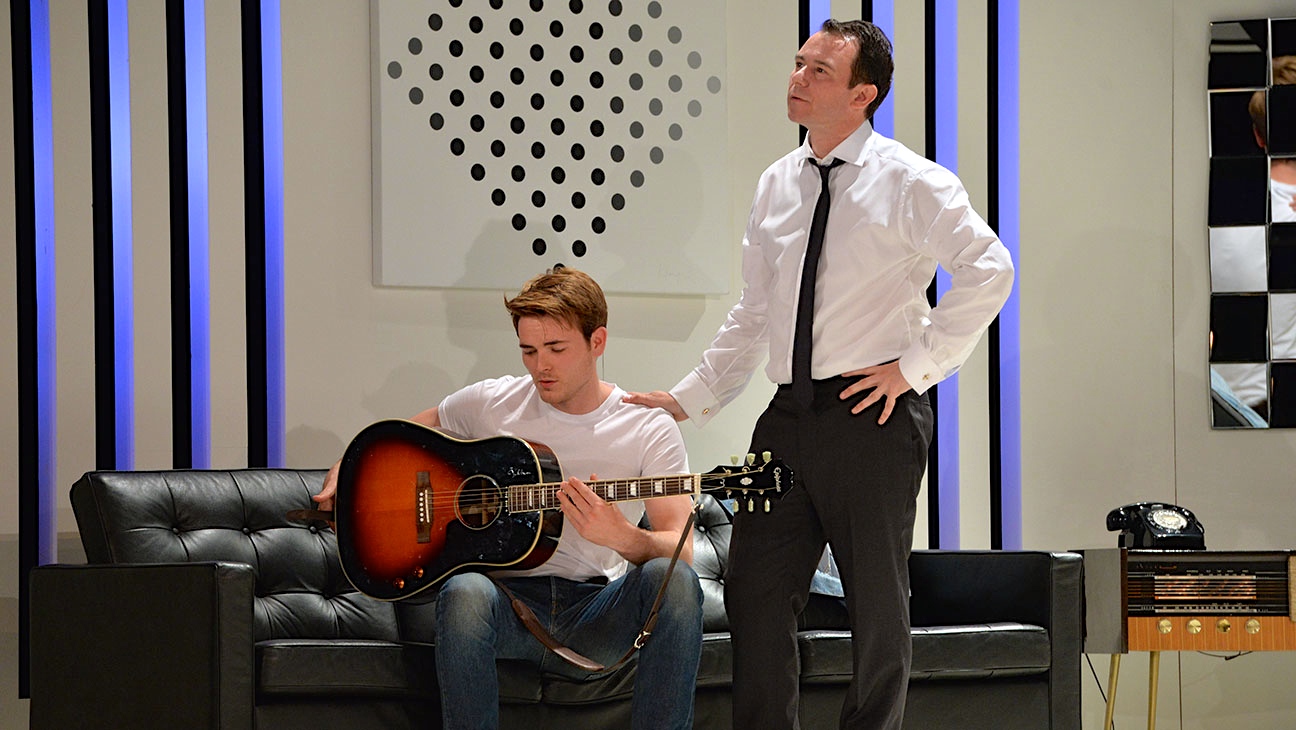
Monologues featuring well-known showbiz personalities are standard fare for the Edinburgh fringe and this one is par for the course. Set in a Sydney hotel room, it shows the tragic clown swigging neat vodka direct from the bottle and recounting anecdotes from his life during that last half hour (more 50 minutes) of his life. Hancock had enjoyed enormous success on radio and television in the 1950s and 60s, even breaking into films, but a series of disastrous career moves had put his career on the skids and brought to the fore all his underlying insecurities. Written by Heathcote Williams and performed by Pip Utton, the play brings to mind Hancock’s own groundbreaking television monologue, being peppered with the same Galton & Simpson style humour, but it tells us little that is not already known from other written and dramatised works.

Performance date: 10 August 2014

lippyBeginning with a post-show discussion of a production which the audience has not seen, this play by Bush Moukarzel and the Irish company, Dead Centre, takes us on a journey from absurdist comedy to surrealist tragedy. The central theme is lip reading, but the play extends this to become an exploration of all communications between human beings, demonstrating how we understand or, more often, misunderstand each other. An unconventional structure leaves us never knowing what to expect next and creates an unsettling effect which helps to keep us gripped, at least until an overlong final filmed section which appears to owe a great deal to Samuel Beckett’s Not I. Well acted and imaginatively staged, the production gives plenty of food for thought.

Performance date: 10 August 2014

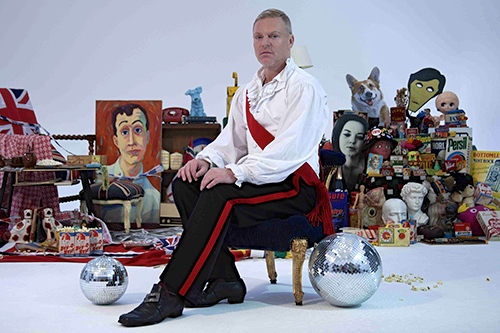
torstenThe best way to describe this show is to quote from the accompanying notes: “A theatrical pop-song cycle of ‘musical postcards from the hotspots of memory’ from a semi-immortal polysexual sensualist’s life”. Devised and written by Barney Ashton with music composed by Christopher Frost, the cycle is performed by Andy Bell (half of the pop group Erasure), firstly in a dinner suit and later getting down to glittering underwear. Torsten is recalling his life in Britain of the 1970s and 80s, time spent in depressing places such as rainy seaside resorts and Bingo halls. Film footage from the period backs up the images created in the stark and vivid lyrics of the songs. Bell sings them with passion, accompanied by synthesiser and, occasionally, a saxophone. An hour listening to Bell is an hour well spent, but how we yearn for just a glimmer of joy in Torsten’s miserable life. Definitely not a show to be recommended to the suicidal.

Performance date: 9 August 2014

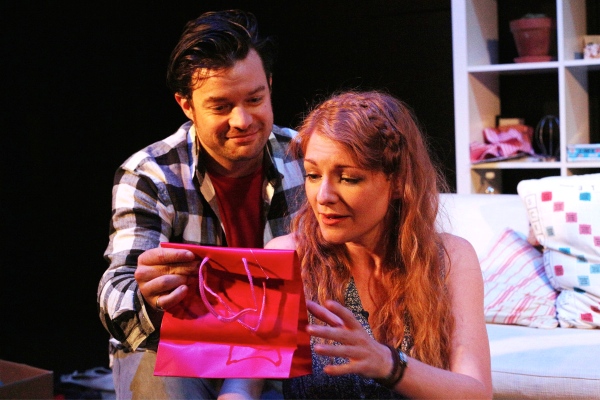
marry me a littleA musical made up of Stephen Sondheim songs, but not a Sondheim musical. Craig Lucas and Norman Rene have devised this lightweight hour long confection, performed here in a cabaret setting, by taking songs written for a wide range of shows to tell a simple story of two New Yorkers, known just as “Man” and “Woman”.  Beginning as singles, they date over pizza and diet Coke, move in together, unpack the cds, contemplate something serious, re-pack the cds and part. There is no spoken dialogue and the song which gives this show its title is easily the best known; interestingly, it was once cut from Company and later reinstated. Many of the other songs have also fallen onto the cutting room floor at some stage and others come from obscure early works. Bang, a raunchy number, sung here when a date goes extremely well, was cut from A Little Night Music. When the couple enjoy a round of golf together, they chant Pour  Le Sport (“I got a birdie, I wasn’t trying…..never occurred to me the bird was flying so low”), from a never-produced show. Simon Bailey and Laura Pitt-Pulford are likeable performers who carry the show well. A mellow and undemanding entertainment.

Performance date: 8 August 2014

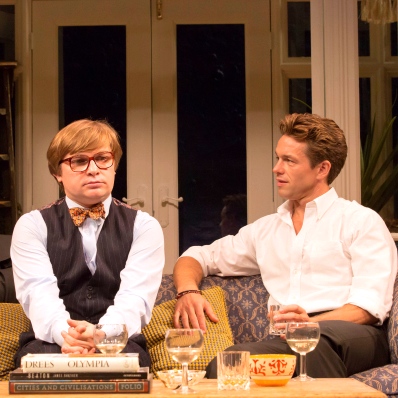
my night with regKevin Elyot died on 7 June 2014, shortly after the Donmar had announced its plans to revive his best known play. This sad event meant that questions as to whether or not this part-subsidised theatre ought to be reviving a play which had a decent West End run relatively recently were replaced by references to a “timely tribute”. However, first thoughts were that maybe it is not such a tribute to stage a revival which could be seen to label this gifted writer as a one-hit wonder and maybe a play the specifics of which are rooted in gay lifestyles of the early 1990s would not do justice to a genuine groundbreaker of British theatre. A stage adaptation of Elyot’s 2007 television work Clapham Junction, still up to date, provocative and challenging to any audience, could perhaps have proved a more appropriate tribute. In contrast, My Night With Reg is a staid parlour piece, rather fitting with the current branding that the Donmar seems to have opted for, but, as soon as this production gets going, two things become clear – firstly, that all of the details which date the play are irrelevant and secondly, that it is not simply a “gay play”, its themes are universal and all that is needed to identify with it is to be alive. Guy (Jonathan Broadbent) is the type that everyone likes and confides in but no-one fancies and he has been infatuated with John (Julian Ovenden) since University days; John is having an affair with Reg (never seen), partner of Daniel (Geoffrey Streatfeild), whilst two other friends, Benny (Matt Bardock) and Bernie (Richard Cant) are bound loosely together in a rocky relationship. They are all so self-absorbed that they are incapable of recognising what is going on around them. We first see the group at a party to celebrate Guy moving into a new flat with a conservatory just being finished off by Eric (Lewis Reeves) a young builder from Birmingham. These are all characters yearning for unattainable happiness, just like those in a Chekhov play, but, whereas in Chekhov the looming cloud was revolution, here the unmentioned elephant in the room is HIV/AIDS. They hold on to feelings, unable to express them until opportunities have passed them by; their relationships are undermined by deception, their friendships are built on top of lies and they find fleeting solace in the form of the poisonous Reg. Elyot writes these characters not as if they are people that he has known, but as if he has been them all himself and the performances of the actors in bringing them to life are perfection. Notwithstanding its underlying bleakness, the play is essentially a comedy with blisteringly funny dialogue and Robert Hastie’s unhurried production brings out all the humour and all the despair. It adds up to the Donmar doing what the Donmar does best and, whilst I have criticised the theatre recently for sitting on the sidelines whilst its rivals embrace exciting new work, this is a production which leaves no room for such criticism, only for celebration.

Performance date: 7 August 2014

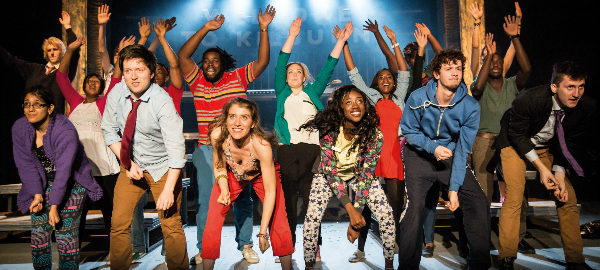
articleimage-Kilburn-PassionKilburn, passion – an oxymoron? Well not as seen in Suhayla El-Bushra’s play, back here for a second run and performed by the company of eighteen 19-25 year olds who inspired it. This is a vibrant and colourful celebration of everyday life in a multi-cultural, multi-ethnic, multi-everything, modern day London NW6. Told in short, mostly comedic sketches, the play introduces us to a collection of identifiable characters, all beautifully played, as they cope with the trials and tribulations of existing in an urban pressure cooker. Laughs are plentiful, but we are always aware of tensions bubbling beneath the surface – racism, homophobia, marital strains, drug addiction, isolation and many more themes appear, but are tackled skilfully with the lightest of touches.  The raw energy of the company is enough to steamroller the cruder elements of Emily Lim’s production, which flows from one short scene to another seamlessly. It all leads to (mostly) happy endings and, in true Passion Play style, the emergence of the unlikeliest Saviour. An entertaining and uplifting 80 minutes.

Performance date: 5 August 2014

epstein_playThis review was originally written for The Public Reviews – http://www.thepublicreviews.com

Known as the man who discovered, packaged, stylised, branded and sold The Beatles, Brian Epstein may indeed have “made” the group; that is made everything except their music. Andrew Sherlock’s play, first seen in Liverpool in 2012, attempts to uncover the private man behind the figure who, it could be argued, moulded the 1960s and influenced every generation that followed. Epstein was a gay, Jewish Liverpudlian who, during a period in London trying unsuccessfully to become an actor, had been convicted on indecency charges. ! At first, he is seen here as a resilient outsider, commenting at one point that he can handle rejection because he has never known anything else. However, the desire to be on stage reveals a need for the limelight which his management role could never satisfy; he recalls with bitterness the occasion when Princess Margaret shook his hand whilst still looking at and talking to John Lennon. The play takes place in 1967 in Epstein’s Belgravia flat. He brings home a young man, known only as “This Boy” (one of several references to Beatles lyrics that creep into Sherlock’s script), who turns out to be an aspiring journalist looking for a story. Sexual chemistry between the two is hinted at throughout, but this proves to be a red herring, as the play adopts the format of an interview. It is a format which sometimes creaks, leaving us wishing that more about Epstein could be revealed through the drama of the two characters’ interaction, rather than by straightforward questions and answers. Where this production scores most is with two compelling performances. Andrew Lancel is outwardly stylish and arrogant as Epstein, but he is clearly a bruised and brittle man. He speaks in the affected manner that might be adopted to conceal an accent, he is capricious, quick tempered and addicted to pills and alcohol. Lancel shows us a man who has achieved success beyond imagination, but is disintegrating before our eyes. Will Finlason deserves more to work on in playing the nameless young man who Sherlock leaves as something of an empty shell. This is one of the play’s weaknesses, but Finlason does a great job in building the character into a sexually ambiguous, cocky Scouser who is in awe of and genuinely concerned for the man that he sees as a genius. Brian Epstein died from a drug overdose, aged 32, on 27 August 1967, exactly a month after the Act legalising homosexuality received Royal assent; the World was moving on rapidly and strains with The Beatles and other performers that he fostered had by then begun to show. Sherlock suggests that, at this point in his whirlwind of a life, Epstein was no longer equipped to cope with further change. As the play is dealing with the private life of a very private man, it can never offer more than interesting supposition, but, as such, it is often very convincing.

Performance date: 4 August 2014

thepublicreview_hor_web copy

photo-142In late 2007, the National Theatre unveiled its show for the Christmas season of that year, a play adapted from a then little known children’s book. It was an unlikely production that asked us to imagine that puppets were real horses, but that production has now toured all around the World and is still playing in London’s West End. In the long-term, the story of War Horse may do more than anything else to connect new generations to the horrors of World War I, which makes it fitting that it should have been chosen as the centrepiece for this concert to mark the centenary of the commencement of British involvement in that conflict. The concert began with a traditional song and then the Military Wives Choir, reassembled for the Proms, massed onto the stage to perform pieces by Holst and Elgar, conducted by Gareth Malone. Then followed a performance of Adrian Sutton’s War Horse Suite, during which the solitary figure of Michael Morpurgo, writer of the original book, sat at a front corner of the stage, watching an enactment of the horse Joey’s birth, his deployment to war, the ravages inflicted upon him and his survival (after all these years, surely it is no longer a secret). The adult Joey emerged for the first time from the central Promenade area and he is now even more majestic and lifelike than I remember him – one of the greatest creations of theatre. Tributes were paid to the fighters, the fallen, the roles played by women in the War effort and, most poignantly, to those executed by their own Army, including conscientious objectors and sufferers from shell shock. The performance of a hymn written in 1914 by Sir Henry Wood, founder of the Proms, linked the concert more closely to its theme as it moved towards its climax, an audience singalong to It’s a Long Way to Tipperary. The music, sombre yet uplifting throughout the concert, was played beautifully by the BBC Concert Orchestra, conductor David Charles Abell. A memorable occasion.

Performance date: 3 August 2014

photo-141The annual concert by the John Wilson Orchestra has become a highlight of the Proms Season. The Orchestra’s unique mission is to recreate the authentic sounds of the Golden Age of Broadway and Hollywood, but this is the first occasion on which it has brought a semi-staged version of a single musical to the Proms. In this case, “semi-staged” means a full company of actors/singers/dancers, fully costumed, performing in the area in front of the Orchestra, without a set and with minimal props. Of course, the nature of the Proms and the venue dictate that the emphasis is placed firmly on the music. Cole Porter’s Kiss Me, Kate was last seen in London at the Old Vic in 2012/13 and such is its stature as a musical comedy that further revivals are never likely to be far away. However, conventional theatre productions have their limitations in terms of orchestra size. There are no synthesisers in this version. The leading roles are sung by Ben Graham (Fred/Petruchio), Alexandra Silber (Lili/Kate), Tony Yazbeck (Bill/Lucentio) and Louise Dearman (Lois/Bianca) and all are faultless. James Doherty and Michael Jibson chip in with a suitably droll Brush Up Your Shakespeare, which, as always, stops the show. Dancing, choreographed by Alistair David, is an additional delight, but the biggest problem with this staging is that acting out the scenes in full simply does not suit the vast Albert Hall nor the musical purpose of the performance. Yes, it is beneficial to be able to put the songs into their context, but that might still have been achievable if several spoken scenes which fall flat had been trimmed or, in one case in the second half, cut out altogether.  That said, this evening is all about the glorious sound that fills the Albert Hall and allows us to close our eyes and imagine being in Radio City Music Hall in the 1940s. We may see versions of Kiss Me, Kate that are better than this, but it is very unlikely that we will ever hear one that is better.

Performance date: 2 August 2014

(The performance was recorded by BBC television for transmission in December)

The Crucible***** (Old Vic)

Posted: August 2, 2014 in Theatre

Richard Armitage in The Crucible at the Old VicThey say that lightning never strikes twice in the same place, but that is certainly not true for Arthur Miller in The Cut, London SE1 this year. In May, after seeing A View From the Bridge at the Young Vic, I wrote “if London theatre sees anything better than this production during 2014, it will have been a truly blessed year.” And so, a truly blessed year it is. The ground-breaking South African director, Yael Farber,  has taken Miller’s play, arguably the finest written in the 20th Century, and transformed it into an experience of extraordinary physicality and shuddering visceral power. Most of the actors must nurse bruises at the end of each performance, not to mention strains to their vocal chords. Atmospheric and slow-paced at times, Farber pays attention to every detail of the staging and every actor’s individual performance; it does not seem to concern her that the running length exceeds three and a half hours, but nor should it when her production is so compelling that no-one thinks about the time. Performing the play in the round is also a big bonus; The Crucible centres on a community whose members have turned against each other, so how effective it is to be made to feel at the heart of that community. Miller’s subject is the infamous 17th Century witch trials in Salem, Massachussetts, although there can be no doubt that, at the time of writing the play in the early 1950s, his mind was on the Communist “witch hunt” of the McCarthy era in America. This matters little nowadays, because the metaphors to be drawn from the play have become even stronger and more relevant to the modern age. Miller’s genius is in showing how ordinary human failings – adultery, greed, racism – can fuel the drive to mass hysteria and lead to persecution of the innocent in the name of religion. Abigail Williams (Samantha Colley) is vengeful following the end of a brief affair with the married John Proctor; Giles Corey (William Gaunt) is a litigious landowner, bent on protecting his own material interests; Tituba (Sarah Niles) is a Jamaican servant and a ready scapegoat. Natalie Gavin as the gullible and confused Mary Warren, Anna Madeley as the virtuous Elizabeth Proctor and Christopher Godwin as the zealous Judge Hathorne are all excellent and Adrian Schiller is outstanding as Reverend John Hale, the man who sets the witch hunt in motion, but is himself broken as he sees the scale of its unstoppable destruction. Richard Armitage is a star name from television and film, but he has done relatively little work on stage, so it is a giant leap for him to tackle one of the greatest roles in theatre; however, he is a towering John Proctor, tormented by guilt, torn between what the church and law tell him is right and what he himself knows to be right, this is an heroic Mr Everyman. Underlying it all is, of course, Miller’s wonderful writing, but the achievement of Farber and her faultless company is to have made what was already a masterpiece, immeasurably better.

Performance date: 1 August 2014